AI Startup Idea Validator for SaaS Founders
An AI startup idea validator helps technically capable solo SaaS founders and AI-assisted builders decide whether an idea deserves the next build cycle. That matters because Cursor, Claude Code, Lovable, Bolt, v0, ChatGPT, and Claude make more ideas feel buildable, but buildability is not the same as viability.
If you are comparing AI validators, the useful question is not which tool gives the fastest opinion. It is whether the workflow helps you judge the idea before code creates sunk cost. This guide builds on Genhone's scoring framework, scorecard, and founder-fit guides by showing how those pieces work together in an AI validator.
An AI startup idea validator helps a founder turn a rough idea into a structured assessment of buyer pain, market demand, build feasibility, monetization, distribution, founder fit, and next evidence steps. The useful output is not just a score; it is a decision artifact that explains whether to build, narrow, kill, or validate further.
That boundary matters. An AI validator is decision support. It cannot prove demand, future revenue, product-market fit, willingness to pay, or startup success. A useful validator helps you validate a SaaS idea before building by turning a rough concept into a structured, scored, comparable artifact instead of a quick confidence score from a vague prompt.
What an AI Startup Idea Validator Should Do
An AI startup idea validator should help a founder clarify the idea, inspect the riskiest assumptions, score the idea transparently, and choose the next validation step. The output should make the decision easier to audit later: what was strong, what was weak, what evidence was missing, and what should happen next.
The score alone is not enough. A score without criteria can hide how the decision was made. A score without reasoning can make uncertainty look precise. A score without a saved artifact can disappear into the same chat thread where the idea was brainstormed.
For SaaS founders, the validator also needs the right calibration. A consumer app, marketplace, enterprise platform, and solo-founder SaaS product do not fail in the same way. A SaaS validator should care about recurring revenue, build feasibility, reachable distribution, support load, founder constraints, and whether the buyer has enough pain to change behavior.
Most AI validator results are product-heavy: fast AI score pages, browser scorecards, validation reports, idea databases, and SaaS scoring tools. That makes the methodology more important. Genhone's deeper SaaS idea scoring framework, practical startup idea scorecard, and founder-idea fit articles cover the pieces behind the validator. This article explains how those pieces come together for the AI validator decision.
| Validator output | Why it matters | What weak validators miss |
|---|---|---|
| Structured idea snapshot | Prevents vague prompts from receiving fake precision. | They score a one-line idea. |
| Criteria-level score | Shows what is strong or weak. | They hide the rubric. |
| Reasoning and evidence gaps | Makes the score auditable. | They give a verdict without explaining uncertainty. |
| Founder-fit input | Adapts the idea to the actual founder. | They treat all founders as interchangeable. |
| Saved comparison artifact | Helps rank multiple ideas over time. | They produce a one-off answer. |
The practical test is simple: after using the validator, you should know whether to build a narrow test, narrow the idea, kill or archive it, or gather better evidence before deciding.
The Problem With Fast Scores From Vague Prompts
Fast AI scores feel useful because they create certainty. The risk is that they can reward polished wording instead of better evidence.
A one-sentence idea usually lacks the details needed for a serious score. "AI assistant for agencies" does not say which agencies, who buys, what painful workflow exists, what they use today, what the solution does, how pricing works, how long the first version takes, how users are reached, or whether the founder can support the product alone.
That missing context matters even more for AI-assisted builders. When the next step is a weekend prototype in Cursor, Claude Code, Lovable, Bolt, or v0, a weak score can move from "interesting idea" to "I already started building" very quickly. AI coding tools make weak ideas cheaper to start and easier to rationalize.
ChatGPT and Claude can still be useful for brainstorming, objections, and alternate questions. But ChatGPT startup idea validation is not the same as a repeatable validation process unless the founder maintains the structure, rubric, evidence standard, and comparison method manually.
A useful validator should force clarification before evaluation. If the input is vague, the right output is not a confident verdict. It is a request for the missing buyer, problem, current alternatives, solution mechanics, pricing model, build scope, distribution path, and founder constraints. That is the difference between a one-shot opinion and a workflow that helps a founder decide before building with AI.
Use Structured Refinement Before AI Scores the Idea
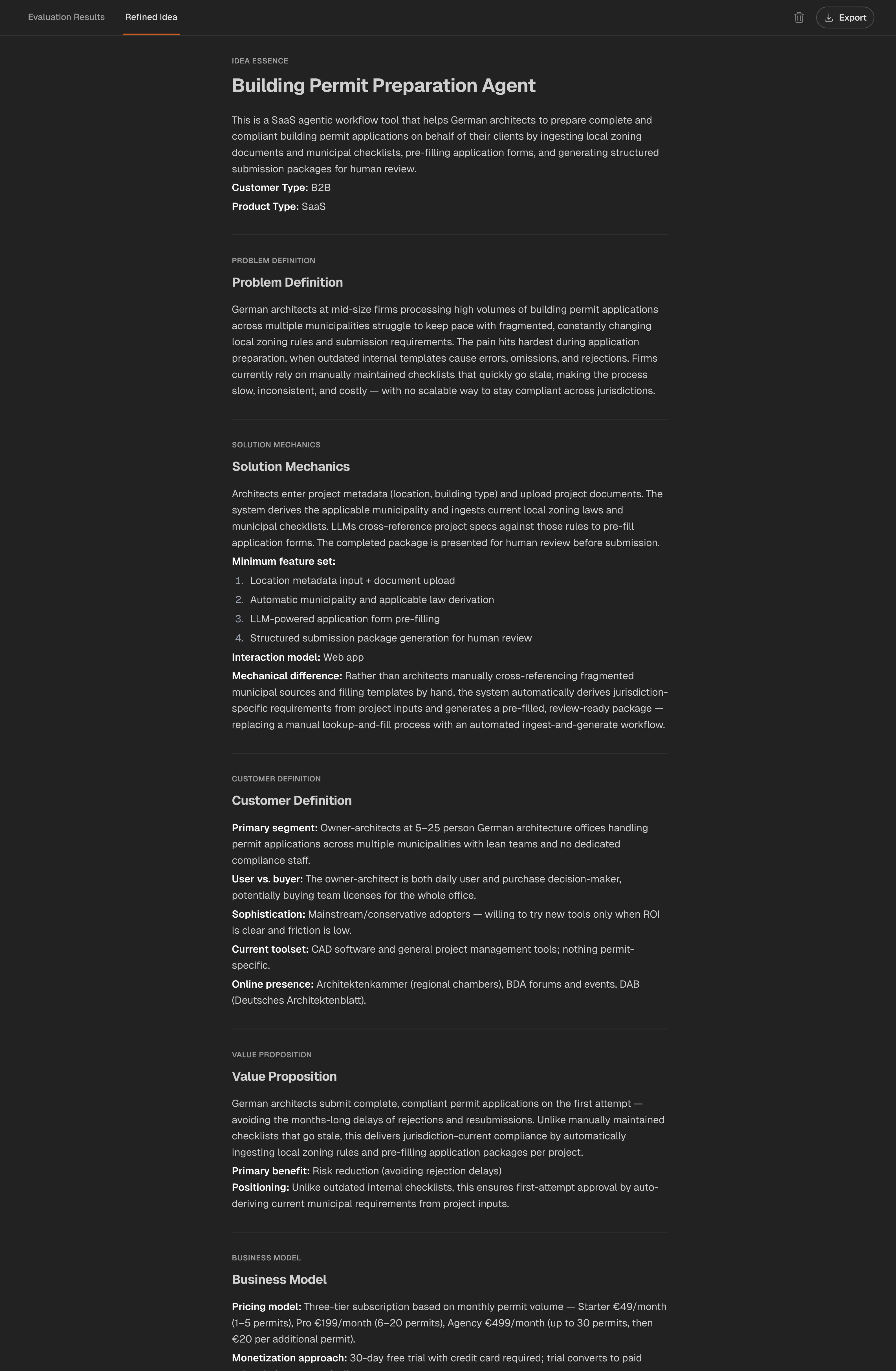
Genhone starts with 12-section guided refinement because an idea has to be specific before it can be scored fairly. The refinement step defines the idea. It does not prove viability by itself.
The 12 sections are:
- Idea Essence
- Problem Definition
- Solution Mechanics
- Customer Definition
- Value Proposition
- Business Model
- Technical Foundation
- Go-to-Market Approach
- Customer Onboarding & Activation
- Key Metrics Framework
- Scope & Boundaries
- Solo Founder Execution
These sections turn a rough idea into a consistent idea snapshot. They force the founder to state the customer, problem, workflow, business model, technical boundary, GTM path, activation logic, metrics, scope, and solo-founder constraints before the scoring system treats the idea as comparable.
That matters because most founders do not compare equally developed ideas. One idea has a clear buyer, pricing logic, and first channel. Another is still a broad category with all the future fixes imagined into it. If both receive a score, the vague idea can look better because it has not yet confronted its tradeoffs.
A SaaS idea validation checklist helps expose the assumptions. Structured refinement makes those assumptions inspectable. Then the validator can score the idea against the same criteria used for other ideas.
Genhone enforces the structure instead of relying on the founder to keep a perfect chat thread. That is the product-led difference: the validator does not start with "give me a score." It starts by making the idea specific enough to evaluate.
The 5 Dimensions an AI SaaS Idea Validator Should Score
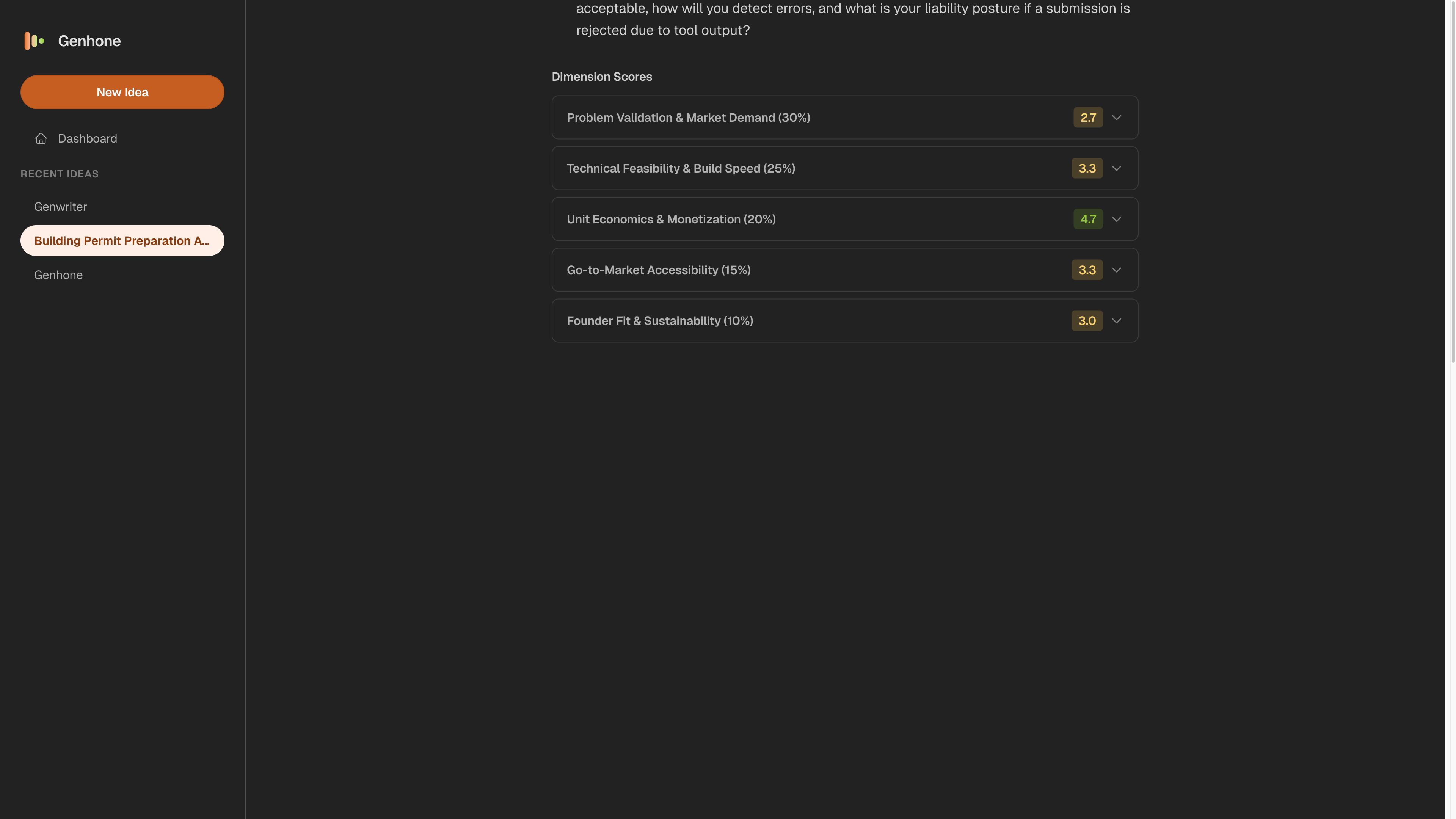
Genhone evaluates SaaS ideas across five weighted dimensions. The weights matter because a weak demand signal, unrealistic build scope, poor monetization path, unreachable buyer, or founder mismatch should not be hidden by a good-looking total score.
Problem Validation & Market Demand carries the most weight because a clean build cannot rescue weak demand. Technical Feasibility & Build Speed matters because solo founders have limited build capacity. Unit Economics & Monetization matters because SaaS needs recurring revenue, not just interest. Go-to-Market Accessibility asks whether early buyers are reachable without a large team. Founder Fit & Sustainability asks whether this specific founder can keep learning, building, selling, and supporting the idea.
| Dimension | Weight | What it tests | Why it matters before building |
|---|---|---|---|
| Problem Validation & Market Demand | 30% | Pain, market size, willingness to pay | A clean build cannot rescue weak demand. |
| Technical Feasibility & Build Speed | 25% | Time to MVP, complexity, skill match | Solo founders have limited build capacity. |
| Unit Economics & Monetization | 20% | CAC, churn, LTV | SaaS needs a path to durable recurring revenue. |
| Go-to-Market Accessibility | 15% | Channels, organic discovery, sales cycle | Early buyers need to be reachable without a large team. |
| Founder Fit & Sustainability | 10% | Competition, interest, resources, operations, validation speed, time to revenue | The same idea can be strong for one founder and weak for another. |
The weighted total is a decision aid, not a prediction. Genhone's current score labels are:
| Genhone label | Score range |
|---|---|
| Strong Opportunity | 4.0-5.0 |
| Promising | 3.0-3.99 |
| Needs Work | 2.0-2.99 |
| High Risk | Below 2.0 |
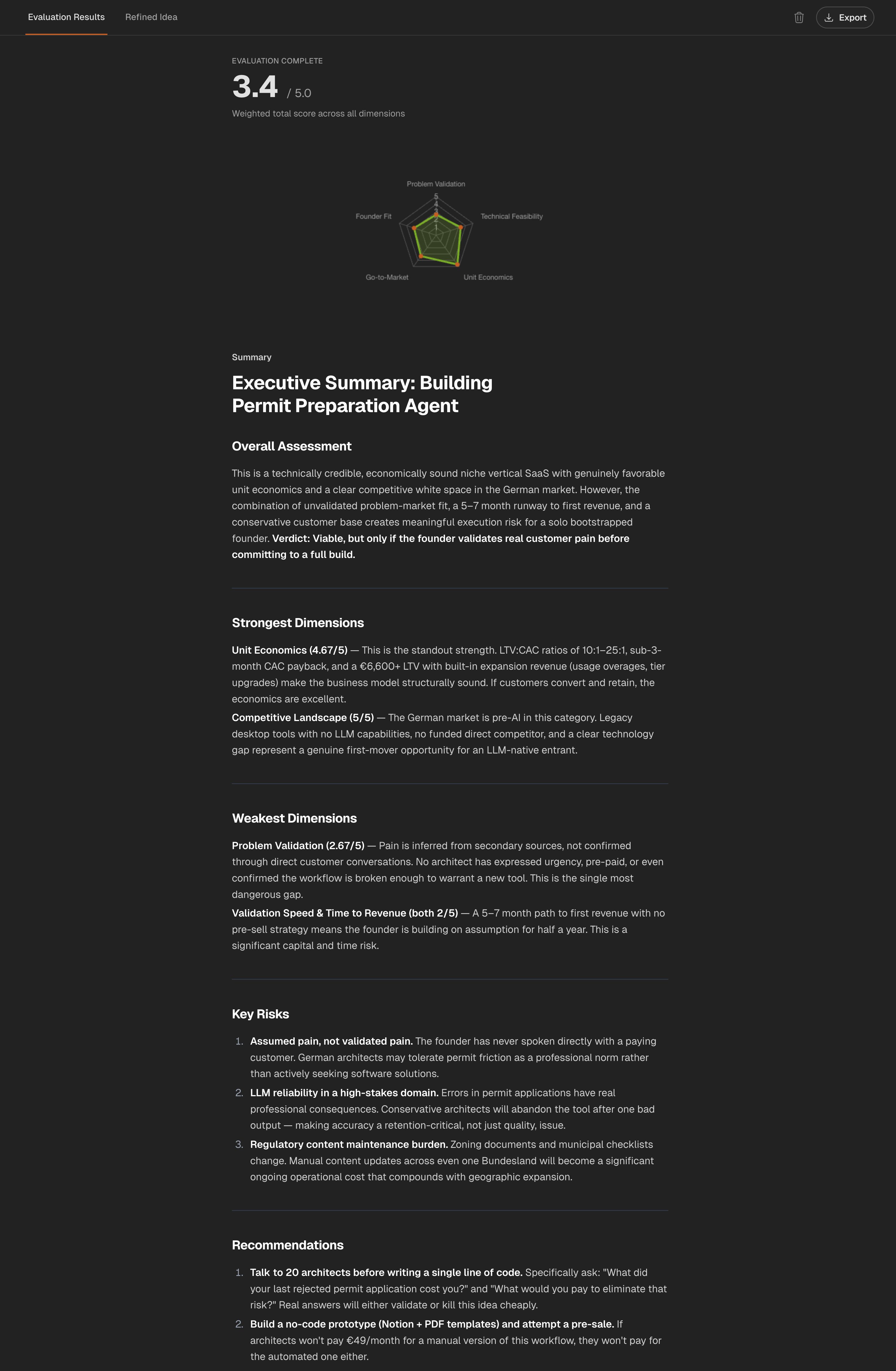
The dimension pattern is often more useful than the average. A high technical score does not fix weak willingness to pay. A strong market score does not make a six-month solo build safe. A promising total can still need narrowing before the founder writes code.
The 18 Criteria Behind Genhone's AI Idea Score
Genhone uses 18 criteria across the five dimensions. The source type matters because it tells the founder what kind of input shaped the score.
Direct automated criteria are scored from the refined idea content. Research-assisted criteria use external market context where that context is needed. Founder-conversation criteria come from founder-specific input that the idea text cannot reliably provide.
The 13 automated criteria consist of 8 direct automated criteria and 5 research-assisted criteria. The five founder-conversation criteria are Problem Criticality, Willingness to Pay, Technical Skill Match, Personal Interest, and Operational Complexity.
Research-assisted scoring should not be mistaken for proof of demand. It can add market context, competitor context, channel signals, or acquisition assumptions. It does not replace customer discovery, pricing conversations, or real buyer behavior.
Methodology note: Genhone starts with 12-section structured refinement. It scores 18 criteria across five weighted dimensions. It combines direct automated scoring, research-assisted scoring where external market context matters, and founder-conversation scoring. It synthesizes dimension scores, a weighted total, an interpretation label, and an evaluation summary. It saves the output as a comparable idea artifact. The score is not a prediction and cannot replace buyer evidence.
For deeper criteria-level context, see the SaaS idea evaluation criteria guide.
| Dimension | Criterion | Source type | What the validator should inspect |
|---|---|---|---|
| Problem Validation & Market Demand | Problem Criticality | Founder conversation | Whether the founder has evidence of urgent pain, not just a plausible problem. |
| Problem Validation & Market Demand | Market Size | Research-assisted | Whether the target market appears large enough and specific enough for the SaaS model. |
| Problem Validation & Market Demand | Willingness to Pay | Founder conversation | Whether buyers already spend money, time, or budget on the problem. |
| Technical Feasibility & Build Speed | Time to MVP | Direct automated | Whether one founder can ship a useful first version quickly. |
| Technical Feasibility & Build Speed | Technical Complexity | Direct automated | Whether scope, integrations, compliance, and infrastructure are manageable. |
| Technical Feasibility & Build Speed | Technical Skill Match | Founder conversation | Whether the founder can build the first version without a major learning detour. |
| Unit Economics & Monetization | CAC Expectations | Research-assisted | Whether the likely acquisition path can support the price point. |
| Unit Economics & Monetization | Expected Churn | Research-assisted | Whether the use case looks durable enough for recurring revenue. |
| Unit Economics & Monetization | LTV Potential | Direct automated | Whether pricing, retention, and expansion assumptions could support the business. |
| Go-to-Market Accessibility | Channel Accessibility | Direct automated | Whether the founder has believable first channels. |
| Go-to-Market Accessibility | Organic Discovery | Research-assisted | Whether search, communities, or category behavior suggest reachable demand. |
| Go-to-Market Accessibility | Sales Cycle Complexity | Direct automated | Whether the sales motion fits a solo founder and self-serve or low-touch model. |
| Founder Fit & Sustainability | Competitive Landscape | Research-assisted | Whether existing alternatives validate demand and leave a plausible wedge. |
| Founder Fit & Sustainability | Personal Interest | Founder conversation | Whether the founder can stay with the problem after the prototype phase. |
| Founder Fit & Sustainability | Resource Requirements | Direct automated | Whether capital, tools, and operational resources fit the founder's constraints. |
| Founder Fit & Sustainability | Operational Complexity | Founder conversation | Whether the founder can support and operate the product alone. |
| Founder Fit & Sustainability | Validation Speed | Direct automated | Whether the founder can test the riskiest assumptions quickly. |
| Founder Fit & Sustainability | Time to Revenue | Direct automated | Whether the path to first revenue is plausible without a long unfunded build. |
If Willingness to Pay or Unit Economics scores are weak, do not compensate by adding features. Step back and validate SaaS pricing before launch. If Competitive Landscape is unclear, run a SaaS competitor analysis before MVP so alternatives become evidence instead of anxiety.
How to Interpret the AI Validator Score
The total score should guide the next decision. It should not create a blind build/no-build answer.
A strong score means the idea is coherent enough to justify the next evidence step. It does not mean the founder should build a full product immediately. A moderate score can be useful when it exposes one fixable weakness. A weak score should point to narrowing, killing, archiving, or collecting better evidence.
Scores should also change. If customer conversations reveal a sharper pain, rescore. If pricing conversations show weaker willingness to pay, rescore. If competitor review mining exposes a better wedge, rescore. If a distribution experiment fails, rescore. A saved score is a decision artifact, not a permanent verdict.
| Genhone label | Score range | What it usually means | Better next action |
|---|---|---|---|
| Strong Opportunity | 4.0-5.0 | The idea is coherent and comparatively strong across the weighted rubric. | Run the highest-risk buyer or pricing test before building broadly. |
| Promising | 3.0-3.99 | The idea has a plausible path but one or more dimensions need work. | Narrow the weak dimension and rescore. |
| Needs Work | 2.0-2.99 | Important assumptions are weak, unclear, or unsupported. | Rework the customer, problem, pricing, scope, or channel before building. |
| High Risk | Below 2.0 | The current version is likely too weak for a build commitment. | Kill, archive, or restart from a sharper problem. |
If you are deciding what makes a SaaS idea worth building, inspect the weakest dimension before trusting the total. A strong build score with weak demand is not a strong idea. A promising score with one clear weakness may be better than a higher score with hidden uncertainty.
If the current version is low-scoring and hard to fix, use a deliberate process for when to kill a startup idea instead of spending another AI-assisted build cycle on it.
Turn a rough SaaS idea into a refined, scored, and comparable artifact with Genhone.
AI Validator, ChatGPT Prompt, Scorecard, or Idea Database?
Searchers for an AI startup idea validator are often comparing tools and approaches. The right choice depends on whether the founder needs a fast reaction, a brainstorming partner, a manual rubric, a database for many ideas, or a saved decision artifact.
The current AI-validator market is product-heavy: fast AI validators, browser scorecards, SaaS-specific scoring products, idea-management databases, and AI-generated validation reports. Genhone should not win by promising more outputs. It should win by being narrower: refine, score, compare, and decide before building.
| Option | Best for | Weakness | When to use it |
|---|---|---|---|
| One-shot AI validator | Fast first reaction | Can score vague inputs too confidently | Early sanity check only. |
| ChatGPT or Claude prompt | Brainstorming, objections, alternate questions | Not persistent or repeatable unless the founder maintains the process | Exploration before a structured score. |
| Browser scorecard | Lightweight self-assessment | Often no saved artifact or comparison workflow | Quick personal rubric. |
| Idea database/prioritization board | Managing many product ideas | Can become broad and less SaaS-specific | Teams or founders tracking many product bets. |
| Genhone | Solo SaaS founders deciding before building | Requires completing structured refinement | When the founder needs a scored, comparable decision artifact. |
Genhone's differentiator is not that AI magically knows the answer. It is that the workflow enforces structured refinement before scoring, applies SaaS-specific criteria, combines direct, research-assisted, and founder-conversation inputs, saves the artifact, and lets multiple ideas be compared side by side.
How Genhone Works as an AI Startup Idea Validator
Genhone is a SaaS web app that helps solo founders refine and evaluate SaaS ideas through guided AI conversations and automated idea scoring. It is built for founders who can build quickly but need a better pause point before committing to the next implementation cycle.
The workflow is intentionally narrow:
| Step | What happens | Output |
|---|---|---|
| 1. Rough idea | The founder enters a SaaS idea. | Starting thesis. |
| 2. 12-section refinement | Genhone guides the founder through structured refinement. | Specific idea snapshot. |
| 3. Automated evaluation | Direct and research-assisted criteria are scored. | Criteria-level scores and reasoning. |
| 4. Founder conversation | Founder-fit inputs are collected. | Founder-specific scoring context. |
| 5. Synthesis | Genhone computes dimension scores, weighted total, interpretation, and summary. | Evaluation artifact. |
| 6. Saved artifact | The result is stored with the idea. | Durable decision record. |
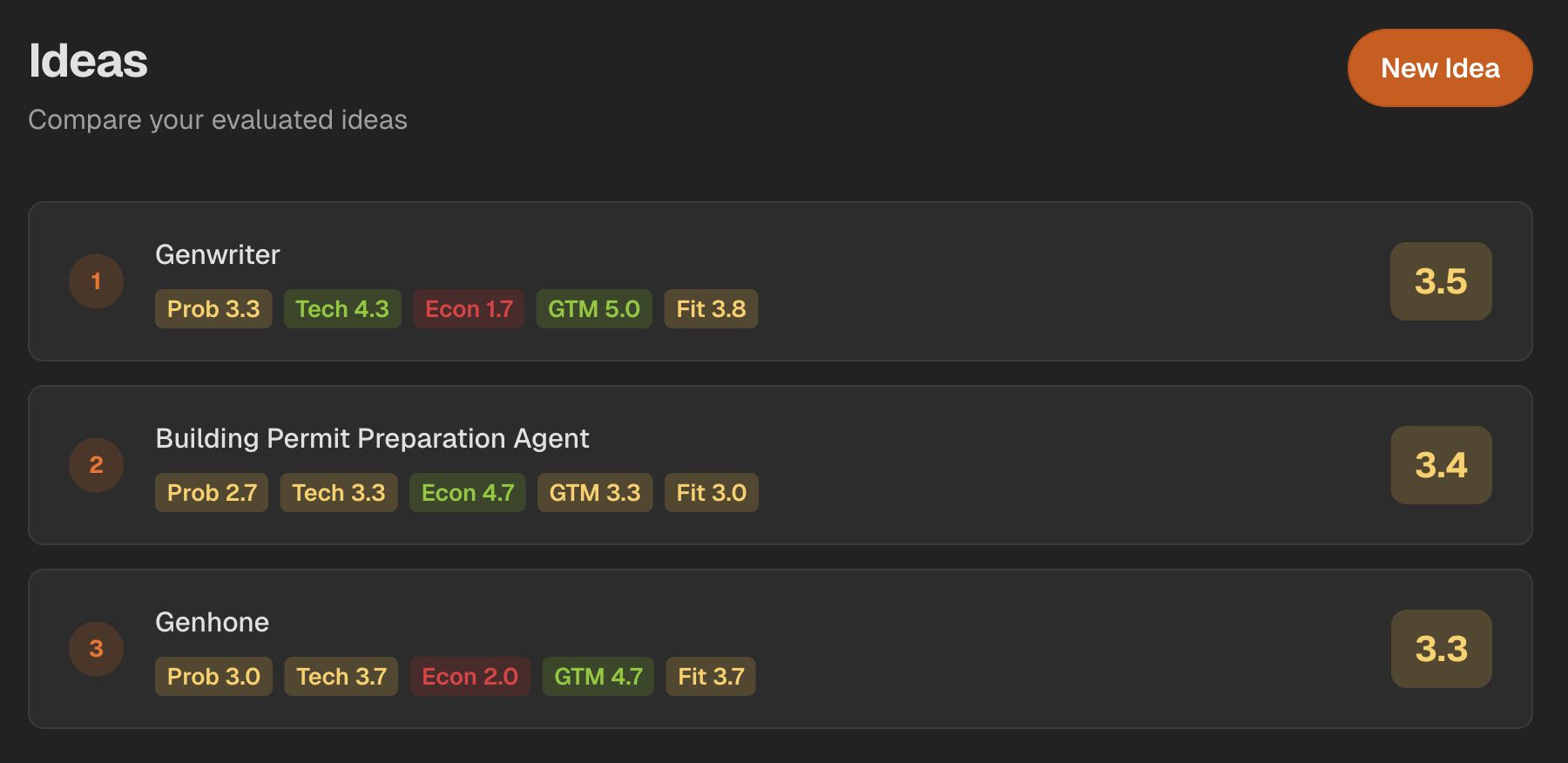
| 7. Comparison | The founder can compare saved ideas side by side. | Better idea selection over time. |
This is different from a generic AI validator because the process keeps the structure, not just the answer. The founder can inspect criteria-level reasoning, revisit the evaluation later, and compare ideas using the same rubric instead of starting from a new prompt every time.
Genhone is a SaaS idea validation tool for solo founders, but its current product boundary matters. It does not generate PRDs, roadmaps, landing pages, pitch decks, build prompts, code, team votes, investor scores, or growth strategies. It does not replace customer discovery or prove demand. It helps the founder decide what to validate, narrow, kill, or compare before building.
Compare Multiple Startup Ideas Before Choosing What to Build
Many solo founders do not have one idea. They have too many plausible ideas.
AI coding tools increase that overload because more options feel buildable. A founder can prototype a scheduling tool, AI note product, compliance dashboard, and internal workflow assistant quickly enough that the real bottleneck becomes judgment. Which idea deserves attention, customer discovery, and a build cycle?
A validator should help compare ideas against the same rubric, not only score one idea in isolation. The comparison should inspect dimension patterns, evidence gaps, and next tests. Sorting only by total score can hide the reason an idea is risky.
The example below is fictional. It is not a customer story, testimonial, anonymized Genhone artifact, or proprietary dataset.
| Fictional idea | Weighted score | Strongest dimension | Weakest dimension | Better next step |
|---|---|---|---|---|
| Scheduling tool for small law firms | 3.8 | Willingness to pay | Sales cycle complexity | Interview buyers about purchasing process. |
| AI note summarizer for indie consultants | 3.1 | Build speed | Differentiation and churn risk | Narrow the workflow and test retention. |
| Compliance dashboard for healthcare vendors | 2.4 | Problem criticality | Technical complexity and sales cycle | Kill or narrow to a lower-compliance wedge. |
The first idea has a stronger payment signal but may require a sales motion the founder cannot handle alone. The second idea looks buildable but may be too easy to copy or too episodic to retain. The third has serious pain but may be too complex for the founder's current constraints.
That is why how to compare startup ideas is not only a ranking exercise. It is a way to choose the next evidence-gathering step. The better idea is not always the highest total. It is often the one with strong pain, reachable buyers, and a weakness the founder can test quickly.
Turn a rough SaaS idea into a refined, scored, and comparable artifact with Genhone.
What an AI Validator Can and Cannot Prove
AI validation can help a founder think more clearly. It can force a rough idea into a structured shape, expose weak assumptions, compare ideas consistently, suggest what evidence to collect next, and reduce build-before-validation risk.
It cannot prove that customers will pay. It cannot prove the market is large enough. It cannot prove that the founder will execute well. It cannot prove product-market fit, future revenue, retention, or startup success.
That means every score should point back to real-world validation. Useful next evidence can include buyer conversations, current spend, pricing tests, manual concierge tests, competitor review mining, and landing page or waitlist tests when the offer is specific enough. If buyer clarity is weak, first define the ICP for a SaaS idea. If the AI score exposes multiple assumptions, use an AI SaaS idea validation checklist to decide which one needs evidence next.
The validator's job is not to replace the test. It is to make the next test more precise.
For AI-assisted builders, this is the main discipline: do not confuse "I can build it now" with "this is the right thing to build next." The score should create a pause point before code, not a permission slip to skip customers.
FAQ
What is an AI startup idea validator?
An AI startup idea validator is an AI-assisted workflow or tool that structures a startup idea, scores its assumptions, and helps the founder decide whether to build, narrow, kill, or validate further.
A useful validator gives reasoning, not just a score. It should show the criteria, evidence gaps, and next decision so the founder can audit the recommendation later.
Can an AI startup idea validator tell me if my idea will succeed?
No. An AI startup idea validator can structure judgment and point to evidence gaps, but startup success depends on real buyer behavior, execution, timing, distribution, retention, willingness to pay, and many other factors.
Use the score to decide what to test next. Do not treat it as proof of demand, product-market fit, future revenue, or startup success.
What should an AI startup idea validator score?
For SaaS founders, it should score painful demand, market context, willingness to pay, build feasibility, technical complexity, unit economics, distribution, sales cycle, founder fit, validation speed, and time to revenue.
The useful output should include both the score and the reasoning behind the score. Otherwise the founder cannot tell whether the idea is strong or merely described well.
Why should the idea be structured before AI scores it?
Vague ideas produce vague or falsely confident scores. A one-line idea often omits the customer, problem, current alternatives, pricing logic, build scope, distribution path, and founder constraints.
Structured refinement gives the AI enough context to evaluate the same dimensions consistently. It also makes multiple ideas comparable because every idea is scored from the same kind of input.
How is Genhone different from ChatGPT prompts or one-shot AI validators?
Genhone enforces 12-section refinement, applies an 18-criterion SaaS-specific rubric, combines automated, research-assisted, and founder-conversation inputs, saves the artifact, and lets ideas be compared.
That does not mean Genhone can prove the idea will work or that every other approach is wrong. It means Genhone is designed for a repeatable pre-build decision workflow instead of a one-off prompt or quick opinion.
Should founder fit affect the score?
Yes. A SaaS idea can be attractive in theory but poor for a founder who cannot reach the buyer, build the first version, support the workflow, or stay with the problem.
Founder fit matters more for solo founders because the founder is also the researcher, builder, seller, support function, and operator. The same idea can be strong for one founder and weak for another.
How do I compare multiple startup ideas with AI?
Refine each idea to the same level of detail, score each against the same criteria and weights, then compare weak dimensions, evidence gaps, and next tests rather than only total score.
The goal is not to pick the idea with the nicest number. The goal is to choose the idea with the best next evidence step and the clearest path to a better decision.