How to Choose Between Startup Ideas
Technically capable solo founders and AI-assisted builders now face a strange problem: too many startup ideas feel buildable. Cursor, Claude Code, Lovable, Bolt, v0, ChatGPT, and Claude can make a prototype appear quickly, but they do not decide which idea deserves the next build cycle.
This article is for founders comparing several plausible ideas before building, especially SaaS ideas. It sits in Genhone's scoring and comparison cluster: the SaaS idea scoring framework explains the full rubric, while this guide focuses on choosing between multiple ideas with the same decision method.
To compare startup ideas, refine each idea to the same level of detail, score every idea with the same criteria, compare the weakest dimensions instead of only the total score, factor in founder fit, and choose the next evidence-gathering step before building. The best idea is usually the one with strong buyer pain, a reachable first market, a realistic build path, and a testable next assumption.
Comparison is decision support. It does not prove demand, product-market fit, revenue, willingness to pay, or future success. Its job is narrower: help you choose the next evidence cycle before a shiny prototype creates sunk cost.
What It Means to Compare Startup Ideas
Comparing startup ideas means judging several ideas against the same decision standard. It is not brainstorming more ideas, validating one idea in isolation, choosing whatever feels most exciting, or building several prototypes and waiting to see what happens.
The useful question is not "Which idea is universally best?" It is "Which idea deserves the next evidence-gathering cycle for this founder?"
A fair comparison needs five things:
| Requirement | Why it matters | Output |
|---|---|---|
| Similar input quality | A vague idea benefits from imagination, while a detailed idea exposes trade-offs. | Every idea starts from a comparable snapshot. |
| Same scoring criteria | Different criteria make the result depend on the method, not the idea. | Every idea is judged by the same rubric. |
| Same evidence standards | One idea should not win because it received more generous assumptions. | Scores are easier to trust and revisit. |
| Same interpretation rules | The highest total score should not automatically override weak dimensions. | The decision reflects risk pattern, not only average score. |
| Founder-fit constraints | A good idea for one founder can be a poor idea for another. | The winner fits access, skills, stamina, and validation speed. |
The most useful output is a saved decision artifact: scores, reasoning, weakest assumptions, and the next action. That is the difference between a real comparison and a chat response you forget next week. A startup idea scorecard should make the reasoning inspectable, not just produce a number.
This narrow focus is deliberate. As of a June 15, 2026 source review, exact-match results for "how to compare startup ideas" and related queries were sparse and unstable. Adjacent results cluster around validation, founder fit, lean startup, customer discovery, and scorecards. The long-tail job is still clear: help founders choose which idea deserves the next evidence cycle before building.
Start by Making Every Idea Comparable
Do not compare a one-sentence idea against a fully refined one. The rough idea will usually look better because it still contains every imagined fix.
"AI assistant for restaurants" might sound promising. But which restaurants? What workflow? Who pays? What do they use today? What is the first version? How does the founder reach buyers? What makes this realistic for one person to build and support?
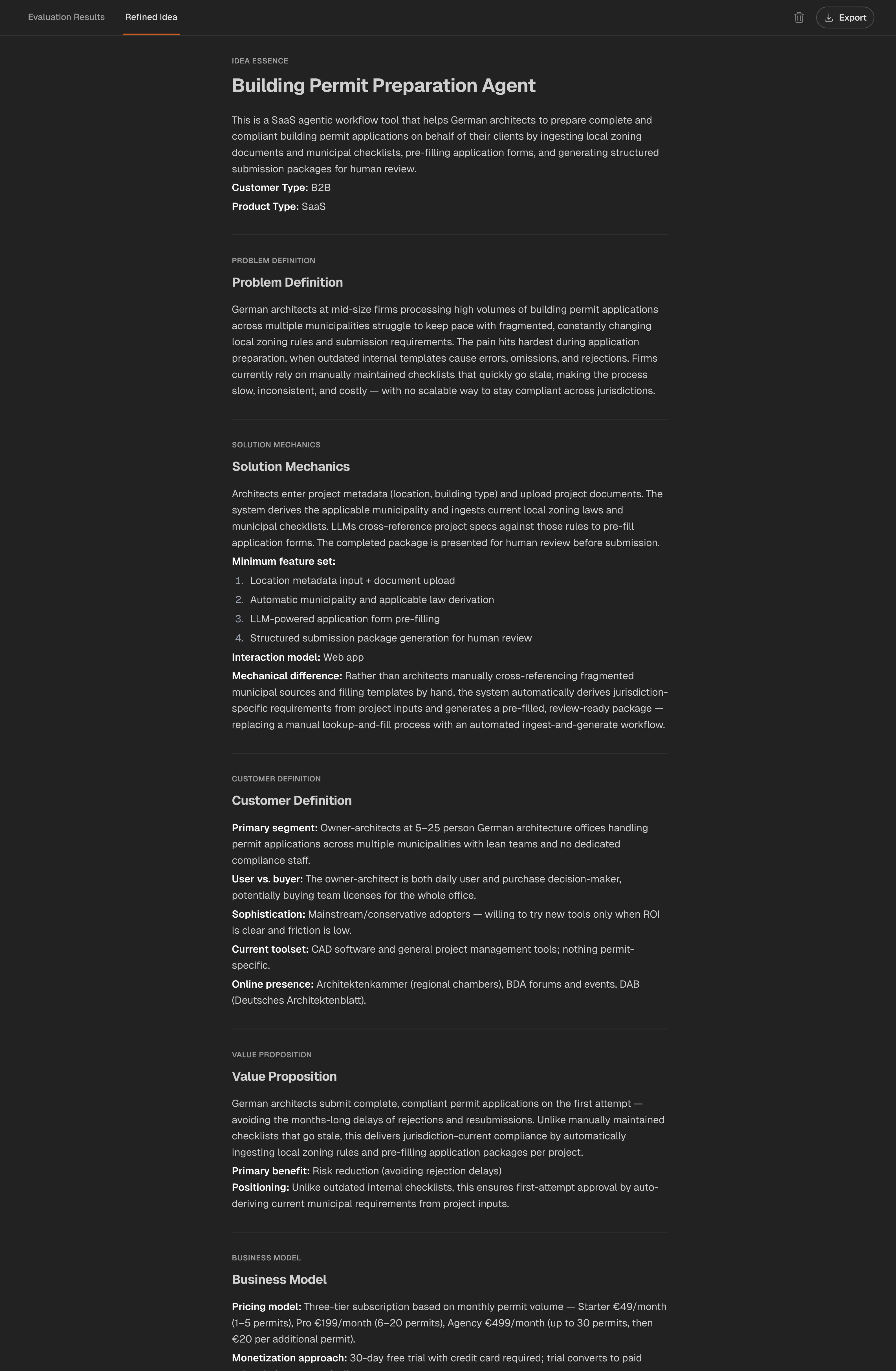
Before comparison, every idea needs the same structured snapshot. Genhone's refinement model structures SaaS ideas across 12 sections:
- Idea Essence
- Problem Definition
- Solution Mechanics
- Customer Definition
- Value Proposition
- Business Model
- Technical Foundation
- Go-to-Market Approach
- Customer Onboarding & Activation
- Key Metrics Framework
- Scope & Boundaries
- Solo Founder Execution
These sections make ideas comparable because each idea has the same shape before scoring. This is where comparison differs from a generic checklist. A checklist can expose assumptions, but comparison requires consistent input across multiple ideas.
Structured business-model tools have the same underlying purpose. Strategyzer describes the Business Model Canvas as a way to describe, design, challenge, and pivot business models. For solo SaaS idea comparison, the same principle applies at a smaller pre-build level: describe each idea clearly enough that the trade-offs become visible.
If an idea is still fuzzy, first validate a SaaS idea before building or use a SaaS idea validation checklist to expose missing assumptions. Then compare.
Use One Weighted Rubric for Every Idea
A comparison is only useful if every idea is scored with the same rubric. Otherwise, the founder can accidentally reward the idea they explained better, researched more, or wanted to win.
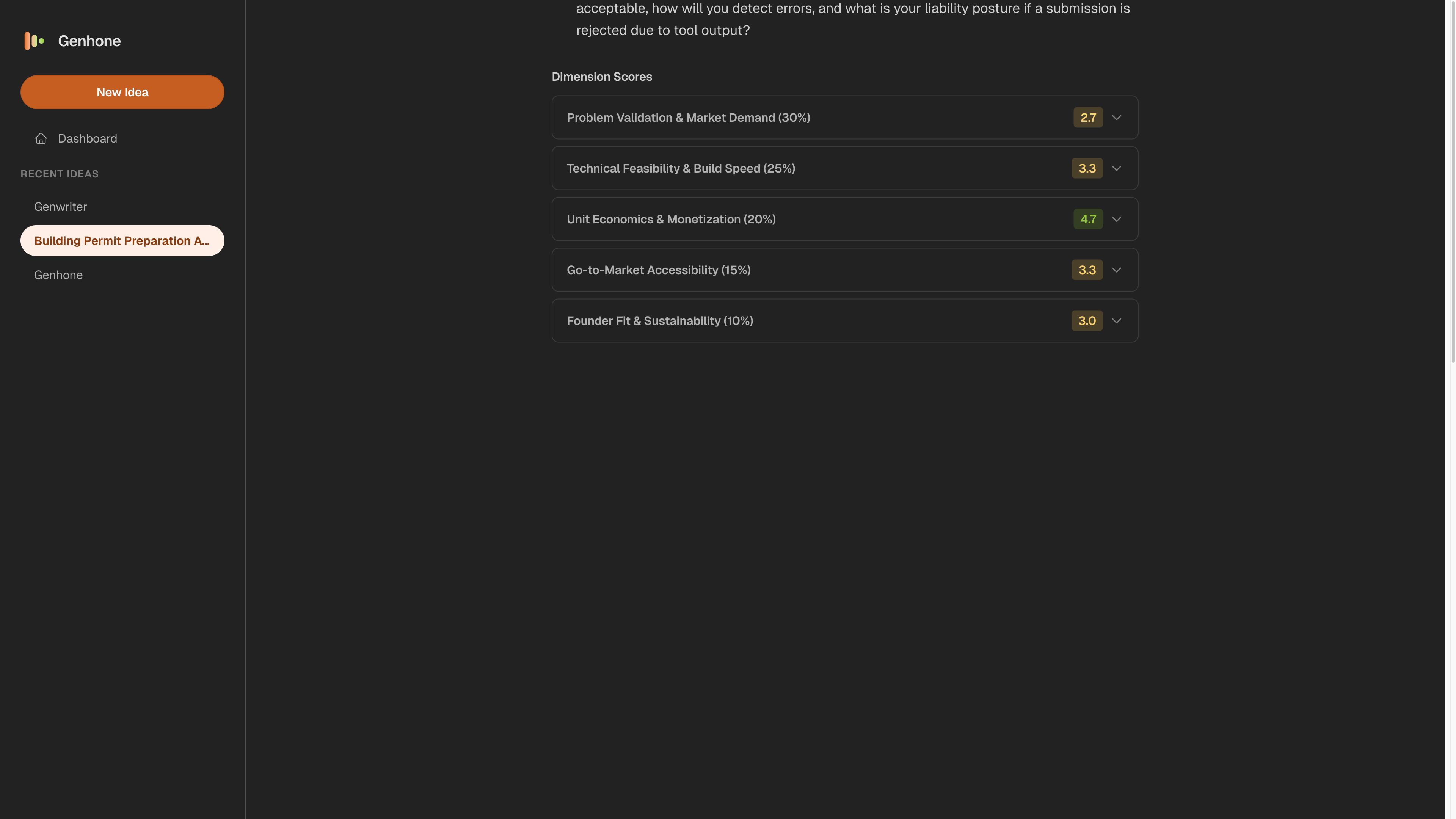
Genhone scores ideas across 18 criteria in 5 weighted dimensions. The weights matter because solo founders should not let an easy build hide weak buyer pain, or let an exciting market hide an unreachable buyer.
| Dimension | Weight | Criteria | Comparison question |
|---|---|---|---|
| Problem Validation & Market Demand | 30% | Problem Criticality, Market Size, Willingness to Pay | Which idea has the strongest painful buyer problem and payment logic worth testing? |
| Technical Feasibility & Build Speed | 25% | Time to MVP, Technical Complexity, Technical Skill Match | Which idea can one founder build and operate fastest without fragile complexity? |
| Unit Economics & Monetization | 20% | CAC Expectations, Expected Churn, LTV Potential | Which idea has the most plausible path to recurring revenue and retention? |
| Go-to-Market Accessibility | 15% | Channel Accessibility, Organic Discovery, Sales Cycle Complexity | Which idea has reachable first users without a large team, ad budget, or long sales motion? |
| Founder Fit & Sustainability | 10% | Competitive Landscape, Personal Interest, Resource Requirements, Operational Complexity, Validation Speed, Time to Revenue | Which idea best fits this founder's constraints, stamina, resources, and learning speed? |
Genhone's current source split is:
- 8 direct automated criteria scored from the refined idea.
- 5 research-assisted automated criteria where external market context matters.
- 5 founder-conversation criteria that require firsthand founder input.
That makes 13 automated criteria and 5 founder-conversation criteria total.
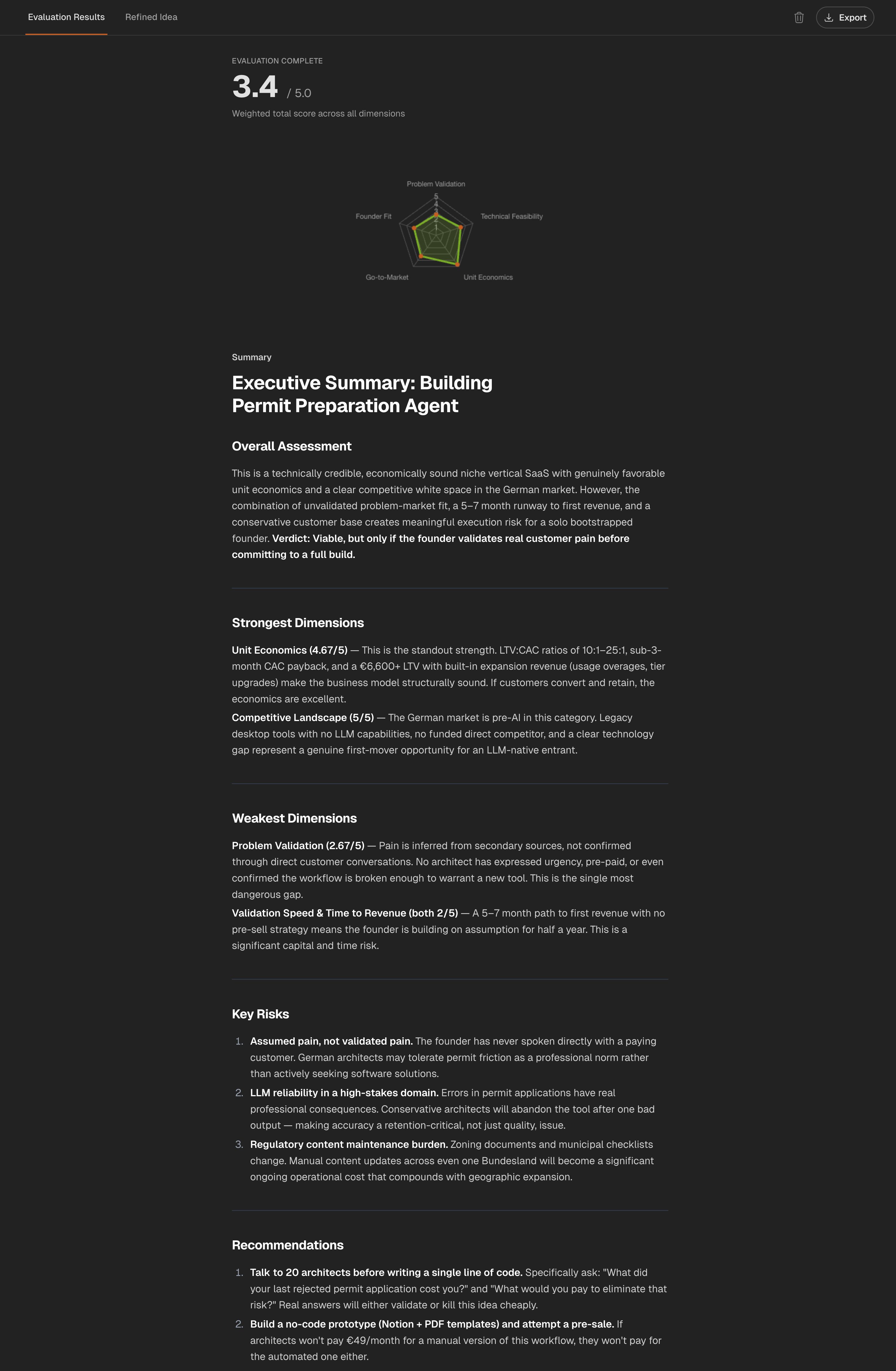
Methodology note: Genhone starts with 12-section structured refinement, evaluates each SaaS idea across 18 criteria in 5 weighted dimensions, combines direct automated scoring with research-assisted automated scoring where market context matters, uses founder conversation for criteria that require firsthand founder context, and saves the result as a comparable idea artifact. The score is not a prediction and cannot replace buyer evidence.
For the deeper model, read the SaaS idea scoring framework. For how the output should be inspected later, read the startup idea scorecard.
Compare Weakest Dimensions, Not Just Total Scores
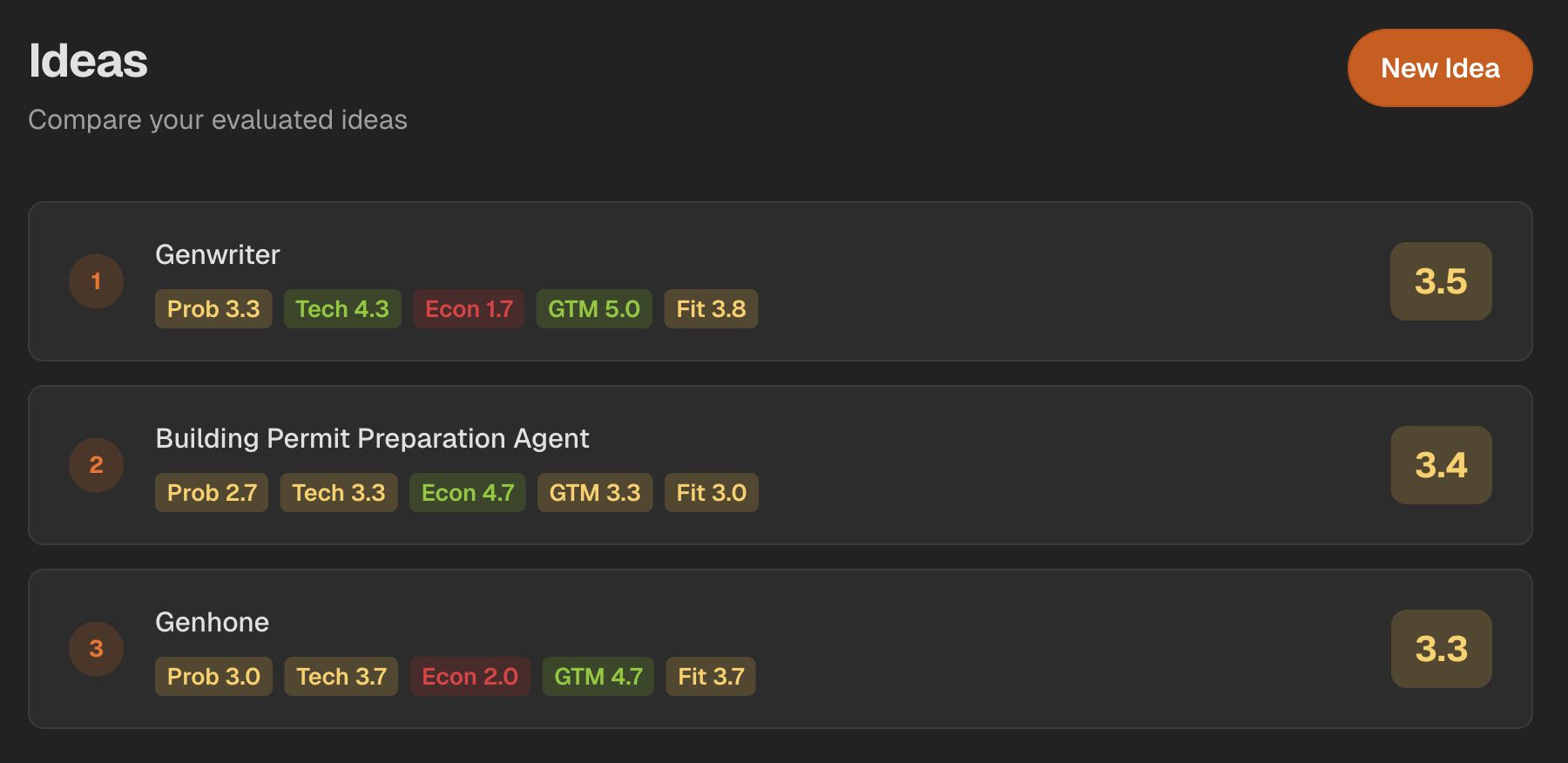
The highest total score should not automatically win. A total score is a compression of the decision, not the decision itself.
Dimension pattern often matters more than the average. A high score can hide a weak buyer, weak channel, weak payment logic, or weak founder fit. A lower-scoring idea can be the better next choice if its weakness is narrow, fixable, and testable quickly.
Use the total label as a first read:
| Weighted score | Label |
|---|---|
| 4.0-5.0 | Strong Opportunity |
| 3.0-3.99 | Promising |
| 2.0-2.99 | Needs Work |
| Below 2.0 | High Risk |
Then ask a better question: what would change your mind next?
| Comparison pattern | What it usually means | Better next action |
|---|---|---|
| High total, weak Problem Validation | The idea may be easy to build but buyer pain or willingness to pay is soft. | Do customer interviews, current-spend checks, or pricing conversations before building. |
| High total, weak Go-to-Market | The problem may be real but the founder cannot yet reach early buyers. | Narrow the ICP, pick one reachable channel, or compare another idea with better access. |
| High feasibility, weak unit economics | The founder can build it, but retention, price, CAC, or LTV may not support SaaS. | Test pricing and recurring value before adding features. |
| Strong demand, weak technical feasibility | The problem may be worth solving, but the current scope is too complex. | Narrow the first workflow or reduce scope before scoring again. |
| Strong market evidence, weak founder fit | The idea may be good in theory but mismatched to this founder's skills, access, or support capacity. | Choose a smaller wedge, change the operating model, or compare a better-fit idea. |
| Lower total, one fixable weakness | The idea may be a better next evidence cycle than a higher-scoring but fragile idea. | Run the smallest test against the fixable weakness and rescore. |
If weak unit economics are the issue, validate SaaS pricing before adding features. If buyer or channel clarity is weak, define the ICP for a SaaS idea before scoring again. If the weakest dimension points to a fatal assumption with no realistic evidence path, use a clear process for when to kill a startup idea.
Add Founder-Fit Constraints Before You Decide
The right idea is not only a market question. It is a founder-to-idea question.
Two founders can compare the same three ideas and correctly choose different winners. One founder may have buyer access, domain understanding, and the right technical background. Another may like the same market but lack the network, patience, support capacity, or build path.
Founder-fit constraints include:
- Can the founder reach buyers?
- Can the founder understand the workflow?
- Can the founder build the first version with current skills?
- Can the founder support and operate the product if it works?
- Does the founder have enough sustained interest to keep learning?
- Can the founder validate quickly enough before motivation and runway fade?
Genhone's five founder-conversation criteria are exactly: Problem Criticality, Willingness to Pay, Technical Skill Match, Personal Interest, and Operational Complexity.
These five criteria do not all belong only to Founder Fit & Sustainability. Founder input affects demand, feasibility, and sustainability. Problem Criticality and Willingness to Pay shape the market side. Technical Skill Match shapes feasibility. Personal Interest and Operational Complexity shape sustainability.
| Founder-fit constraint | Strong comparison signal | Weak comparison signal | What to do |
|---|---|---|---|
| Buyer access | The founder can name and reach real prospects this week. | Buyer is abstract or only described as a broad market. | Prioritize the idea with reachable buyers or narrow the segment. |
| Technical skill match | The founder can build a narrow first version with known tools. | The idea requires a stack, compliance burden, or infrastructure the founder does not know. | Reduce scope or choose the idea with faster learning. |
| Support and operational fit | The founder can handle early onboarding, support, and edge cases alone. | The product needs high-touch implementation, fragile integrations, or constant manual support. | Narrow the workflow or avoid the idea for now. |
| Personal interest | The founder can see themselves learning from this market for years. | Interest is mostly trend-driven or tied to the excitement of a prototype. | Treat interest as a constraint, not validation. |
| Validation speed | The next evidence step can happen quickly. | The idea requires a full product before any real signal appears. | Choose a smaller test or compare another idea. |
The term founder-idea fit has also started to appear in startup-evaluation research. The arXiv paper Founder-GPT: Self-play to evaluate the Founder-Idea fit treats founder-profile-to-idea fit as a decision concept. That is useful concept validation, not proof that AI can predict startup success.
For a deeper version of this lens, read the guide to founder-idea fit.
Choose the Next Evidence-Gathering Cycle
The output of comparison is not a full product build, PRD, roadmap, growth strategy, investor pitch score, or coding-agent handoff. The output is the next evidence cycle for the most promising idea or the most fixable assumption.
This matches durable startup advice. YC's Essential Startup Advice emphasizes launching, talking to users, iterating, focusing on narrow painful problems, and avoiding premature scaling. Paul Graham's Do Things That Don't Scale supports the same early behavior from another angle: founders often need to recruit and learn from users manually before scalable systems exist. Steve Blank's HBR article, Why the Lean Start-Up Changes Everything, is another useful reference for treating early startups as learning under uncertainty rather than execution of a fixed plan.
Real evidence includes buyer interviews, current spend, competitor reviews, search behavior, community complaints, paid pilots, and actual usage. Scores should change after better evidence arrives.
| Weakest comparison area | Next evidence cycle | Suggested internal support |
|---|---|---|
| Buyer or ICP clarity | Define the first buyer, build an interview list, and test whether the problem is repeated. | Define the ICP for a SaaS idea |
| Problem urgency | Run buyer interviews, review mining, or manual workflow observation. | Validate a SaaS idea before building |
| Alternatives or competitive wedge | Study current tools, reviews, workarounds, switching friction, and unserved segments. | SaaS competitor analysis before MVP |
| Willingness to pay | Test current spend, budget ownership, paid pilots, or pricing language. | Validate SaaS pricing before launch |
| Broad checklist gaps | Use the validation checklist to expose missing assumptions. | SaaS idea validation checklist |
| Fundamental risk remains after narrowing | Kill, park, or restart from a stronger problem. | When to kill a startup idea |
A comparison should make the next move smaller. If alternatives are unclear, run a SaaS competitor analysis before MVP. If the broad checklist has gaps, use the SaaS idea validation checklist. If one finalist needs deeper evaluation, use a separate process to evaluate a SaaS idea before building.
Example: Compare Three Startup Ideas Before Building
The example below is fictional. It is not a customer story, testimonial, anonymized Genhone user artifact, or claim about real market demand.
Imagine a technically capable solo founder comparing three SaaS ideas. All three have been refined to the same level before scoring. The goal is not to pick the most exciting idea. The goal is to choose the next evidence cycle.
| Fictional idea | Problem Validation | Technical Feasibility | Unit Economics | Go-to-Market | Founder Fit | Total label | Weakest dimension | Next evidence cycle |
|---|---|---|---|---|---|---|---|---|
| Building permit follow-up assistant | 4.2 / 5 | 3.2 / 5 | 3.5 / 5 | 2.3 / 5 | 3.7 / 5 | Promising | Go-to-Market | Identify one reachable buyer segment, build an outreach list, and test whether permit delays are urgent enough to discuss. |
| Shopify retention audit tool | 3.8 / 5 | 4.1 / 5 | 3.6 / 5 | 3.5 / 5 | 4.2 / 5 | Promising | Unit Economics | Interview one store segment, test pricing language, and check whether the audit creates recurring value. |
| AI meeting notes for all teams | 2.4 / 5 | 4.2 / 5 | 2.3 / 5 | 1.9 / 5 | 3.0 / 5 | Needs Work | Go-to-Market | Kill or restart with a narrower buyer, sharper workflow, and clearer competitive wedge. |
The building permit assistant has strong pain in this fictional comparison, but the founder does not yet know how to reach the first buyers. The idea should not move straight into a build. It needs buyer-access evidence.
The Shopify retention audit tool is less flashy, but it has a more balanced pattern. The founder can build it, reach a more defined buyer, and test pricing quickly. It may be the best next evidence cycle even if it is not the idea with the loudest novelty.
The AI meeting notes idea is technically feasible, which makes it tempting. But feasibility is not enough. Broad buyer definition, crowded alternatives, weak differentiation, and weak go-to-market make it a poor next choice until it is narrowed.
Turn rough startup ideas into scored, comparable artifacts with Genhone.
Spreadsheet, ChatGPT, One-Shot Validator, or Genhone?
You can compare ideas with several tools. The right choice depends on whether you need manual flexibility, brainstorming, fast feedback, or a repeatable pre-build workflow.
| Option | Best for | Comparison risk | Where Genhone differs |
|---|---|---|---|
| Spreadsheet | Manual scoring and custom weights. | Easy to compare ideas inconsistently or change criteria midstream. | Genhone applies the same refinement and scoring structure to every idea. |
| ChatGPT or Claude | Brainstorming assumptions, objections, and customer-discovery questions. | Prompt drift can make one idea look stronger than another without a stable rubric. | Genhone preserves the structured artifact, scores, and reasoning. |
| One-shot validator | Fast first-pass feedback. | A rough input can receive a confident-looking verdict. | Genhone requires structured refinement before scoring and comparison. |
| Genhone | Refining, scoring, and comparing solo-founder SaaS ideas. | It still does not prove demand or build the product. | The output is a saved, comparable decision artifact. |
A spreadsheet can work if you already have a stable rubric and maintain evidence discipline. ChatGPT and Claude can help you think, but ChatGPT startup idea validation becomes unreliable when each idea gets a different prompt, memory, scoring scale, or evidence standard.
One-shot validators can be useful for quick feedback. The risk is that a vague input can produce a confident-looking report. Genhone is more useful when the founder wants guided refinement, consistent criteria, founder-fit conversation, saved artifacts, and side-by-side comparison. For product context, see the SaaS idea validation tool page.
How Genhone Supports Side-by-Side Idea Comparison
Genhone is a SaaS web app for solo founders to refine and evaluate SaaS ideas before building.
The workflow is intentionally narrow. Genhone guides solo founders through 12 structured refinement sections, then evaluates each idea across 18 criteria in 5 weighted dimensions. It uses 13 automated criteria and 5 founder-conversation criteria. Some automated criteria are research-assisted where market context matters. The founder-fit conversation captures firsthand information that cannot be inferred reliably from written idea text alone.
The result is saved as an artifact with scores, criteria-level reasoning, weighted dimensions, final interpretation, and a summary. Founders can compare saved ideas side by side in the dashboard.
That is different from a generic chat. The process enforces structure, creates persistent artifacts, and keeps comparison criteria consistent across ideas.
Genhone does not generate PRDs, create roadmaps, build the product, write code, produce growth strategies, score investor pitches, or guarantee product-market fit. It helps a founder decide which idea deserves the next evidence-gathering step.
Turn rough startup ideas into scored, comparable artifacts with Genhone.
FAQ
What is the best way to compare startup ideas?
Refine each idea to the same level of detail, score every idea with the same rubric, compare weak dimensions and founder fit, then choose the next evidence step before building.
The goal is not to find the universally best idea. The goal is to choose the idea with the strongest evidence path for this founder right now.
Should I choose the startup idea with the highest score?
Not automatically. A high score with a fatal weak dimension may be worse than a slightly lower score with one fixable assumption.
Read the dimension pattern, criteria-level reasoning, and weakest assumptions. The best next idea is usually the one with strong buyer pain, reachable first users, realistic feasibility, and a fast evidence cycle.
How many startup ideas should I compare at once?
Three to five is usually enough for a useful decision. More than that can create analysis paralysis and make the comparison harder to maintain.
If you have more ideas, first screen for obvious no-build gates: vague buyer, no payment logic, unrealistic build scope, unreachable users, or weak founder fit. Then score the shortlist.
What if one idea is exciting but has weak founder fit?
Treat excitement as useful energy, not validation. A founder can be excited about a prototype and still lack buyer access, domain understanding, support capacity, or willingness to stay with the market.
If founder fit is weak, narrow the buyer, reduce scope, change the wedge, or compare another idea. The founder-idea fit question should change what you do next.
Can AI choose the best startup idea for me?
AI can structure the comparison, apply a rubric, surface weak assumptions, and suggest next evidence steps. It cannot prove buyer pain, budget, switching behavior, product-market fit, retention, or founder stamina without real-world evidence.
Use AI to make the decision process more consistent. Do not treat AI output as customer evidence.
Should I build multiple startup ideas at the same time?
Usually no, especially as a solo founder. It is better to compare ideas first, choose one evidence cycle, and keep the others as saved artifacts to revisit.
Parallel unvalidated builds create more sunk cost and less learning. Comparison should reduce build commitments, not multiply them.