Startup Idea Scorecard for Solo Founders
A startup idea scorecard helps technically capable solo founders and AI-assisted builders decide which SaaS idea deserves the next build cycle. That matters more now because Cursor, Claude Code, Lovable, Bolt, v0, ChatGPT, and Claude make weak ideas easier to start and easier to rationalize.
This page is about using, reading, and comparing a scorecard. If you want the deeper scoring methodology behind the rubric, read the SaaS idea scoring framework.
A startup idea scorecard is a structured rubric for judging whether an idea is worth building, narrowing, killing, or testing further. A useful scorecard scores buyer pain, market demand, build feasibility, monetization, distribution, founder fit, and validation speed, then explains the reasoning behind each score.
The boundary matters: a scorecard does not prove demand, product-market fit, or future revenue. It gives you a consistent way to inspect assumptions before a build sprint creates sunk cost.
What a Startup Idea Scorecard Should Show
A useful startup idea scorecard is not just a total score. It should show the criteria being scored, the score for each area, the reasoning behind the score, the quality of the evidence, and the next decision.
For solo SaaS founders, the scorecard should be weighted toward risks that most often break pre-build ideas: painful demand, build feasibility, unit economics, reachable distribution, and founder fit. Novelty can be useful, but novelty rarely saves an idea with weak pain, no reachable buyer, or a build scope that one founder cannot maintain.
The practical test is simple: after reading the scorecard, you should know what to do next. Build a narrow test. Narrow the buyer. Rework the pricing assumption. Kill the idea. Or gather better evidence before deciding.
A lightweight checklist can help you think. A spreadsheet can help you compare manually. A one-shot AI score can give fast feedback. A saved Genhone artifact is different because it starts from structured idea input, applies a consistent rubric, preserves criteria-level reasoning, and lets you compare ideas later instead of losing the decision in a chat thread.
| Scorecard element | Why it matters | What the scorecard should say |
|---|---|---|
| Structured idea input | Prevents vague ideas from receiving fake precision. | A scorecard is only as good as the idea snapshot underneath it. |
| Weighted dimensions | Prevents easy criteria from masking fatal ones. | Solo founders should weight demand and feasibility more heavily than novelty. |
| Criteria-level reasoning | Makes the score auditable. | Readers need to know why a criterion scored high or low. |
| Evidence quality | Separates facts from assumptions. | Interviews, current spend, competitor reviews, and search behavior matter more than hunches. |
| Next decision | Turns scoring into action. | The output should point to build, narrow, kill, or gather better evidence. |
| Persistent comparison | Helps founders choose between ideas. | Saved artifacts are more useful than a score lost in a chat thread. |
Use the Scorecard After the Idea Is Structured
Scoring a one-sentence idea creates fake precision. "AI assistant for accountants" may sound promising, but it does not say which accountants, which recurring pain, what they do today, why they would switch, what the first version must include, how it reaches buyers, or whether one founder can support it.
That is why Genhone uses guided refinement before scoring. The goal is to turn a rough idea into a consistent idea snapshot, so two ideas can be judged against the same kind of evidence.
Before scoring, Genhone guides the founder through 12 refinement sections:
- Idea Essence
- Problem Definition
- Solution Mechanics
- Customer Definition
- Value Proposition
- Business Model
- Technical Foundation
- Go-to-Market Approach
- Customer Onboarding & Activation
- Key Metrics Framework
- Scope & Boundaries
- Solo Founder Execution
Those sections are not paperwork. They create the minimum structure needed to validate a SaaS idea before building, compare ideas fairly, and avoid rewarding whichever idea had the most polished pitch.
If one idea has a clear buyer, narrow first workflow, pricing logic, and build boundary, while another is still a broad product category, the scores are not comparable yet. Use a SaaS idea validation checklist first, then score.
The 5-Dimension Startup Idea Scorecard
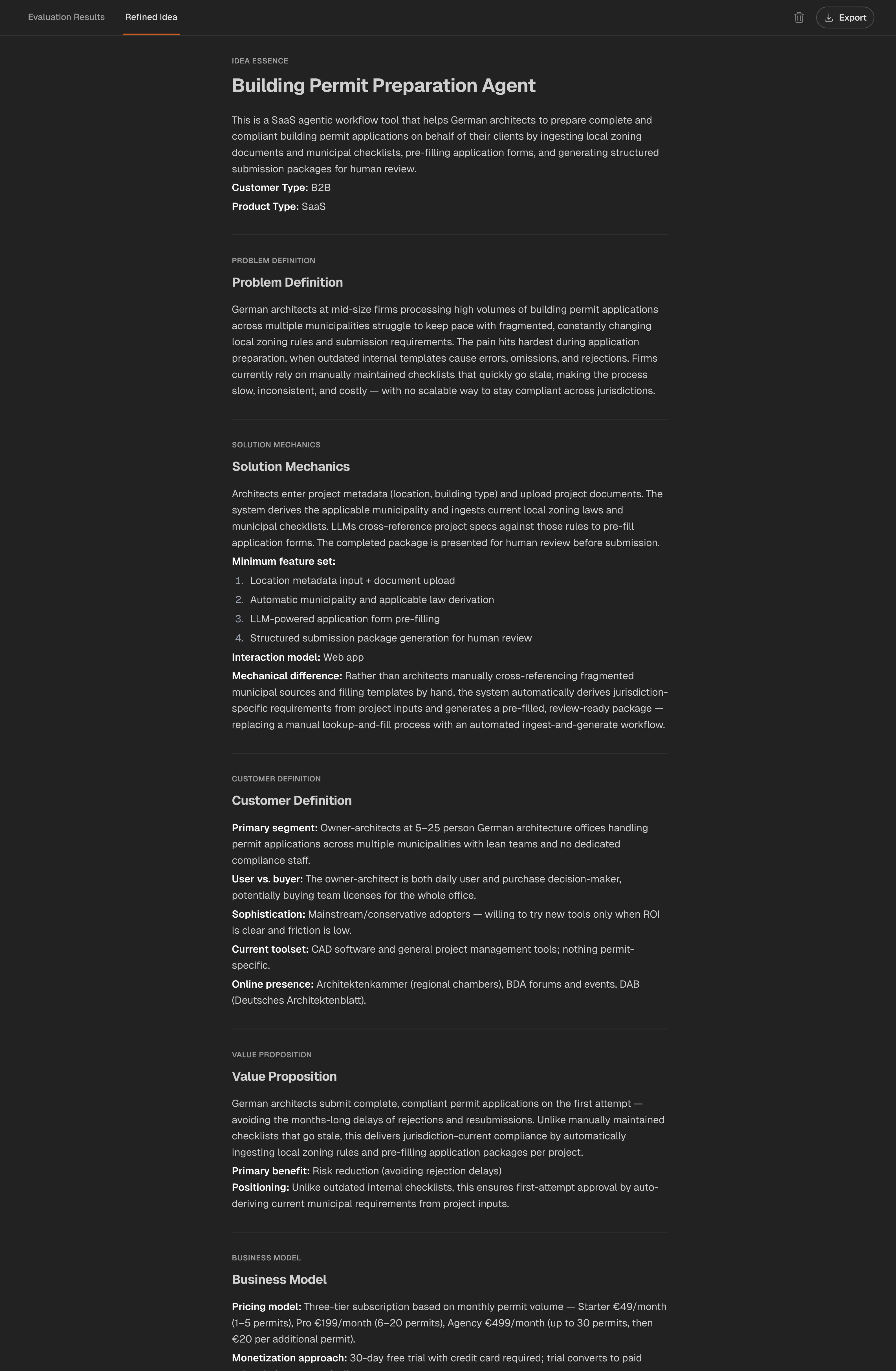
Genhone scores SaaS ideas across five weighted dimensions. The weights matter because not all startup risks are equally important for a solo founder.
Problem Validation & Market Demand carries the most weight because a clean build cannot rescue a product aimed at weak pain. Technical Feasibility & Build Speed comes next because a solo founder has limited build capacity. Unit Economics & Monetization matters because a SaaS idea needs a path to recurring revenue, not just interest. Go-to-Market Accessibility tests whether early users are reachable. Founder Fit & Sustainability asks whether this specific founder can stay with the idea long enough to learn.
Founder input is not isolated inside the Founder Fit dimension. Genhone uses founder-conversation criteria across demand, feasibility, and sustainability because firsthand access, skills, constraints, and stamina can change the final decision.
For the deeper methodology, see the SaaS idea scoring framework.
| Dimension | Weight | What the scorecard inspects | Strong score signal |
|---|---|---|---|
| Problem Validation & Market Demand | 30% | Problem criticality, reachable market, willingness to pay. | A specific buyer has a repeated pain and a reason to change behavior. |
| Technical Feasibility & Build Speed | 25% | MVP timeline, complexity, founder skill match. | One founder can build and operate a narrow first version quickly. |
| Unit Economics & Monetization | 20% | CAC expectations, churn risk, LTV potential. | Pricing, acquisition, retention, and support load can support a subscription business. |
| Go-to-Market Accessibility | 15% | Channel access, organic discovery, sales cycle complexity. | Early users are reachable without an unrealistic sales team or ad budget. |
| Founder Fit & Sustainability | 10% | Competition, personal interest, resources, operations, validation speed, time to revenue. | The idea fits the founder's constraints and can be tested before sunk cost grows. |
The 18 Criteria to Inspect in the Scorecard
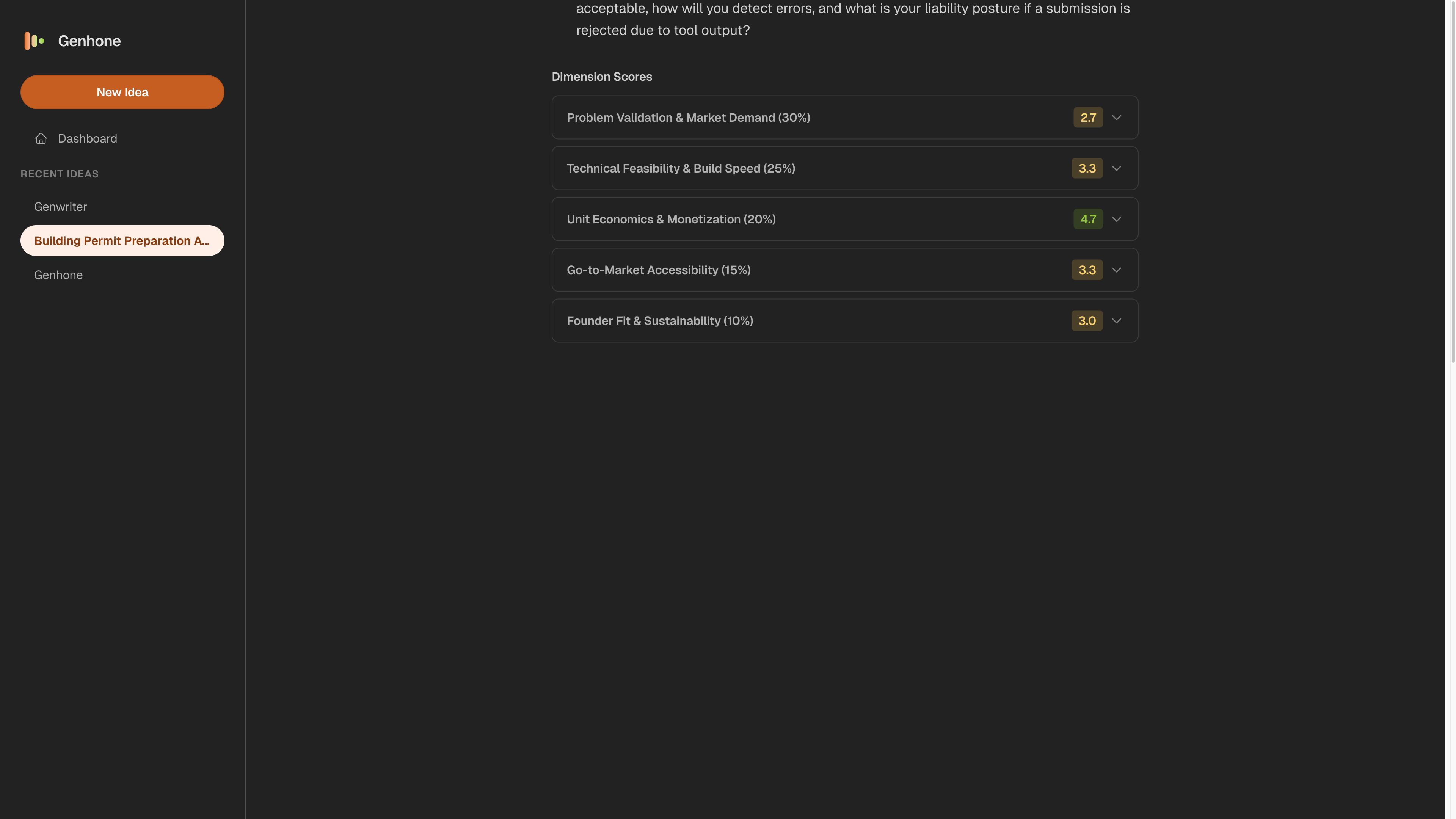
The full scorecard breaks those five dimensions into 18 criteria. The source type matters because it shows how each criterion should be interpreted.
Some criteria can be scored directly from the refined idea. Some need research-assisted market context. Some need firsthand founder input because they cannot be inferred reliably from written notes alone.
This is methodology transparency, not a backend implementation detail. When you read a scorecard, you should know whether a score reflects the idea snapshot, external market context, or a separate founder-fit conversation.
This is also where customer clarity matters. If the idea does not define the ICP, market and channel scores become soft. If the competitive wedge is vague, run a competitor analysis before MVP. If payment logic is mostly hope, validate SaaS pricing before treating a high demand score as commercial proof.
| Dimension | Criterion | Source type | What to inspect |
|---|---|---|---|
| Problem Validation & Market Demand | Problem Criticality | Founder conversation | Is the pain urgent, repeated, specific, and strong enough to change behavior? |
| Problem Validation & Market Demand | Market Size | Research-assisted automated | Is the reachable market large enough for a solo SaaS business but focused enough to target? |
| Problem Validation & Market Demand | Willingness to Pay | Founder conversation | Is there current spend, budget ownership, or economic pain that supports payment? |
| Technical Feasibility & Build Speed | Time to MVP | Direct automated | Can a credible first version be built in a realistic solo-founder window? |
| Technical Feasibility & Build Speed | Technical Complexity | Direct automated | Does the idea avoid infrastructure, compliance, integration, or platform scope that demands a larger team? |
| Technical Feasibility & Build Speed | Technical Skill Match | Founder conversation | Can this founder build and maintain the product with current skills or a small learning curve? |
| Unit Economics & Monetization | CAC Expectations | Research-assisted automated | Can the likely channel and price support a reasonable payback period? |
| Unit Economics & Monetization | Expected Churn | Research-assisted automated | Does the use case suggest recurring value rather than one-time curiosity? |
| Unit Economics & Monetization | LTV Potential | Direct automated | Could pricing, retention, and expansion support a viable SaaS lifetime value? |
| Go-to-Market Accessibility | Channel Accessibility | Direct automated | Can the founder reach first qualified users through plausible channels? |
| Go-to-Market Accessibility | Organic Discovery | Research-assisted automated | Are there search, community, marketplace, or content signals that buyers look for this problem? |
| Go-to-Market Accessibility | Sales Cycle Complexity | Direct automated | Can the product be sold self-serve or low-touch rather than requiring long enterprise sales? |
| Founder Fit & Sustainability | Competitive Landscape | Research-assisted automated | Do competitors and substitutes prove demand while leaving a realistic wedge? |
| Founder Fit & Sustainability | Personal Interest | Founder conversation | Does the founder have enough genuine interest to stay with the problem beyond the first prototype? |
| Founder Fit & Sustainability | Resource Requirements | Direct automated | Can the idea be tested and launched without capital, staff, compliance, or support needs beyond the founder? |
| Founder Fit & Sustainability | Operational Complexity | Founder conversation | Can the founder sustainably support, maintain, and improve the product if it works? |
| Founder Fit & Sustainability | Validation Speed | Direct automated | Can the core assumptions be tested quickly before a large build commitment? |
| Founder Fit & Sustainability | Time to Revenue | Direct automated | Is there a plausible path to first revenue soon enough for a bootstrapped founder? |
Read the table from left to right. The dimension tells you which risk area is being judged. The criterion tells you the specific assumption. The source type tells you what kind of input shaped the score. The final column tells you what to inspect before trusting the number.
Why Founder Fit Belongs in the Scorecard
Founder fit is not a motivational add-on for solo founders. It changes feasibility, endurance, support load, and the chance that the founder can reach the market.
Two founders can score the same SaaS idea differently for good reasons. One may already know the buyer, understand the workflow, and have the technical skill to build a narrow first version. Another may like the market but lack access, domain context, or the patience to support the operational edge cases.
Genhone collects founder-fit input through a separate chat because some criteria cannot be inferred reliably from the written idea alone. The founder-conversation criteria are Problem Criticality, Willingness to Pay, Technical Skill Match, Personal Interest, and Operational Complexity.
That distinction matters. Problem Criticality and Willingness to Pay are market-facing, but founder access affects how honestly they can be judged. Technical Skill Match belongs in feasibility. Personal Interest and Operational Complexity affect whether the founder can keep learning after the first prototype.
Founder fit should change the final decision when an idea is good in theory but mismatched to the founder's skills, access, constraints, or stamina.
How to Read the Final Score
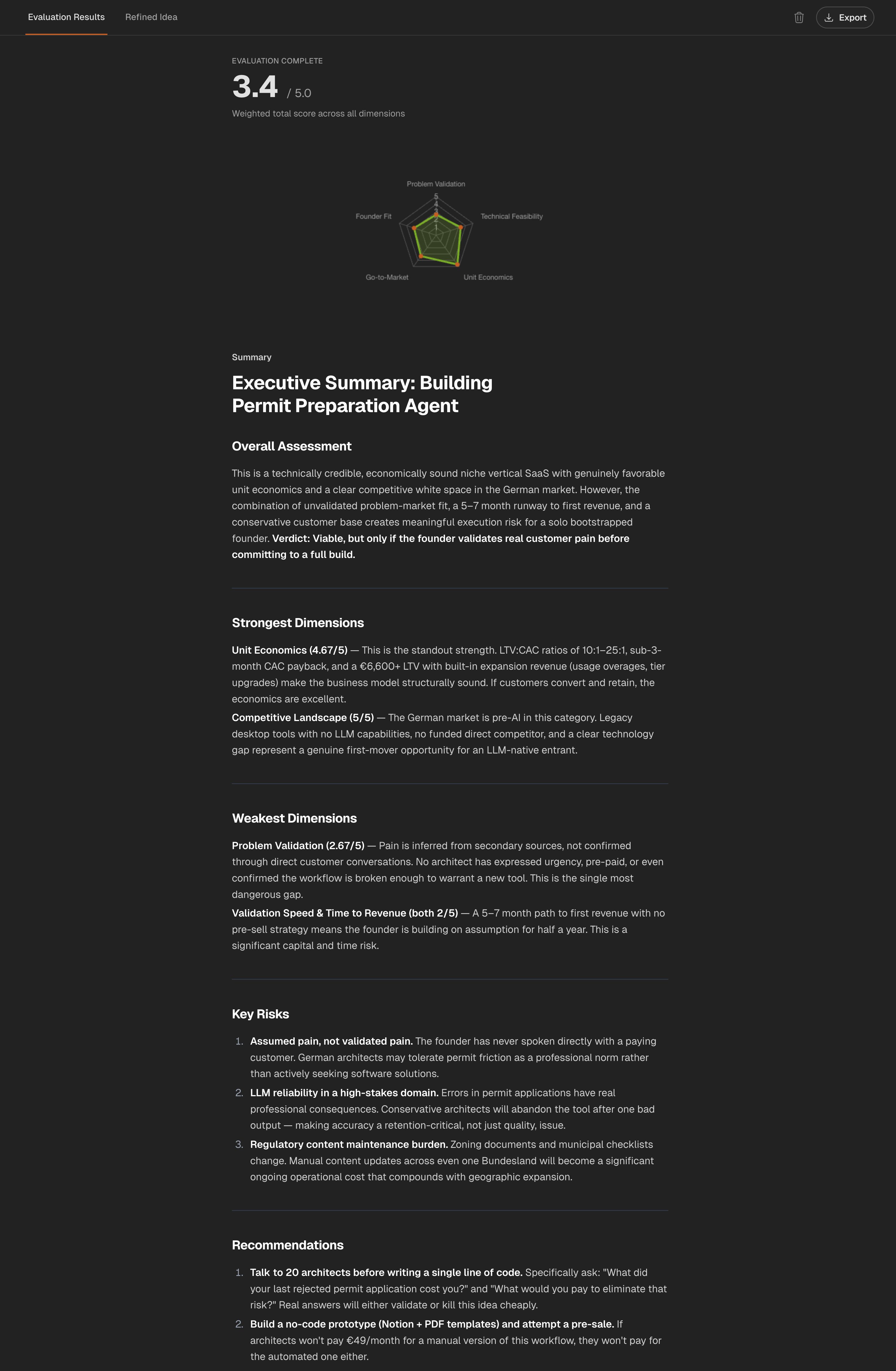
Genhone computes weighted dimension scores and a weighted total on a 1-5 scale. The total gives you a quick read, but the weakest dimension is often more important than the average.
A 4.1 can still hide a dangerous assumption if one dimension is low. A 3.4 may be a better near-term project than a 3.8 if the weakness is clear, fixable, and testable in a week. Read the label, then inspect the weak spots.
Use the score to choose the next validation move. A high score can justify the next buyer-evidence test or a tightly scoped MVP. It should not justify a full unvalidated build. A middling score should tell you what to narrow. A low score should usually trigger a kill, archive, or major rework decision. If you are unsure, use the scorecard alongside a separate decision process for when to kill a startup idea.
| Weighted score | Label | Practical interpretation | Best next action |
|---|---|---|---|
| 4.0-5.0 | Strong Opportunity | The idea is coherent across demand, feasibility, economics, GTM, and founder fit. | Run the next smallest buyer-evidence test or tightly scoped MVP. |
| 3.0-3.99 | Promising | The idea has real potential but one or more dimensions need sharper evidence or narrowing. | Fix the weakest dimension before building. |
| 2.0-2.99 | Needs Work | The idea has significant risk or vague assumptions. | Narrow the buyer, problem, pricing, channel, or MVP boundary and rescore. |
| Below 2.0 | High Risk | The current thesis is weak for a solo SaaS build. | Kill, archive the learning, or restart from a stronger problem. |
Turn a rough SaaS idea into a scored, comparable artifact with Genhone.
Example Startup Idea Scorecard
The example below is fictional. It is not a customer story, testimonial, or anonymized Genhone user artifact.
Imagine a technically capable solo founder considering a SaaS product that helps freelance design studios chase overdue invoices, send polite follow-ups, and identify clients who repeatedly pay late. The idea is narrow enough to score, but the scorecard should still expose weak assumptions.
In this fictional case, the pain is specific and repeated. The founder can build the first version without a large team. The weaker area is unit economics: small studios may feel the pain but resist another subscription unless the product clearly saves cash flow, admin time, or awkward client conversations.
| Example idea | Problem Validation | Technical Feasibility | Unit Economics | Go-to-Market | Founder Fit | Final label | Weakest assumption | Next action |
|---|---|---|---|---|---|---|---|---|
| [Fictional example] Invoice follow-up assistant for freelance design studios | 4.1 / 5 | 4.0 / 5 | 3.2 / 5 | 3.5 / 5 | 4.3 / 5 | Promising | Studios may want better invoice follow-up but may not pay enough for a standalone tool. | Gather evidence from 10 studio owners, test pricing language, and rescore before building the full workflow. |
The important part is not the label alone. The useful artifact would also include criteria-level reasoning: why Problem Criticality scored high, why LTV Potential is uncertain, which channel looks plausible, and what evidence would change the score.
A scorecard should make the next move smaller and clearer. In this case, the next action is not "build the app." It is to test payment urgency and pricing with the buyer segment most likely to feel the pain.
How to Compare Multiple Startup Ideas With One Scorecard
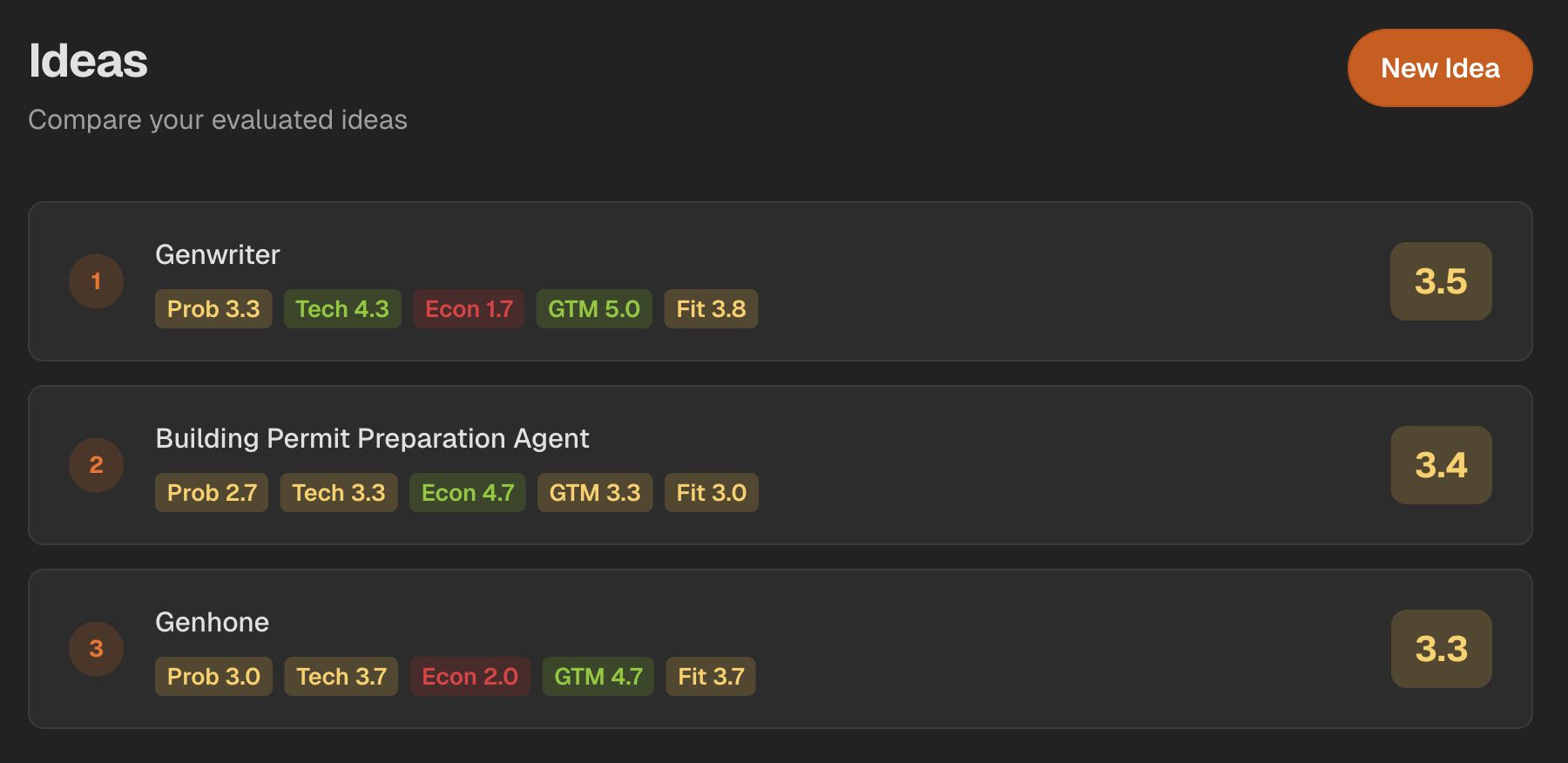
A scorecard becomes more useful when you apply it consistently across several ideas. The key is to compare ideas that have been refined to a similar level of detail.
Do not compare a polished idea snapshot against a one-line thought. Refine each idea first, then score every idea with the same criteria and weights. That keeps the comparison from rewarding whichever idea you happened to explain better.
When you compare, do not sort only by total score. Look for dimension patterns. One idea may have the highest total because it is easy to build, but weak buyer pain. Another may score lower overall but have a sharp pain, reachable buyers, and one fixable technical risk. For a solo founder, the second idea may be a better next test.
Saved artifacts matter here. If the reasoning is preserved, you can revisit why an idea scored well or poorly. You are not relying on memory, scattered notes, or an old chat response. You can inspect the criteria, compare the weak assumptions, and decide which idea deserves the next evidence-gathering cycle.
| Comparison question | Why it matters |
|---|---|
| Which idea has the strongest buyer pain? | Strong demand can justify harder execution. |
| Which idea has the fastest validation path? | Solo founders need evidence before sunk cost grows. |
| Which idea has the weakest fatal assumption? | A high total can hide a broken buyer, channel, or pricing assumption. |
| Which idea fits the founder's current constraints? | Founder fit changes whether an idea is actually executable. |
| Which idea can produce first revenue soonest? | Bootstrapped founders cannot ignore time to revenue. |
Spreadsheet, ChatGPT, One-Shot Validator, or Genhone?
Different tools fit different stages of thinking.
A spreadsheet is useful when you want full manual control. ChatGPT or Claude can help brainstorm criteria, objections, and sharper questions. One-shot validators can be useful for fast first-pass feedback. The current tool market includes products positioned around fast AI scoring, browser-based scorecards, idea databases, or validation reports, including IdeaValidator, SaaSValidatr, Meysam's SaaS Idea Validator, Idealyzer, and Idea Score.
The risk is treating speed as confidence. A fast score on a vague input can make an idea feel more validated than it is. That is why ChatGPT prompts are not a startup validation process by themselves.
Genhone is designed for the founder who wants the scorecard to become a saved decision artifact: guided refinement, consistent criteria, founder-fit input, criteria-level reasoning, and side-by-side comparison. For more product context, see the SaaS idea validation tool page.
| Option | Best for | Limitation | Where Genhone differs |
|---|---|---|---|
| Spreadsheet | Manual scoring and custom weights. | Easy to compare vague ideas inconsistently. | Genhone starts from guided refinement and saves reasoning with the score. |
| ChatGPT or Claude | Brainstorming criteria and questions. | The rubric, memory, and evidence discipline depend on the prompt. | Genhone uses a consistent product-backed rubric and persistent artifacts. |
| One-shot validator | Fast first-pass feedback. | Can make rough ideas feel more certain than they are. | Genhone enforces structure before scoring and includes founder-fit input. |
| Genhone | Refining, scoring, and comparing solo-founder SaaS ideas. | It does not prove demand or build the product for you. | The output is a saved scorecard artifact for decision-making. |
What the Scorecard Can and Cannot Prove
A scorecard can structure judgment. It can expose weak assumptions. It can help you compare ideas. It can guide the next validation step. It can also make a founder more honest about whether an idea is ready for a build cycle.
It cannot prove future revenue, product-market fit, customer demand, willingness to pay, or founder stamina.
Real evidence still matters: buyer interviews, current spend, competitor reviews, search behavior, community complaints, paid pilots, and actual usage. The scorecard should help you decide which evidence to gather next, not replace the evidence itself.
This is especially important with AI-assisted building. The cheaper it becomes to start building, the easier it becomes to skip the uncomfortable evidence. A scorecard gives you a pause point before the code exists and sunk cost starts shaping the decision.
Scores should also change. If a buyer interview contradicts the assumed pain, rescore. If pricing conversations show stronger willingness to pay than expected, rescore. If a competitor review pattern reveals a sharper wedge, rescore. The scorecard is a living decision artifact, not a one-time verdict.
Turn the Scorecard Into a Saved Decision Artifact
Genhone is a SaaS web app for solo founders to refine and evaluate SaaS ideas through guided AI conversations and automated idea scoring.
The workflow is intentionally narrow: refine, score, compare, decide. Genhone enforces 12 refinement sections before scoring, then evaluates the idea across 18 criteria in five weighted dimensions. Scoring consists of 13 automated criteria plus five founder-fit criteria collected through a separate founder chat.
The output is a saved artifact. That means the score, reasoning, weak assumptions, and decision context can be revisited later. When you have several ideas, you can compare saved scorecards side by side in the dashboard instead of rebuilding the logic from memory.
The boundary is just as important as the workflow. Genhone does not build the product for you, generate a roadmap, create a PRD, write build prompts, replace customer discovery, or prove the idea will work. It helps you decide which idea deserves the next evidence-gathering step before AI-assisted building makes everything feel buildable.
Turn a rough SaaS idea into a scored, comparable artifact with Genhone.
FAQ
What should a startup idea scorecard include?
A startup idea scorecard should include weighted dimensions, specific evaluation criteria, criteria-level reasoning, evidence quality, and a recommended next action.
For solo SaaS founders, the core dimensions are Problem Validation & Market Demand, Technical Feasibility & Build Speed, Unit Economics & Monetization, Go-to-Market Accessibility, and Founder Fit & Sustainability. The 18-criterion scorecard then breaks those dimensions into inspectable assumptions.
The scorecard should not stop at a number. It should explain what made the idea strong or weak.
What score means a startup idea is worth building?
In Genhone, a weighted score of 4.0-5.0 is labeled Strong Opportunity. That usually means the idea is coherent enough to justify the next buyer-evidence test or a tightly scoped MVP.
It does not mean "build everything." A 3.0-3.99 Promising idea may also be worth pursuing if the weakest dimension is fixable. A 2.0-2.99 Needs Work idea should usually be narrowed and rescored. Below 2.0 is High Risk and usually points to killing, archiving, or restarting from a stronger problem.
Can AI scoring replace customer discovery?
No. AI scoring can structure assumptions, surface risks, compare ideas, and prioritize what to test next. Customer discovery still comes from real buyer behavior: conversations, current spend, sales objections, pricing tests, usage, and willingness to change.
Use AI scoring to decide what evidence matters most. Do not treat it as proof that the market wants the product.
Should founder fit change the final score?
Yes, especially for solo founders. Skills, buyer access, motivation, support capacity, and operational complexity change whether an idea is actually executable.
An idea can be attractive in theory and still be wrong for a founder who cannot reach the buyer, build the first version, support the workflow, or stay interested long enough to learn from the market. Founder fit belongs in the scorecard because it changes the real odds of executing the next step.
How do I compare multiple startup ideas with one scorecard?
Refine each idea to the same level of detail first. Then score every idea against the same criteria and weights.
Compare dimension patterns, weakest assumptions, and next evidence tests, not only total scores. The best next idea is often the one with strong buyer pain, a fast validation path, and a fixable weakness. Saved scorecards make this easier because you can revisit the reasoning behind each score.
Should I use a spreadsheet, ChatGPT, or Genhone?
Use a spreadsheet if you want manual control and are disciplined about consistent scoring. Use ChatGPT or Claude if you want brainstorming help, objections, or sharper validation questions.
Use Genhone when you want enforced structure before scoring, a consistent product-backed rubric, founder-fit input, criteria-level reasoning, saved artifacts, and side-by-side comparison for solo-founder SaaS ideas.