How to Define the ICP for a SaaS Idea
A first-buyer framework for founders before they validate, price, or build.
To define the ICP for a SaaS idea, start with one first buyer, not a broad market. Specify the company or user context, the painful recurring workflow, the trigger that makes the problem urgent, who uses and buys the product, current alternatives, where you can reach the first 20 prospects, and which traits disqualify weak-fit customers. Treat this ICP as a hypothesis until interviews, workflow evidence, and pricing tests confirm it.
If you need to define the ICP for a SaaS startup idea, do not start with a market, persona deck, or firmographic list. Start with one customer context, painful workflow, trigger, reachable channel, and clear exclusions.
What an ICP Means for a SaaS Idea
ICP means Ideal Customer Profile. In B2B SaaS, an ICP usually describes the company or account most likely to get value from the product, buy it, retain, and expand. For an early SaaS idea, it is not proven yet. It is a hypothesis about who to test first.
A mature SaaS ICP tells a team where to focus sales, marketing, product, and customer success. A pre-build SaaS ICP tells a founder who to learn from first.
The first ICP should be narrower than the total market. It should identify who feels the pain, who can buy, when the pain becomes urgent, what workflow breaks, and where qualified prospects can be reached. For B2C, prosumer, or solo-buyer SaaS, the ICP may describe an individual buyer context instead of a company account.
ICP vs Target Market vs Buyer Persona
ICP is a focusing filter, not a demographic paragraph. The target market tells you who could possibly buy. The ICP tells you which customer should be tested first. The buyer persona sits inside that ICP.
| Concept | What it answers | Example | How founders misuse it |
|---|---|---|---|
| Target market | Who could possibly buy? | Shopify stores | Too broad to guide interviews or MVP scope. |
| ICP | Which customer should we focus on first? | Solo Shopify operators with 300-2,000 monthly orders and no lifecycle marketer | Treated as a static marketing persona instead of a testable hypothesis. |
| Buyer persona | Which person inside the ICP do we need to understand? | Founder-operator who owns retention and approves tools | Written before the company or buyer context is clear. |
| User persona | Who uses the product day to day? | Store operator setting up follow-up campaigns | Confused with the buyer when budget or approval sits elsewhere. |
Why Your ICP Should Come Before Your MVP
A vague ICP makes every later validation step noisy. Interviews are weaker when you mix buyer types. Pricing tests fail when the budget owner is unclear. MVP scope expands when several segments are blended into one product promise.
Distribution also depends on ICP clarity. If you cannot say where the first buyers gather, search, complain, or ask for help, you have not validated access. AI coding tools make this more urgent because a broad idea can become a working product before the customer decision is clear.
If you are pressure-testing the full business case, use the broader guide to validating a SaaS idea before building. If you want the shorter artifact, use the SaaS idea validation checklist after you draft the ICP.
The First-Buyer ICP Framework
Use this framework to turn a broad audience into a testable first-buyer hypothesis.
| ICP field | Question to answer | Weak answer | Stronger answer | How to test it |
|---|---|---|---|---|
| Customer context | What context has the pain? | "Small businesses." | "Bootstrapped B2B SaaS founders doing founder-led sales with 1-5 employees." | List 20 reachable examples. |
| Painful workflow | What repeated workflow breaks? | "They need productivity." | "They clean trial signup lists before outbound." | Ask for last-time stories. |
| Trigger moment | What makes the pain urgent now? | "They want to grow." | "They launched a free trial and cannot rank signups for follow-up." | Look for recent launches, misses, or role changes. |
| User vs buyer | Who uses it and who pays? | "Marketing teams." | "Founder uses it and approves the spend." | Confirm budget ownership. |
| Current alternative | What do they use today? | "Nothing exists." | "Stripe exports, manual enrichment, and CRM notes." | Observe the current workflow. |
| Value and budget logic | Why would this be worth paying for? | "It saves time." | "It helps recover high-intent trial accounts before they churn." | Run pricing or paid manual tests. |
| Reachability | Where can the founder reach the first 20 prospects? | "LinkedIn and ads." | "r/SaaS launch threads, Indie Hackers posts, and recent Product Hunt SaaS launches." | Build the list before building. |
| Technical and operational fit | What toolset or maturity must exist? | "Any team." | "Uses Stripe or Paddle, has a free trial, and has no RevOps hire." | Check stack and process clues. |
| Negative ICP | Who should be excluded? | No exclusions. | "Enterprise teams, agencies, and pre-product founders." | Reject interviews outside the ICP. |
| First validation test | What test comes next? | "Build MVP." | "Interview 8-10 matching founders, then offer a paid manual audit." | Test the weakest assumption. |
1. Start with customer context, not a market label
Market labels do not identify names. Add role, stage, toolset, workflow, or trigger.
2. Tie the ICP to a repeated workflow
A useful ICP is about repeated work. Ask what happened last time, which tools were open, who did the work, and what broke.
3. Name the trigger moment
Trigger moments create urgency: funding, a new role, missed target, churn spike, reporting deadline, compliance change, platform shift, or paid acquisition push.
4. Separate user, buyer, and budget owner
In self-serve SaaS, user and buyer may match. In B2B SaaS, they may differ. A user-only ICP creates pricing confusion.
5. Define who is not your ICP
Negative ICP prevents false positives. Exclude by stage, budget, workflow maturity, stack, company size, sales cycle, support needs, or problem frequency.
How to Draft an ICP Hypothesis When You Have No Customers
If you have no customers, you cannot produce a final data-backed ICP. The right output is an ICP hypothesis that can be tested.
Use directional evidence, not fake certainty: interviews, workflow walkthroughs, community posts, reviews on G2, Capterra, Product Hunt, the Shopify App Store, Reddit r/SaaS, and Indie Hackers. Job posts, launch pages, and search behavior can also help.
Start with two or three possible ICPs only if the idea truly has multiple plausible buyers. Then pick one to test first. Do not blend feedback from multiple ICPs into one average conclusion.
An AI-generated ICP is useful as a starting hypothesis, not as validation evidence. It can sharpen language, but it cannot prove that a buyer is reachable, urgent, or willing to pay.
A SaaS ICP Template You Can Fill In
Use this template once you have a narrow first-buyer hypothesis. A hard-to-fill field shows what to test next.
Our initial ICP is [specific customer context] who [repeated painful workflow] when [trigger moment]. The daily user is [user], the buyer or budget owner is [buyer], and they currently solve the problem with [current alternative]. They are reachable through [specific channel or list source], likely to pay because [value or budget logic], and not a fit when [negative ICP traits]. The next validation test is [interview, manual pilot, pricing test, or channel test].
| Template field | Prompt | Good answer test |
|---|---|---|
| Customer context | Which role, stage, toolset, or behavior defines the buyer? | You can name 20 examples. |
| Workflow | What recurring job creates the pain? | The buyer recalls the last time. |
| Trigger | What makes them act now? | You can identify the moment. |
| User | Who uses it daily? | The workflow is written for them. |
| Buyer | Who approves or pays? | Pricing involves this person. |
| Alternative | What happens today? | The workaround exists. |
| Reachability | Where will 20 prospects come from? | The channel exists before the MVP. |
| Value logic | Why is it worth paying for? | Pain maps to time, money, revenue, risk, or quality. |
| Negative ICP | Who should be excluded? | You can reject noisy interviews. |
| Next test | What will you test first? | It targets the weakest assumption. |
Example: Narrowing a Broad SaaS Idea Into an ICP
Consider the same rough idea used across the Genhone validation cluster:
An AI onboarding assistant for lean Shopify stores that turns first purchases into repeat customers.
The raw idea is plausible, but "Shopify stores" is a target market.
| Candidate ICP | Why it is tempting | Why it is weak or strong | Verdict |
|---|---|---|---|
| All Shopify stores | Huge market, clear platform | Too broad by size, category, budget, and retention workflow. | Reject as target market only. |
| Enterprise Shopify Plus brands | Higher budgets | Committees, lifecycle teams, long sales cycles, and heavy integrations. | Not first ICP for solo founder. |
| Agencies serving Shopify brands | Easy to find and tool-savvy | They may be service providers, not the buyer with the pain. | Possible later channel. |
| New stores with low order volume | Accessible and eager | Too little repeat-purchase data and weak willingness to pay. | Weak first ICP. |
| Solo Shopify operators with 300-2,000 monthly orders and no lifecycle marketer | Specific workflow, reachable operator, possible revenue pain, clear tool context. | Willingness to pay still needs evidence. | Best first ICP hypothesis. |
The strongest first hypothesis is narrow enough to test.
Our initial ICP is solo Shopify operators with 300-2,000 monthly orders who manage post-purchase retention without a dedicated lifecycle marketer. The pain appears after a paid acquisition push, when first-time buyers are not coming back and the operator manually exports customers, edits Klaviyo templates, or does nothing. They are reachable through ecommerce founder communities, Shopify Slack groups, and outbound to stores with visible retention offers. They are not a fit if they already have a lifecycle team, have fewer than 100 monthly orders, or outsource retention to an agency. The next test is 8-10 interviews plus a paid manual onboarding audit.
Next, interview matching operators, inspect their workflow, and test whether a manual audit is worth paying for.
How Your ICP Changes Validation, Pricing, Distribution, and MVP Scope
ICP is not a writing exercise. It changes what the founder does next.
| Decision area | What a clear ICP changes | What to test next |
|---|---|---|
| Interviews | Ask one buyer type for last-time stories. | Interview 5-10 people from one narrow ICP. |
| Checklist | Grade evidence against one first buyer. | Score the ICP before comparing the whole idea. |
| Pricing | Test willingness to pay with the budget owner. | Ask the budget owner about current spend or run a pricing test. |
| Competitor research | Compare alternatives used by this ICP. | Inspect current workarounds and good-enough tools. |
| Distribution | Choose where this ICP already looks for help. | Build a list of 20-50 reachable prospects. |
| MVP scope | Build one workflow for one customer context. | Cut the first build to one workflow and one outcome. |
If this table exposes weak evidence, use the SaaS idea validation checklist to score the idea, the full SaaS idea validation framework to pressure-test pricing and distribution, or the questions before vibe coding before turning the ICP into an AI build prompt.
When buyer, reachability, or budget ownership is still weak, reduce customer-definition risk before moving to MVP.
How to Validate Your ICP Before Building
Five to ten narrow interviews can reveal patterns if the ICP is specific. YC's startup advice emphasizes talking to users; Paul Graham's "Do Things That Don't Scale" reinforces manual early learning.
| ICP risk | Test | Strong signal | Weak signal |
|---|---|---|---|
| Buyer is too broad | Interview one narrow buyer group | Stories repeat across 5-10 conversations | Every interview differs. |
| Pain may be weak | Workflow walkthrough | Buyer shows workaround and cost | Buyer cannot recall the last time. |
| Trigger is unclear | Ask what happened before they looked for a fix | Recent event creates urgency | No trigger appears. |
| Buyer/user split is wrong | Ask who approves tools and budget | Budget owner is clear | User likes it but cannot buy. |
| Distribution is unproven | Build a list of 20-50 prospects | Founder can contact them directly | Channel is vague or blocked. |
| Value is unproven | Paid manual offer or pricing conversation | Buyer pays, preorders, or discusses value seriously | Buyer avoids price. |
Do not mix interviews across ICPs and call the average "validation." Manual pilots can validate value before software. Search and community signals are useful, but not substitutes for buyer behavior.
Common ICP Mistakes SaaS Founders Make
Common mistakes are calling a market an ICP, writing a persona too early, testing multiple ICPs at once, picking an unreachable enterprise segment, ignoring the trigger, confusing user with buyer, skipping negative ICP, treating AI output as proof, or building after interviews show the ICP is wrong.
When to Keep, Narrow, or Change the ICP
Narrow is the most common productive early outcome. It means the pain may be real, but the customer definition is not sharp enough yet.
| Verdict | Use when | Next action |
|---|---|---|
| Keep | The same buyer type repeats the same workflow pain, current workaround, urgency trigger, and budget logic. | Continue validation and define the narrow MVP around this ICP. |
| Narrow | Pain exists, but answers vary by company size, role, stage, or toolset. | Split the audience and test the strongest subsegment first. |
| Change | The ICP is unreachable, does not own budget, has weak pain, or uses alternatives that are good enough. | Save the artifact and test a different ICP or idea. |
Changing the ICP is not abandoning the idea. A saved artifact helps compare ideas and avoid repeating the same vague segment.
How Genhone Fits Into ICP Definition
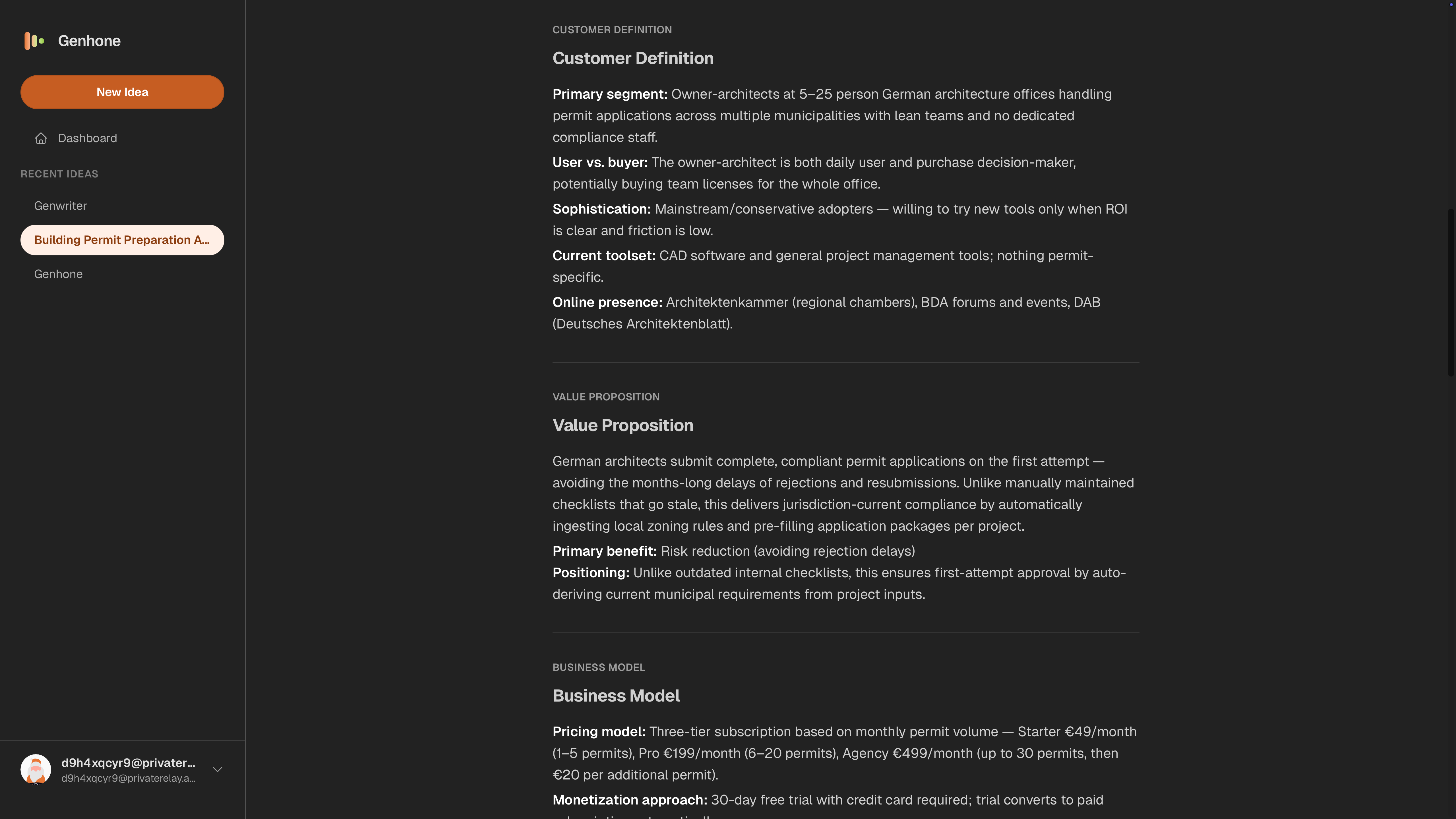
Genhone guides solo founders through structured SaaS idea refinement before they build. Its Customer Definition section asks for the primary customer segment, user vs buyer distinction, sophistication level, current toolset, and where the customer gathers.
That definition connects to problem, value proposition, business model, go-to-market, metrics, scope, and founder fit. Genhone is not a magic validation oracle; it helps structure assumptions and choose the next validation test.
Use Genhone when your SaaS idea still says "startups," "small businesses," or "Shopify stores" and you need a structured SaaS idea refinement workflow before building.
FAQ
What is an ICP in SaaS?
An ICP, or Ideal Customer Profile, describes the customer or account most likely to get value, buy, retain, and create a good business outcome. For an early SaaS idea, treat it as a first-buyer hypothesis.
How do I define an ICP for a SaaS startup before I have customers?
Start with a hypothesis. Define the customer context, painful workflow, trigger, user and buyer, current alternative, reachability, value logic, and negative ICP. Then test it with interviews, walkthroughs, manual pilots, and pricing conversations.
What is the difference between ICP and buyer persona?
ICP defines which customer or account to focus on. Buyer persona defines the person inside that context, including goals, objections, and decision role.
How narrow should my first SaaS ICP be?
Narrow enough that you can name 20 reachable prospects and predict the workflow they struggle with. If it cannot guide interviews, pricing, distribution, and MVP scope, it is too broad.
Should a SaaS startup have multiple ICPs?
A startup may have multiple possible ICPs, but it should validate one at a time. Testing several at once creates mixed feedback and bloated MVP scope.
Can AI define my ICP?
AI can generate ICP hypotheses, sharpen language, and suggest research questions. It cannot prove reachability, urgency, or willingness to pay.
What evidence shows my ICP is wrong?
The ICP is likely wrong if buyers cannot describe repeated pain, use no workaround, cannot be reached, do not own budget, have strong alternatives, or require a scope the founder cannot serve.