SaaS Idea Scoring Framework for Solo Founders
18 criteria to decide whether to build, narrow, or kill a SaaS idea before your next AI-assisted build cycle.
AI coding tools make almost any plausible SaaS idea feel buildable. That does not make every idea worth the next build cycle. A SaaS idea scoring framework helps a technically capable solo founder turn a rough concept into a comparable decision artifact: what looks strong, what is weak, what needs better evidence, and whether the next move is build, narrow, kill, or test.
A SaaS idea scoring framework is a weighted rubric for deciding whether a software idea is worth building, narrowing, killing, or testing further. A useful framework scores buyer pain, market demand, technical feasibility, unit economics, distribution, founder fit, and validation speed after the idea is specific enough to evaluate.
At Genhone, this framework is shaped by Malte Hedderich's work shipping software, using AI-assisted coding workflows, and seeing how easy it is to build before validation. The point is practical: make the decision artifact stronger before the build sprint creates sunk cost.
What a SaaS Idea Scoring Framework Does
A SaaS idea scoring framework turns an idea into a structured decision. Instead of asking, "Do I like this idea?" it asks, "How does this idea perform against the same criteria I would use for my other ideas?"
That matters for solo founders because the constraint is not only engineering time. It is attention, motivation, distribution, support load, and the cost of chasing the wrong thing for another month.
A useful score should help you decide whether to:
- Build the next smallest validation test or tightly scoped MVP.
- Narrow the buyer, problem, price, channel, or product boundary.
- Kill or archive the idea before sunk cost grows.
- Gather better evidence because the current score is mostly assumption.
Use scoring after the idea has a defined buyer, problem, solution mechanic, pricing logic, distribution path, scope, and founder constraint. If those inputs are missing, first validate a SaaS idea before building and turn the loose concept into something specific enough to judge.
The score is not proof of product-market fit, customer demand, future revenue, or willingness to pay. Cursor, Claude Code, Lovable, Bolt, v0, ChatGPT, and Claude can make building faster. They do not decide which idea deserves the build cycle.
Why Scoring Starts With a Structured Idea
Bad input creates fake precision. A vague idea can receive a confident-looking score, but the result is only as useful as the idea snapshot underneath it.
"AI tool for restaurants" is not scorable in a meaningful way. Which restaurant? What workflow? Who buys? What do they use today? What pricing model fits? Is this a web app, POS integration, dashboard, or done-for-you service? Can one founder support it?
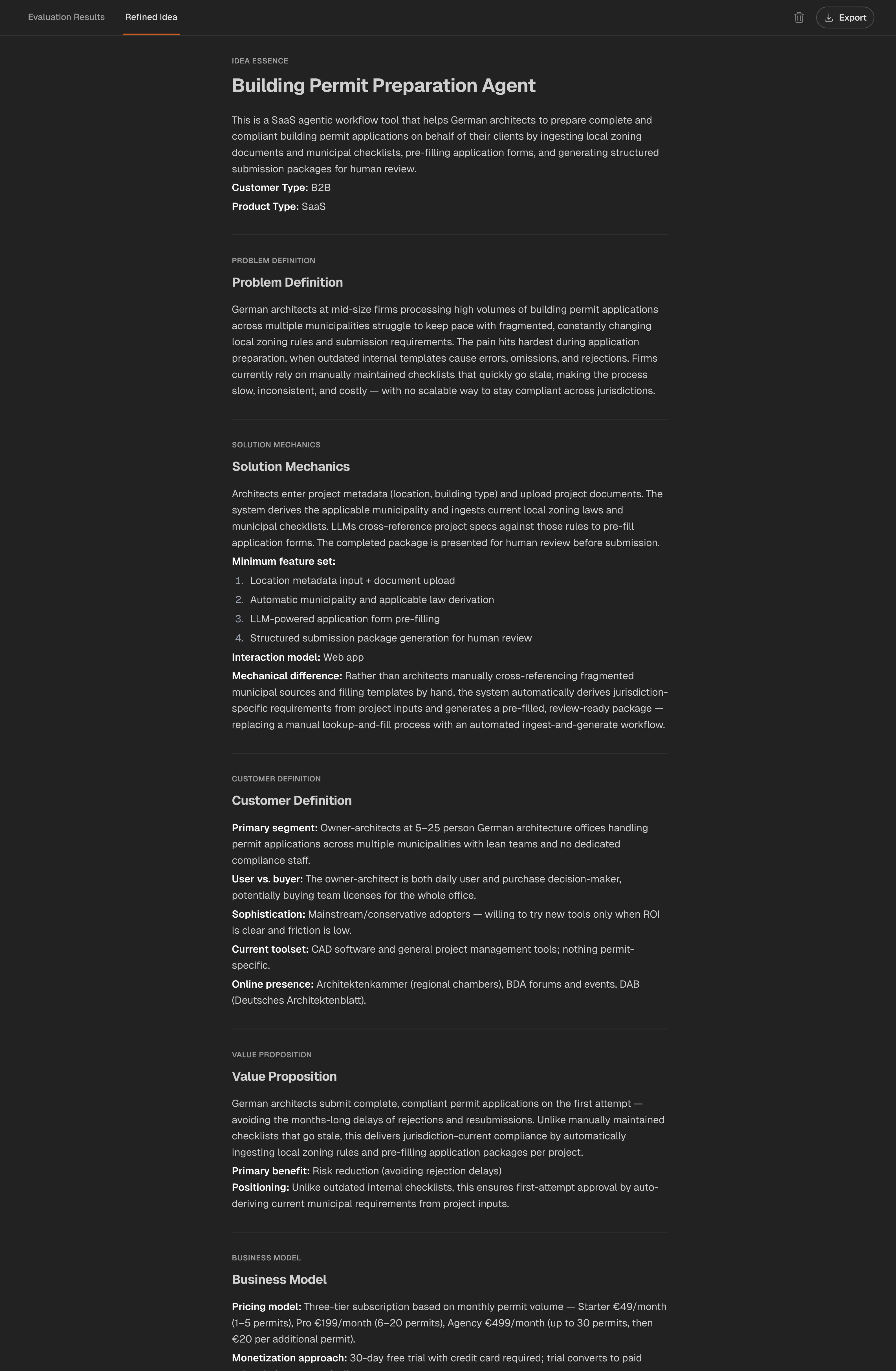
Before scoring, a founder needs a consistent idea snapshot. Genhone's refinement model structures every idea across 12 sections:
- Idea Essence
- Problem Definition
- Solution Mechanics
- Customer Definition
- Value Proposition
- Business Model
- Technical Foundation
- Go-to-Market Approach
- Customer Onboarding & Activation
- Key Metrics Framework
- Scope & Boundaries
- Solo Founder Execution
These sections make ideas comparable because every idea is evaluated from the same shape of input. One idea should not get a detailed buyer, pricing, and channel model while another is scored from a one-sentence hunch.
That is also why a SaaS idea validation checklist is useful before scoring. The checklist helps expose the raw assumptions. The scoring framework weighs them.
The 5 Weighted Dimensions of a Solo-Founder SaaS Score
Not every criterion deserves the same weight. For a solo SaaS founder, painful demand and build feasibility usually matter more than broad market-size theater. A giant market does not help if the first buyer is vague, the MVP takes six months, or the founder cannot reach users without a sales team.
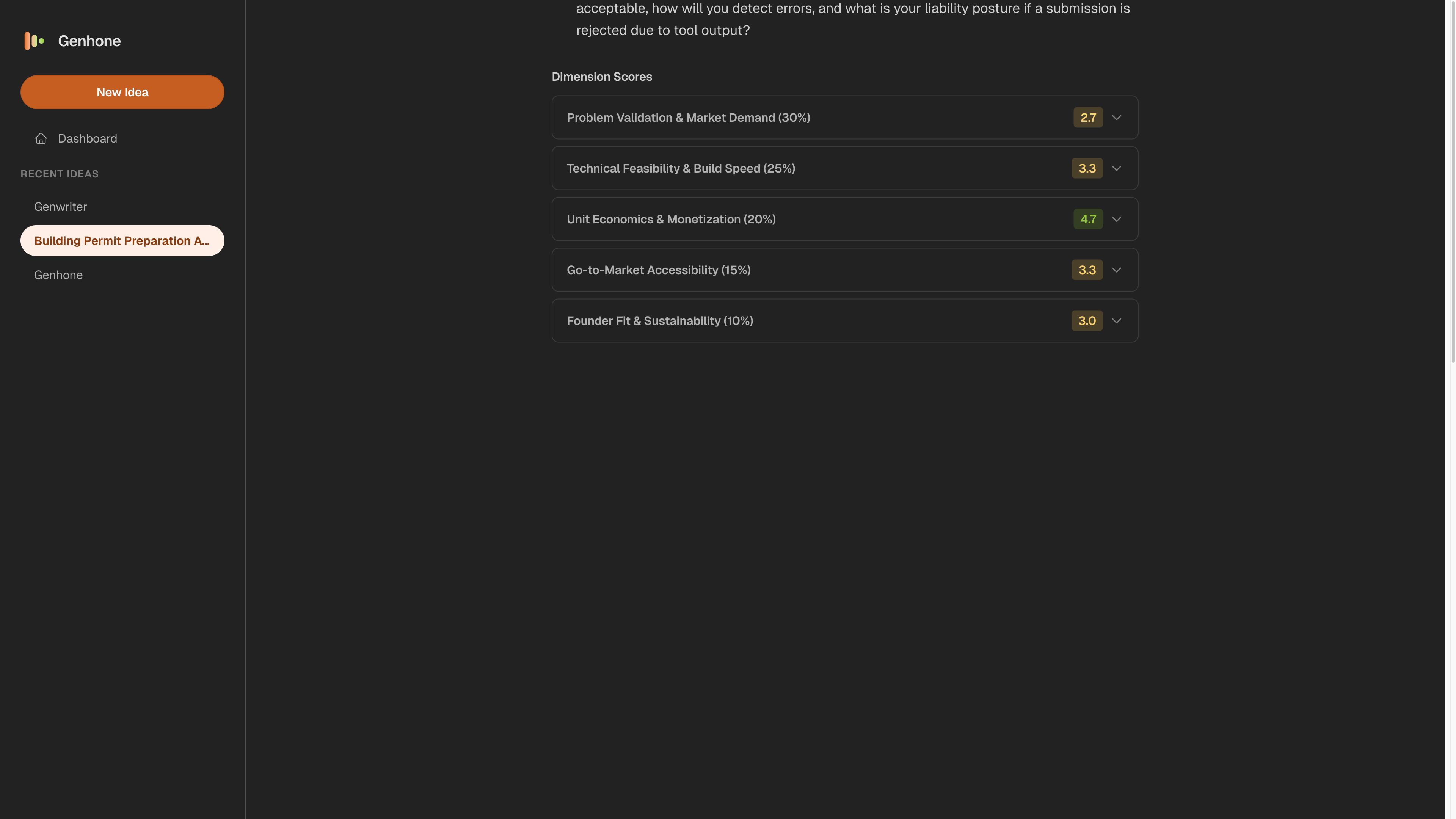
Genhone scores SaaS ideas across five weighted dimensions:
| Dimension | Weight | Criteria | What a strong score means |
|---|---|---|---|
| Problem Validation & Market Demand | 30% | Problem Criticality, Market Size, Willingness to Pay | A specific buyer has a painful problem, market context, and payment logic worth testing. |
| Technical Feasibility & Build Speed | 25% | Time to MVP, Technical Complexity, Technical Skill Match | A solo founder can build and maintain a narrow first version quickly enough. |
| Unit Economics & Monetization | 20% | CAC Expectations, Expected Churn, LTV Potential | Price, retention, support load, and acquisition path could support a real subscription business. |
| Go-to-Market Accessibility | 15% | Channel Accessibility, Organic Discovery, Sales Cycle Complexity | The founder can reach early buyers without a large sales team or unrealistic ad spend. |
| Founder Fit & Sustainability | 10% | Competitive Landscape, Personal Interest, Resource Requirements, Operational Complexity, Validation Speed, Time to Revenue | The idea fits the founder's constraints, interests, resources, timing, and competitive opening. |
The weights are opinionated for solo SaaS work. Problem Validation & Market Demand carries the most weight because no amount of clean implementation saves a product aimed at weak pain. Technical Feasibility & Build Speed is next because a solo founder has limited build capacity. Unit economics matter because subscription software has to retain and monetize users, not only attract interest.
Founder fit receives a smaller explicit dimension weight, but founder input is not limited to that dimension. Genhone uses founder conversation input for Problem Criticality, Willingness to Pay, Technical Skill Match, Personal Interest, and Operational Complexity. That means the founder's lived access, skills, constraints, and stamina affect demand, feasibility, and sustainability.
The final score is a structured judgment. It is not an automated guarantee.
The 18-Criterion SaaS Idea Scorecard
A useful SaaS scorecard should show the question behind every label. "Market Size" is not enough. The founder needs to know whether the market is reachable, focused, and large enough for a solo SaaS business.
Genhone separates the 18 criteria by source type:
- 8 direct automated criteria scored from the refined idea.
- 5 research-assisted automated criteria where external market context matters.
- 5 founder-conversation criteria that require firsthand input from the founder.
Methodology note: Genhone starts with 12-section structured refinement, scores 18 criteria across 5 weighted dimensions, combines direct automated scoring with research-assisted automated scoring and founder-conversation scoring, then saves the output as a comparable idea artifact. The score is not a prediction and cannot replace buyer evidence.
| Dimension | Criterion | Source type | Scoring question |
|---|---|---|---|
| Problem Validation & Market Demand | Problem Criticality | Founder conversation | Is the problem urgent, repeated, and painful enough that the buyer would change behavior? |
| Problem Validation & Market Demand | Market Size | Research-assisted automated | Is the reachable market large enough for a solo SaaS business but narrow enough to focus? |
| Problem Validation & Market Demand | Willingness to Pay | Founder conversation | Is there current spend, budget ownership, or economic pain that supports payment? |
| Technical Feasibility & Build Speed | Time to MVP | Direct automated | Can the first credible version be built in a short solo-founder time frame? |
| Technical Feasibility & Build Speed | Technical Complexity | Direct automated | Does the product avoid complexity that requires a larger team, risky infrastructure, or broad platform scope? |
| Technical Feasibility & Build Speed | Technical Skill Match | Founder conversation | Can this founder build and operate the product with current skills or a small learning curve? |
| Unit Economics & Monetization | CAC Expectations | Research-assisted automated | Can the likely acquisition path support a viable payback period for this price point? |
| Unit Economics & Monetization | Expected Churn | Research-assisted automated | Does the use case suggest recurring value rather than one-time curiosity? |
| Unit Economics & Monetization | LTV Potential | Direct automated | Could pricing, retention, and expansion create enough lifetime value for a SaaS business? |
| Go-to-Market Accessibility | Channel Accessibility | Direct automated | Can the founder reach the first qualified users through plausible channels? |
| Go-to-Market Accessibility | Organic Discovery | Research-assisted automated | Are there search, community, marketplace, or content signals that buyers look for this problem? |
| Go-to-Market Accessibility | Sales Cycle Complexity | Direct automated | Can the product be sold self-serve or low-touch rather than requiring long enterprise sales? |
| Founder Fit & Sustainability | Competitive Landscape | Research-assisted automated | Do competitors and substitutes prove demand while leaving a realistic wedge? |
| Founder Fit & Sustainability | Personal Interest | Founder conversation | Does the founder have enough genuine interest to stay with the problem beyond the first prototype? |
| Founder Fit & Sustainability | Resource Requirements | Direct automated | Can the idea be tested and launched without capital, staff, compliance, or support needs beyond the founder? |
| Founder Fit & Sustainability | Operational Complexity | Founder conversation | Can the founder sustainably support, maintain, and improve the product if it works? |
| Founder Fit & Sustainability | Validation Speed | Direct automated | Can the core assumptions be tested quickly before a large build commitment? |
| Founder Fit & Sustainability | Time to Revenue | Direct automated | Is there a plausible path to first revenue soon enough for a bootstrapped founder? |
The table is intentionally SaaS-specific. It does not score investor appeal, pitch quality, or generic startup novelty. It scores whether a solo founder can define, test, reach, build, and sustain the idea before committing to a serious implementation cycle.
How to Score a SaaS Idea Without Fake Precision
Use a consistent 1-5 scale, but never let the number stand alone. Write the reason behind every score.
Score the current idea thesis, not the future version you hope it becomes. If the ICP is vague today, score buyer clarity as vague. If the pricing logic is unsupported today, score it as unsupported. Do not silently upgrade the idea because you can imagine fixing it later.
Also avoid averaging away fatal flaws. A high technical feasibility score does not make an idea build-ready if buyer ownership, pain, payment logic, or reachability is broken. A founder can build quickly and still build the wrong thing.
Separate evidence from opinion:
| Category | Examples |
|---|---|
| Evidence | Customer interviews, current spend, competitor reviews, search behavior, community complaints, paid pilots, existing workflows. |
| Opinion | "I think founders need this," "AI says the market is big," "people liked the demo," or "the prototype feels useful." |
AI can help structure the analysis, but unstructured prompts can make weak assumptions sound complete. If your current workflow is mostly prompt-based, read the guide to ChatGPT startup idea validation before trusting a score.
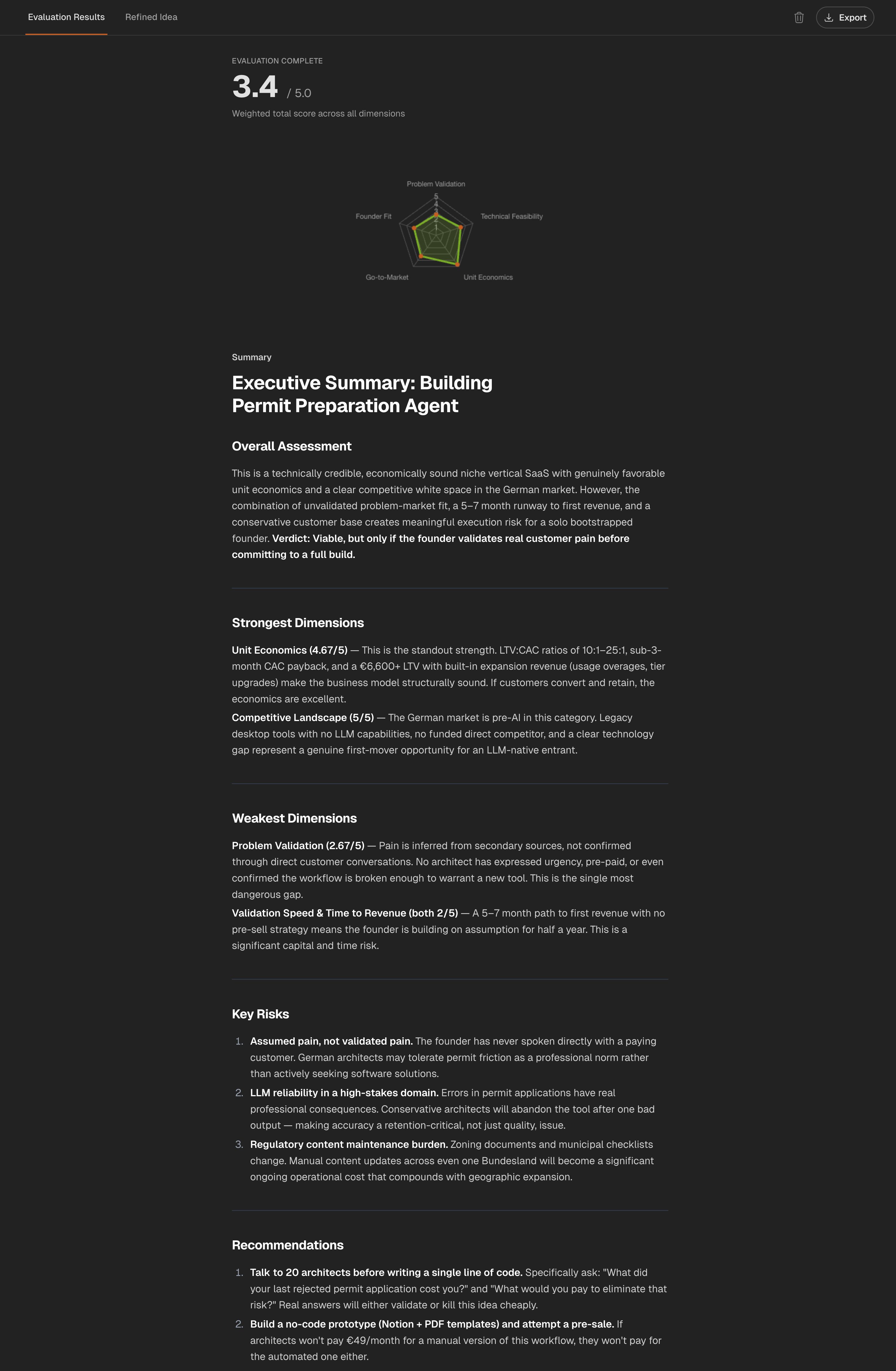
Scores should change as better evidence arrives. That is a feature, not a flaw. A score from desk research should look different after five interviews, a pricing test, or a manual pilot. Genhone saves the refined idea, score, reasoning, and summary as an artifact so the founder can revisit the decision instead of losing the rationale inside a chat thread.
How to Interpret the Final Score
Genhone computes weighted dimension scores and a weighted total on a 1-5 scale. The total is useful because it compresses the overall picture. The dimension scores are usually more useful because they show what to do next.
| Weighted score | Label | Practical interpretation | Best next action |
|---|---|---|---|
| 4.0-5.0 | Strong Opportunity | The idea is coherent across demand, feasibility, economics, GTM, and founder fit. | Run the next smallest buyer-evidence test or tightly scoped MVP. |
| 3.0-3.99 | Promising | The idea has real potential but one or more dimensions need sharper evidence or narrowing. | Fix the weakest dimension before building. |
| 2.0-2.99 | Needs Work | The idea has significant risk or vague assumptions. | Narrow the buyer, problem, pricing, channel, or MVP boundary and rescore. |
| Below 2.0 | High Risk | The current thesis is weak for a solo SaaS build. | Kill, archive the learning, or restart from a stronger problem. |
A high score should usually justify the next validation step, not a full product build. A middling score should identify which dimension to narrow. A low score should trigger a serious when to kill a startup idea decision instead of another build sprint.
If monetization is the weak area, do not compensate by adding features. Step back and validate SaaS pricing before launch. If buyer clarity is weak, fix that before writing code. If distribution is weak, choose a narrower reachable buyer or a different channel hypothesis.
CTA: Turn a rough SaaS idea into a scored, comparable artifact with Genhone.
Example: Compare Three SaaS Ideas With the Same Rubric
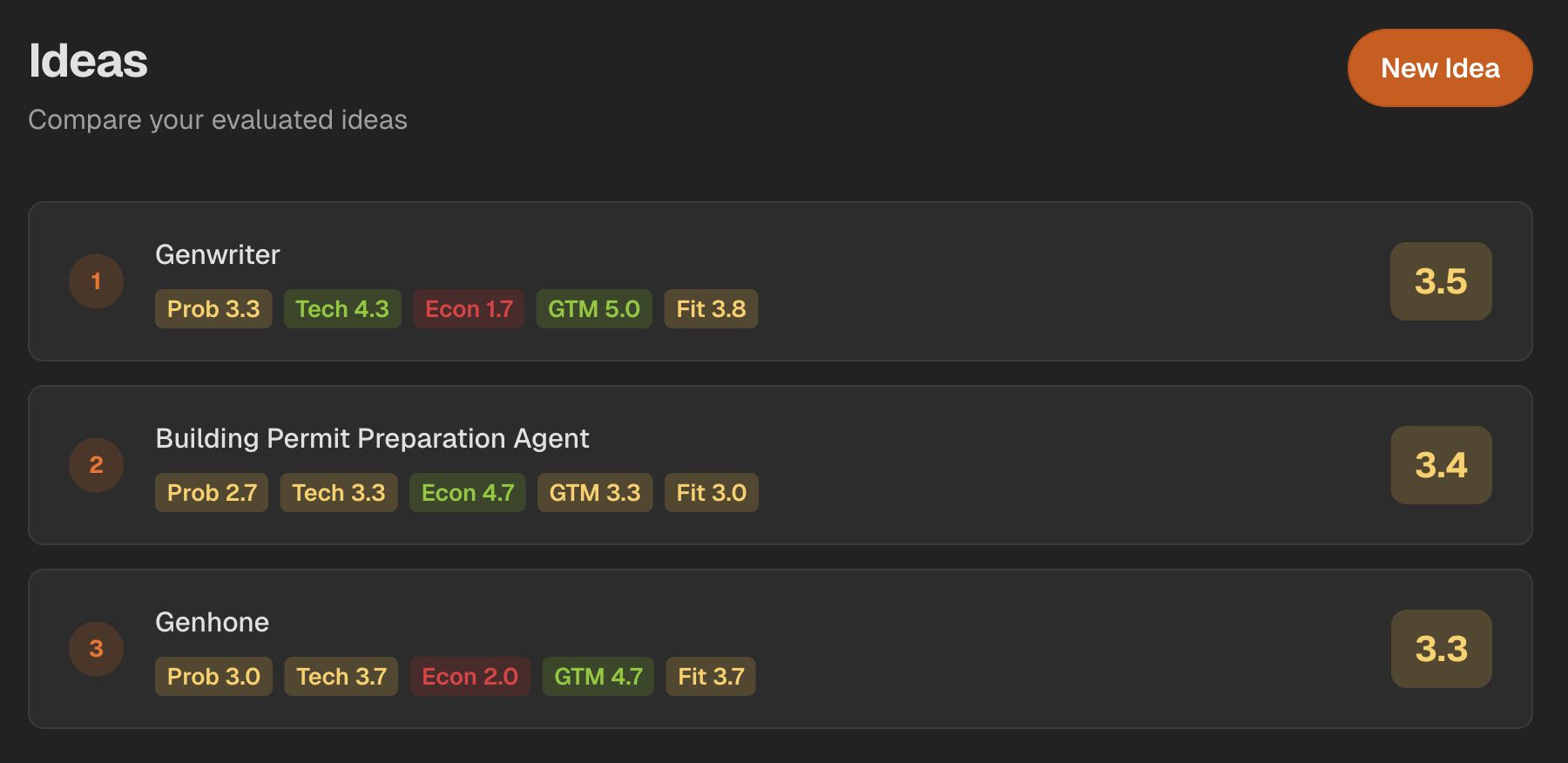
The example below is fictional. It shows how the same scoring rubric can make idea comparison less dependent on whichever idea feels most exciting this week.
| Fictional idea | Problem Validation | Technical Feasibility | Unit Economics | Go-to-Market | Founder Fit | Total label | Decision |
|---|---|---|---|---|---|---|---|
| Building permit follow-up assistant | 4.0 / 5 | 3.1 / 5 | 3.2 / 5 | 2.8 / 5 | 3.6 / 5 | Promising | Narrow the first buyer and channel before building. |
| Shopify retention audit tool | 3.8 / 5 | 4.2 / 5 | 3.7 / 5 | 3.4 / 5 | 4.0 / 5 | Promising | Run buyer interviews and a pricing test for one store segment. |
| AI meeting notes for all teams | 2.3 / 5 | 3.9 / 5 | 2.1 / 5 | 1.8 / 5 | 2.9 / 5 | Needs Work | Kill or restart with a narrower buyer and sharper wedge. |
The "AI meeting notes for all teams" idea may feel exciting because it is familiar and easy to prototype. The rubric exposes a different picture: broad buyer, crowded alternatives, weak wedge, and unclear go-to-market. The Shopify retention audit tool is less glamorous, but it has a clearer buyer, tighter workflow, and better founder fit in this fictional comparison.
Side-by-side comparison reduces "whichever idea I thought of last" bias. It also stops you from comparing a fully refined idea against a vague idea that still benefits from imagination.
Spreadsheet, ChatGPT, or SaaS Idea Scoring Tool?
You can score SaaS ideas with several tools. The right choice depends on how much structure, memory, and comparison you need.
| Option | Good for | Weakness |
|---|---|---|
| Spreadsheet | Founders who already have a clear rubric and will maintain it across ideas. | Easy to change criteria, weights, or evidence standards without noticing. |
| ChatGPT or Claude | Brainstorming criteria, pressure-testing assumptions, and drafting interview questions. | Prompts, scale, memory, and evidence can vary from idea to idea. |
| One-shot AI validator | Fast feedback on a rough idea. | Vulnerable to vague inputs and opaque score logic. |
| Genhone | Guided refinement, consistent criteria, founder-fit conversation, saved artifacts, and side-by-side comparison. | Best when the founder wants a structured pre-build workflow, not just a quick opinion. |
A spreadsheet can work if you are disciplined. ChatGPT and Claude can help you think, but ChatGPT startup idea validation becomes weak when the prompt changes each time. One-shot validators can be useful for a first reaction, but they often start scoring before the idea is structured.
A product-backed workflow is most useful when you want repeatability. The SaaS idea validation tool page explains how Genhone turns refinement, scoring, founder-fit input, and comparison into one workflow.
What to Do After You Score the Idea
The score should point to the next evidence step. It should not turn into a broad roadmap, feature plan, or build brief.
If buyer clarity is weak, define the ICP for a SaaS idea before changing features. A sharper buyer often fixes more than another product concept.
If pain or alternatives are weak, run interviews or review mining. Look for repeated complaints, existing workarounds, and budget ownership. The SaaS competitor analysis before MVP guide can help you separate real demand signals from crowded-market anxiety.
If monetization is weak, validate SaaS pricing before launch. Ask what people spend now, what the workflow costs them, and whether a paid pilot would be credible. Do not treat compliments as payment evidence.
If go-to-market is weak, choose a narrower reachable buyer or a different channel hypothesis. A good idea with no reachable first users is still not ready for a solo build cycle.
If founder fit is weak, reduce scope, choose a better wedge, or stop. Solo-founder constraints are not motivational trivia. They change the real quality of the idea.
If the score is high, move to the smallest validation or MVP test that can change your mind. Y Combinator's startup advice emphasizes talking to users, and Paul Graham's "Do Things That Don't Scale" is a useful reminder that early learning often requires manual work before systems. Use the SaaS idea validation checklist to decide which assumption deserves the next test.
How Genhone Applies This Framework
Genhone applies this framework as a structured pre-build workflow for solo founders.
First, it guides the founder through 12 refinement sections so the idea becomes a consistent snapshot. Then it evaluates the idea across 18 criteria in 5 weighted dimensions. Thirteen criteria are automated, including research-assisted checks where market context matters. Five criteria come from a founder conversation because the written idea alone cannot reliably infer urgency, willingness to pay, skill match, personal interest, or operational support load.
The result is saved as an artifact with scores, reasoning, and a summary. Founders can compare saved ideas side by side in the dashboard instead of starting over in a new chat thread every time.
Genhone is a SaaS idea validation tool for solo founders, but the point of this article is the framework behind the decision. The product helps apply it consistently.
CTA: Turn a rough SaaS idea into a scored, comparable artifact with Genhone.
FAQ
What criteria should I use to score a SaaS idea?
Use five dimensions: Problem Validation & Market Demand, Technical Feasibility & Build Speed, Unit Economics & Monetization, Go-to-Market Accessibility, and Founder Fit & Sustainability.
Inside those dimensions, score 18 criteria: Problem Criticality, Market Size, Willingness to Pay, Time to MVP, Technical Complexity, Technical Skill Match, CAC Expectations, Expected Churn, LTV Potential, Channel Accessibility, Organic Discovery, Sales Cycle Complexity, Competitive Landscape, Personal Interest, Resource Requirements, Operational Complexity, Validation Speed, and Time to Revenue.
What is a good SaaS idea score?
In Genhone, 4.0-5.0 is Strong Opportunity, 3.0-3.99 is Promising, 2.0-2.99 is Needs Work, and below 2.0 is High Risk.
A good score does not prove the idea will work. It means the current thesis is coherent enough to justify the next evidence-gathering step or a tightly scoped MVP test.
Should founder fit affect the final score?
Yes. For solo founders, founder fit can determine whether an idea is actually worth pursuing. Skill match, interest, support load, operational complexity, resource constraints, and time to revenue all affect execution quality.
A theoretically attractive SaaS idea can still be a poor choice if the founder lacks access, stamina, technical fit, or a realistic way to support it alone.
Can AI scoring replace customer discovery?
No. AI can structure the idea, score assumptions, surface risks, and suggest evidence gaps. It cannot prove buyer pain, budget, switching behavior, or willingness to pay without real-world evidence.
Use AI scoring to decide what to test next. Then collect evidence from interviews, current workflows, pricing conversations, competitor reviews, manual pilots, or buyer behavior.
How do I compare multiple SaaS ideas?
Use the same structured input and scoring rubric for every idea. Then compare the dimension scores, weakest assumptions, and next evidence steps.
Avoid comparing one detailed idea against one vague idea. The vague idea will usually look better because it still contains all of your imagined future fixes.
Should I use a spreadsheet, ChatGPT, or a scoring tool?
Use a spreadsheet if you already have a stable rubric and will maintain it. Use ChatGPT or Claude for brainstorming and assumption pressure-testing. Use a scoring tool when you want guided refinement, consistent criteria, founder-fit input, saved artifacts, and side-by-side comparison.
For the product-backed workflow, see Genhone's SaaS idea validation tool.