SaaS Idea Validation Tool for Solo Founders
Genhone helps solo founders refine and evaluate SaaS ideas before they build. Start with a rough concept, work through 12 guided refinement sections, score the idea across 18 criteria with research-backed checks where relevant, add founder-fit input through conversation, and compare saved ideas side by side.
Before you open Cursor, Lovable, Bolt, Claude Code, v0, or another AI coding tool, use Genhone to decide whether the idea deserves the next build cycle.
Primary CTA: Start 14-day free trial Secondary CTA: See how scoring works
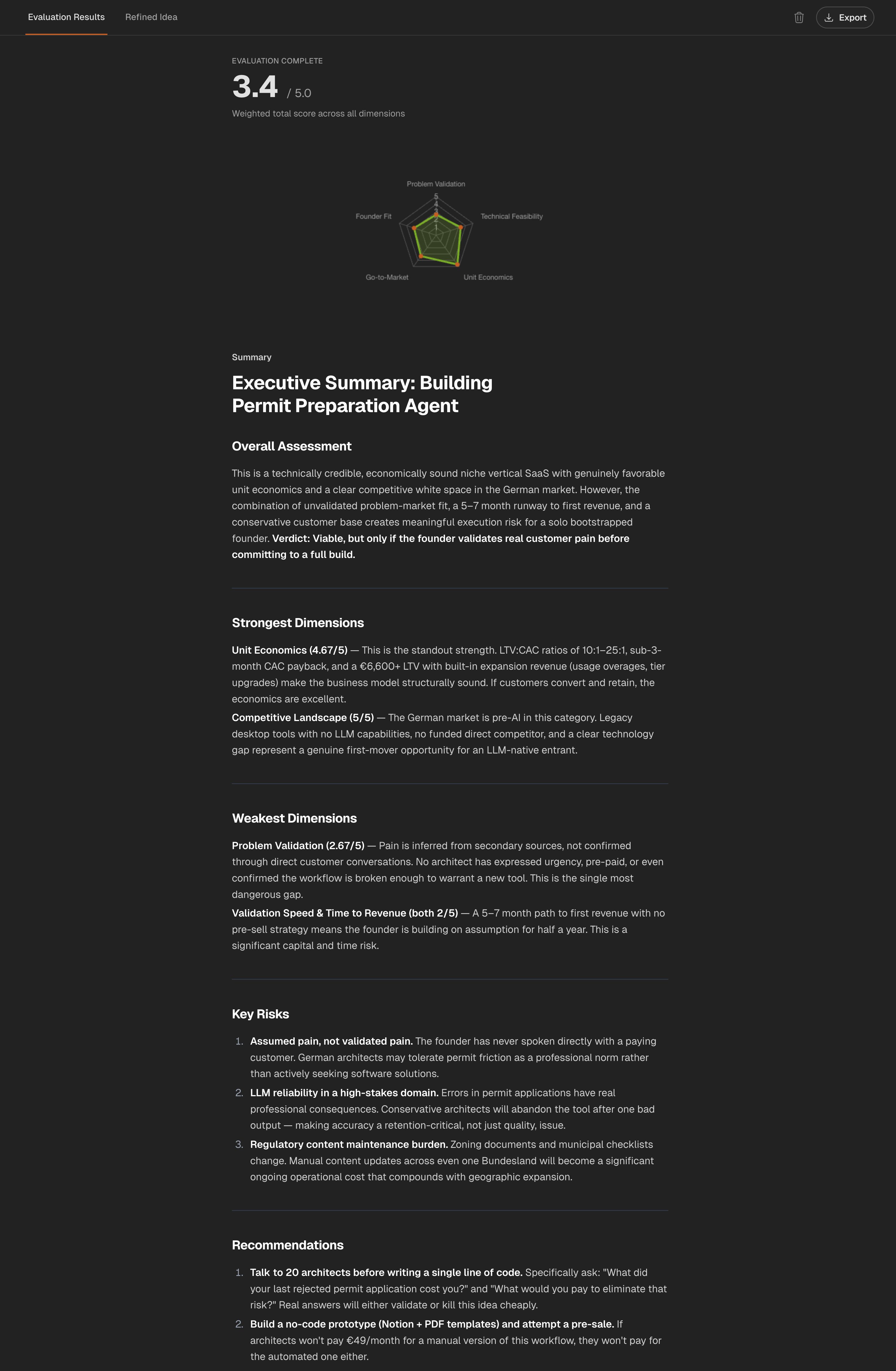
A SaaS idea validation tool helps founders check whether a software idea has a specific buyer, painful problem, viable pricing, reachable distribution, realistic MVP scope, and founder fit before building. Genhone adds guided 12-section refinement, hybrid 18-criterion scoring with research-backed checks where relevant, and saved idea comparison.
Validate the SaaS Idea Before the Build Cycle Starts
Modern builders can ship faster than they can validate. That speed is useful, but it also makes it easier to spend weeks on a product before the buyer, pricing, channel, and scope are clear.
Genhone is built for technically capable solo founders, indie hackers, and AI-assisted builders with more ideas than evidence. It gives you a structured way to validate a SaaS idea before building, then decide whether to build, narrow, compare, or stop.
If you are trying to validate before you build with AI, the job is not to generate more features. The job is to expose the riskiest assumptions while the idea is still cheap to change.
| Before Genhone | After Genhone |
|---|---|
| A loose idea in a doc, chat thread, or notes app. | A structured idea snapshot with the same sections for every idea. |
| A confident AI answer based on fuzzy input. | A score with criteria-level reasoning, research-backed checks where relevant, and visible gaps. |
| Comparing ideas by excitement. | Comparing saved artifacts against the same framework. |
How Genhone Works
flowchart LR
    A["Rough SaaS idea"] --> B["12-section guided refinement"]
    B --> C["Hybrid scoring"]
    C --> D1["8 direct automated criteria"]
    C --> D2["5 research-backed automated criteria"]
    C --> D3["5 founder-conversation criteria"]
    D1 --> E["Saved validation artifact"]
    D2 --> E
    D3 --> E
    E --> F["Side-by-side idea comparison"]
    F --> G["Build, narrow, test, or stop"]
1. Start With a Rough SaaS Idea
Describe your SaaS idea in plain language. You do not need a spreadsheet, business-plan template, or polished pitch.
Genhone treats the rough idea as a starting point, not as enough evidence for an instant verdict. The first job is to make the idea specific enough to evaluate.
2. Refine It Through 12 Guided Sections
Genhone guides the idea through 12 sequential sections:
Idea Essence, Problem Definition, Solution Mechanics, Customer Definition, Value Proposition, Business Model, Technical Foundation, Go-to-Market, Onboarding & Activation, Key Metrics, Scope & Boundaries, and Solo Founder Execution.
The point is constraint. Each section forces a different part of the idea into the open, so the output becomes a complete idea snapshot rather than loose chat notes.
3. Score the Idea Across 18 Criteria
After refinement, Genhone evaluates the idea across five weighted dimensions:
Problem Validation & Market Demand at 30%, Technical Feasibility & Build Speed at 25%, Unit Economics & Monetization at 20%, Go-to-Market Accessibility at 15%, and Founder Fit & Sustainability at 10%.
Scores include reasoning, not only a number. Where a criterion depends on external market context, Genhone adds research before scoring instead of relying only on the refined idea text. The score is decision support. It helps you see which assumptions look strong, weak, or unproven before you spend time building.
4. Add Founder-Fit Through Conversation
Not every criterion should be inferred from written idea notes. Genhone uses founder conversation input for five criteria: Problem Criticality, Willingness to Pay, Technical Skill Match, Personal Interest, and Operational Complexity.
These founder-conversation criteria overlap with founder fit, but they are not identical to the Founder Fit & Sustainability dimension. Some founder input affects market demand, technical feasibility, and execution risk too.
5. Compare Saved Idea Artifacts
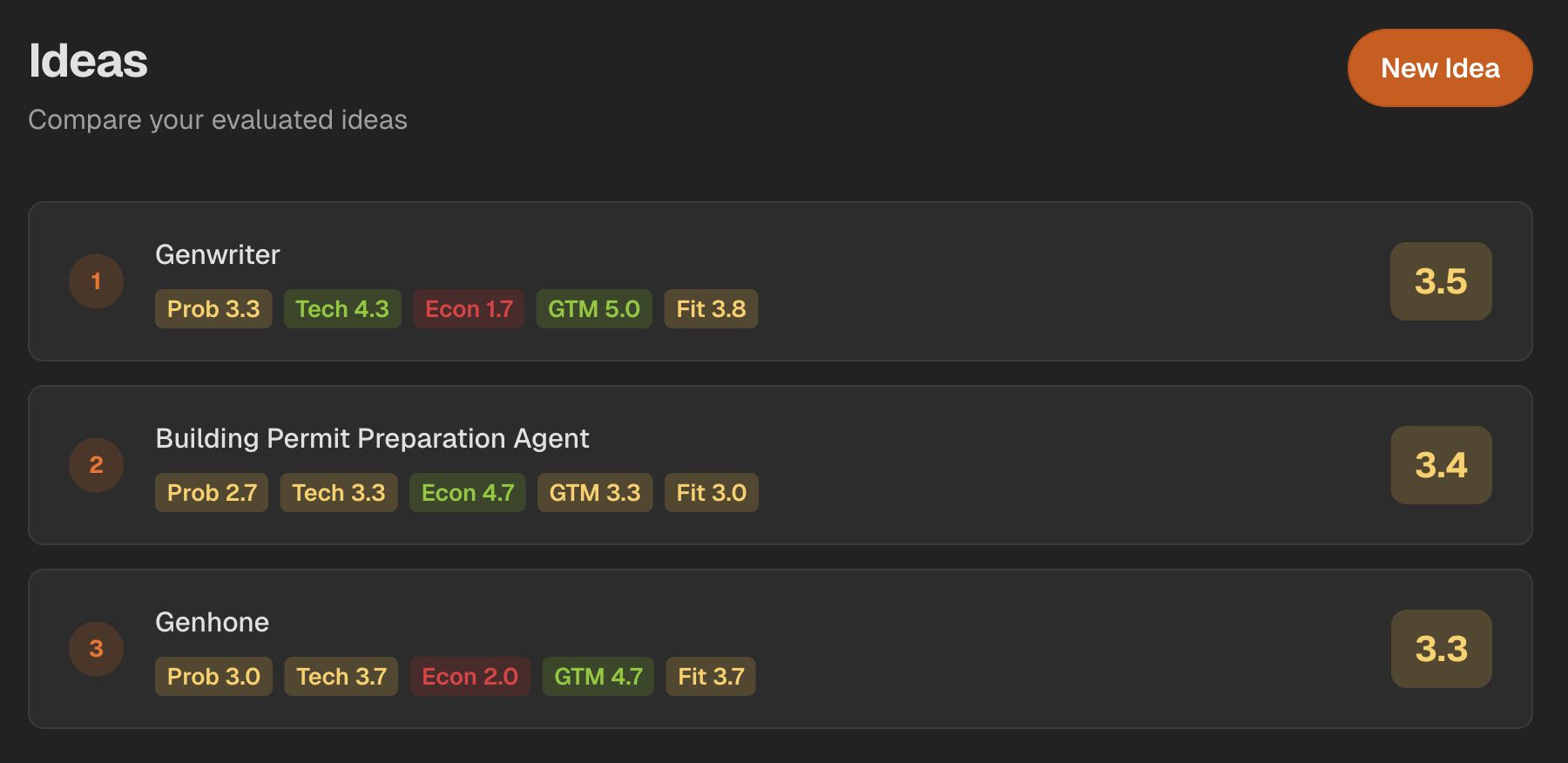
Each refined idea, scoring rationale, relevant research findings, dimension scores, and summary is saved as a persistent artifact. That matters when you have several plausible ideas.
Instead of exporting isolated PDFs or keeping disposable prompt outputs, Genhone lets you compare multiple SaaS ideas through the same framework.
What the SaaS Idea Validation Tool Checks
SaaS validation is not just market size. A large market does not help if the buyer pain is weak, the first channel is unreachable, the MVP is too broad, or the founder is poorly matched to the work.
Genhone checks the idea across 18 criteria so a strong signal in one area can be weighed against risk in another.
| Dimension | Criteria | What Genhone checks |
|---|---|---|
| Problem Validation & Market Demand | Problem Criticality, Market Size, Willingness to Pay | Is there a painful, repeated problem for a reachable buyer who may pay? |
| Technical Feasibility & Build Speed | Time to MVP, Technical Complexity, Technical Skill Match | Can a solo founder build and maintain the first version quickly enough? |
| Unit Economics & Monetization | CAC Expectations, Expected Churn, LTV Potential | Could the idea become a viable subscription business without VC-style spend? |
| Go-to-Market Accessibility | Channel Accessibility, Organic Discovery, Sales Cycle Complexity | Can the founder reach early buyers without a sales team or large ad budget? |
| Founder Fit & Sustainability | Competitive Landscape, Personal Interest, Resource Requirements, Operational Complexity, Validation Speed, Time to Revenue | Does the idea fit the founder's constraints, motivation, and execution path? |
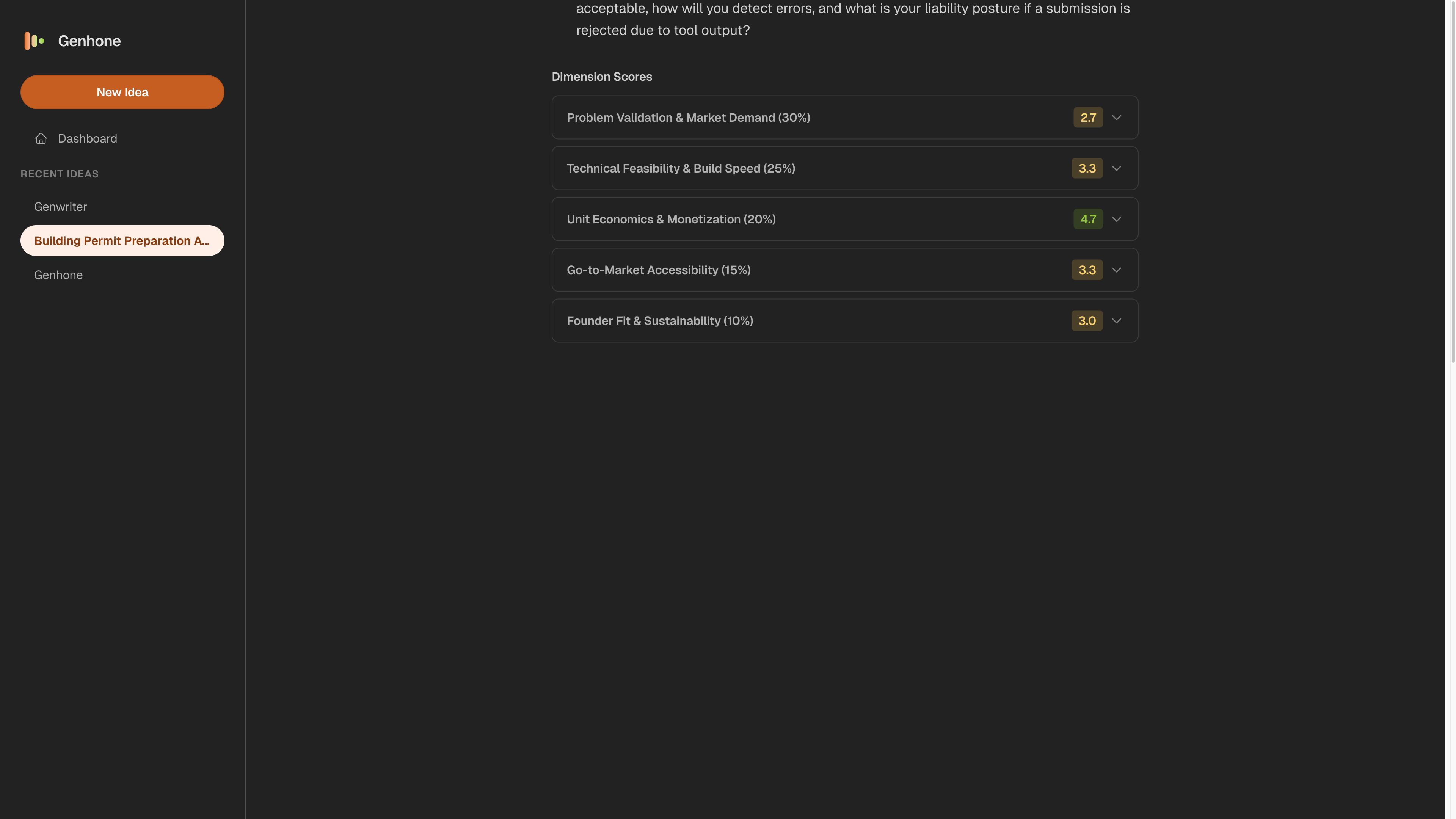
Methodology note: Genhone uses a 12-section refinement framework before scoring. The evaluation combines 8 direct automated criteria, 5 research-backed automated criteria, and 5 founder-conversation criteria, then saves the result as a comparable idea artifact.
Why Genhone Is Different From One-Shot AI Validators
The difference is not that Genhone uses AI. The difference is the workflow before and after the score.
A prompt can be useful for brainstorming. A fast validator can give first-pass feedback. A landing page can collect behavioral demand signals. But each approach breaks down if the idea going in is vague.
Genhone's core advantage is structured refinement before the score.
| Approach | What it is good for | Limitation | Genhone difference |
|---|---|---|---|
| ChatGPT or Claude prompt | Brainstorming, assumption mapping, interview questions | Unstructured, no persistent scoring, easy to accept confident guesses | Enforced sections, saved artifacts, comparable outputs |
| One-shot AI idea validator | Fast first-pass feedback | Scores fuzzy inputs and may overstate certainty | Refinement before scoring and transparent next assumptions |
| Landing-page validation tool | Behavioral demand signal from traffic | Requires offer, audience, and positioning before it can test well | Genhone prepares the idea, ICP, pricing, and scope before experiments |
| Generic startup validator | Broad startup report | Often not calibrated for solo SaaS constraints | SaaS-specific and bootstrapped-founder weighted dimensions |
If you are currently using ad hoc AI chat, read why ChatGPT prompts are not a validation process.
See the Artifact You Get Before You Build
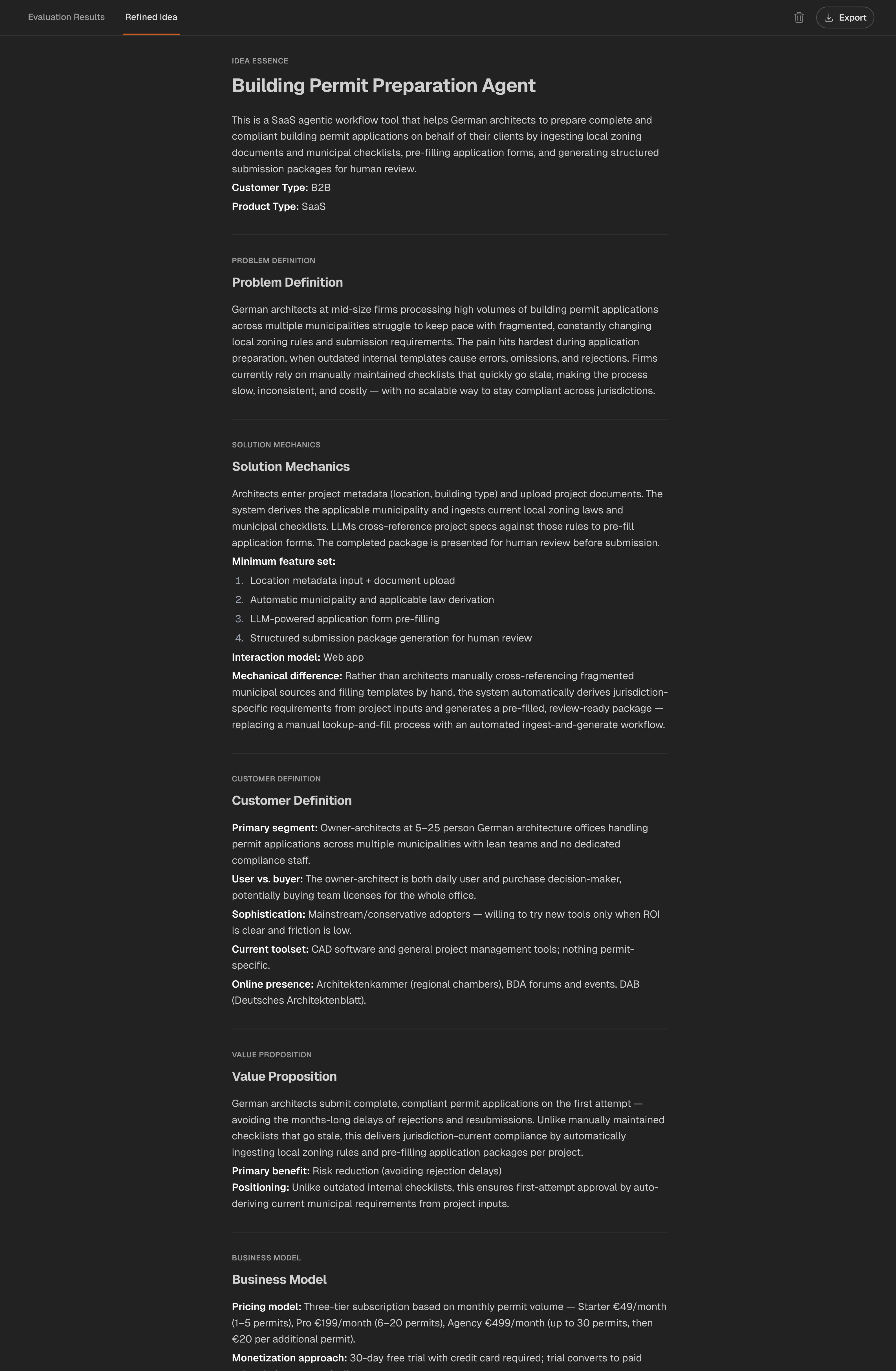
Genhone gives you an artifact you can return to after the session ends.
The artifact includes the refined idea snapshot, dimension score breakdown, criteria-level reasoning, research-backed findings where relevant, summary recommendation, and gaps or assumptions to validate with buyers. It is saved in the dashboard so you can compare it with other ideas later.
From Score to Real Validation Evidence
Genhone does not replace customer interviews, pricing tests, waitlists, preorders, usage data, or actual buyer behavior.
It reduces uncertainty by showing what to test next. A score should help you prioritize the next evidence collection step, not pretend the work is finished.
| If the score shows... | Next validation action |
|---|---|
| Weak buyer definition | Define the ICP and build an interview list. |
| Weak willingness to pay | Run pricing conversations or a paid manual pilot. See how to validate SaaS pricing before launch. |
| Weak channel accessibility | Write a first-20-users plan before building. |
| Weak technical feasibility | Narrow the MVP scope before implementation. |
| Weak competitive or differentiation risk | Run SaaS competitor analysis before MVP. |
| Weak founder fit | Choose another idea, reduce operational burden, or use a kill, narrow, or keep decision. |
Built for Solo Founders Choosing Between SaaS Ideas
Best Fit
Genhone is a good fit for solo founders, indie hackers, and builders using Cursor, Lovable, Bolt, Claude Code, v0, or similar tools.
It is especially useful when you have multiple SaaS ideas and need a consistent comparison process before implementation. If you are in that mode, the questions before vibe coding an app and vibe coding startup validation guides can help you prepare the raw inputs.
Not a Fit
Genhone is not an MVP builder, code generator, or VC-scale business-plan generator.
It is also not for founders who want AI to guarantee demand. If you only need generic startup brainstorming, a chat prompt may be enough. Genhone is for structured strategic clarity before implementation.
Pricing and Trial
Start with a 14-day free trial. The subscribe flow says: "No charge today. Cancel anytime."
Pricing is based on how many ideas you want to refine and compare.
| Plan | Monthly | Annual | Ideas/month | Included |
|---|---|---|---|---|
| Genhone Starter | EUR 19/month | EUR 180/year | 3 | AI-powered refinement & evaluation, 18-criteria scoring with market research |
| Genhone Pro | EUR 49/month | EUR 468/year | 10 | AI-powered refinement & evaluation, 18-criteria scoring with market research, PDF export |
Annual billing copy: Save 21%. Starter does not include PDF export. Pro includes PDF export.
CTA: Start 14-day free trial →
Questions Founders Ask Before Using a SaaS Idea Validation Tool
Can an AI tool validate my SaaS idea?
AI can structure assumptions, score risk, and identify gaps. It cannot prove demand without buyer behavior. Use Genhone before interviews, pricing tests, and build decisions so you know what evidence to collect first.
How is Genhone different from ChatGPT?
ChatGPT is open-ended. Genhone enforces a 12-section refinement framework, scores 18 criteria, saves the artifact, and lets you compare ideas using the same structure.
What does Genhone score?
Genhone scores five weighted dimensions: market demand, technical feasibility, unit economics, go-to-market accessibility, and founder fit. Some criteria are scored directly from the refined idea, some use external research where market evidence matters, and five use founder-conversation input. The full criteria table is in the scoring section above.
Does Genhone replace customer interviews or landing pages?
No. It helps you decide what to test, what questions to ask, and which idea deserves the next experiment. Interviews and landing pages still matter.
Can I compare multiple SaaS ideas?
Yes. Genhone saves refined ideas and evaluation artifacts so you can compare multiple ideas through the same framework.
Is Genhone only for AI SaaS ideas?
No. Genhone is for SaaS ideas generally. AI SaaS ideas can use the same validation workflow, then apply extra AI-specific checks from the AI SaaS idea validation checklist.
Does Genhone build the MVP?
No. Genhone is a strategy and validation tool before implementation. It helps you choose what deserves to be built.
Choose the Idea Worth Building
You do not need another build sprint before you know what the idea is, where the risk sits, and how it compares to your other options.
Use Genhone to refine, score, and compare SaaS ideas before the next build cycle starts.
Primary CTA: Start 14-day free trial Secondary CTA: Read the SaaS idea validation checklist