How to Validate SaaS Pricing Before Launch
A pricing evidence ladder for founders before they build the wrong plan, package, or product.
To validate SaaS pricing before launch, define one target buyer, identify what they use or spend today, connect the price to a measurable pain or outcome, test the pricing model and package before the exact number, then look for payment-related behavior such as a paid pilot, preorder, fake-door checkout, or serious sales conversation. Treat compliments, waitlists, and survey interest as weak evidence until a qualified buyer takes a payment-related action.
If you need to validate SaaS pricing before launch, do not start by asking strangers whether $49 per month sounds fair. Start by proving that one buyer has a painful workflow, a current alternative, and enough trust to make a payment-related decision. A price that sounds reasonable is still unvalidated until the right buyer compares, chooses, or pays.
What SaaS Pricing Validation Means Before Launch
SaaS pricing validation tests whether the proposed value exchange makes sense before a full launch. For a pre-launch founder, it reduces uncertainty around the buyer, value, package, pricing model, and price range.
Pricing includes buyer, budget owner, value metric, package, activation model, billing period, upgrade trigger, first price range, and comparison alternative.
Mature SaaS pricing validation asks whether a pricing system will perform in-market. Pre-launch SaaS pricing validation asks whether a specific buyer has enough pain, budget, and trust to support a first price hypothesis.
A mature company may need pricing research, sales enablement, billing changes, and migration planning. A founder with only an idea needs a narrower answer: build, narrow, retest, or stop. For the broader business case, validate a SaaS idea before building.
Do Not Start by Asking "Would You Pay $X?"
Direct willingness-to-pay questions are weak because people answer politely or without buying context. A buyer compares price against alternatives, urgency, risk, ROI, trust, switching cost, budget, and approval path.
Paddle's willingness-to-pay guide defines WTP as a maximum price, but notes that it varies by context, customer, demographics, and time. Pace Pricing's willingness-to-pay glossary adds that B2B SaaS WTP depends on segment, use case, and alternatives.
That is why "yes, I would pay" is weaker than behavior. Checkout intent, procurement questions, paid pilot approval, or comparison to current spend is stronger than a compliment. "Too expensive" can mean the buyer is wrong, package is confusing, metric feels punitive, pain is not urgent, or message is unclear.
| Weak question | Better prompt | Signal to listen for |
|---|---|---|
| Would you pay $49/month? | What do you use today, and what does it cost? | Existing spend, manual work, or business pain. |
| Is this price fair? | What would you compare this against internally? | Competitors, employee time, agencies, lost revenue, or budget category. |
| Which plan do you like? | Which package fits your workflow, and why not the others? | Segment fit, feature fences, usage volume, and confusion. |
| Would your company buy this? | Who would approve it, and what would they need to believe? | Budget owner, procurement path, trust barriers, and proof needs. |
| Is this too expensive? | When would this become hard to justify? | Value ceiling, ROI logic, and price sensitivity. |
The SaaS Pricing Validation Ladder
Use the ladder in sequence. Do not test exact price points before buyer, pain, alternative, model, and package are coherent. Weak evidence usually means narrow, repackage, simplify the metric, or run a stronger test.
| Step | What to validate | Best pre-launch test | Strong signal | Weak signal | Decision if weak |
|---|---|---|---|---|---|
| 1. Buyer | One buyer or budget owner. | ICP interviews and prospect review. | 20 reachable buyers own or influence spend. | "Small businesses" or "SaaS founders." | Narrow the ICP. |
| 2. Pain value | Pain ties to money, time, risk, revenue, or retention. | Last-time story interviews. | Recent painful events with business cost. | Interesting, but no concrete event. | Retest the problem. |
| 3. Current alternative | Buyer pays, works around, or absorbs a known cost. | Alternative audit. | Software, spreadsheet labor, agency spend, time, or lost revenue is visible. | No workaround or consequence. | Reframe value or stop. |
| 4. Value metric | Pricing model maps to value growth. | Metric pushback interview. | Buyer understands it and sees it as fair. | Confusing, punitive, or gameable. | Change the metric. |
| 5. Package | First package has the right promise and boundaries. | Show package without price. | Buyer chooses a package and explains why. | Buyer wants pieces from every tier. | Fix packaging. |
| 6. Price range | Range is plausible against value and alternatives. | Staged interview or threshold questions. | Medium pushback and comparison anchors. | Instant acceptance or disengaged rejection. | Change range or value story. |
| 7. Payment behavior | Buyer takes payment-related action. | Paid pilot, preorder, fake-door checkout, or sales test. | Payment, checkout, procurement questions, or paid pilot. | Waitlist, compliment, or "keep me posted." | Do not call it validated. |
| 8. Launch decision | Pricing supports a focused MVP. | Build/narrow/stop review. | Buyer, value, package, range, and behavior align. | Price requires broader scope or different buyer. | Narrow scope or choose another idea. |
If price depends on enterprise trust, onboarding, integrations, or support, the MVP must reflect that.
Step 1: Anchor Pricing to One Buyer and One Painful Workflow
Pricing feedback is only meaningful from the intended buyer. Mixing freelancers, SMB operators, agencies, and enterprise teams creates noisy feedback because urgency, budgets, alternatives, and value ceilings differ.
Before testing price, write the buyer in a way that can produce names. "Shopify stores" is not enough; "solo Shopify operators with 300-2,000 monthly orders and no lifecycle marketer" is closer.
If the buyer is still fuzzy, define the ICP for a SaaS idea first. If you cannot name 20 reachable buyers who own or influence spend, pricing validation is premature.
Step 2: Identify Alternatives, Current Spend, and the Value Ceiling
Buyers compare price to the current alternative: SaaS tool, spreadsheet, labor, contractor, agency, script, marketplace service, or deliberate inaction. Current spend is stronger than stated interest. "No competitor" can mean overlooked market or weak willingness to pay.
| Current alternative | What it tells you | Pricing implication |
|---|---|---|
| Paid SaaS tool | Budget category exists. | Price against your gap, not the whole incumbent. |
| Spreadsheet or manual process | Pain may be real; software budget is unproven. | Test whether saved time or lower risk is worth paying for. |
| Agency or freelancer | Buyer pays for the outcome. | Price against the recurring piece SaaS can replace. |
| Internal employee time | Value may be high; budget ownership may be indirect. | Find who owns the cost. |
| Doing nothing | Pain may be low or switching costly. | Discover why they tolerate it. |
| Competitor with complaints | Demand exists and the wedge may be visible. | Price around the underserved workflow, segment, or support need. |
Step 3: Validate the Pricing Model Before the Price Point
Pricing model means how the customer is charged. The value metric should be understandable, value-aligned, hard to game, and operationally simple.
Willingness to Pay's SaaS pricing validation guide recommends showing pricing progressively: packaging first, pricing model second, and price points last. If a buyer rejects "$10 per user per month," you need to know which part failed.
| Model | Best fit | Founder risk |
|---|---|---|
| Flat monthly price | Solo-buyer tools with one clear workflow. | Undercharges heavy users. |
| Tiered packages | Usage, sophistication, or feature needs grow. | Fences become arbitrary. |
| Per seat | Team collaboration products. | Discourages adoption if value needs broad usage. |
| Usage based | Infrastructure, AI, data, credits, or processing-heavy tools. | Buyers fear unpredictable bills. |
| Volume based | Ecommerce, content, operations, or workflow-volume products. | Metric must be clear and hard to dispute. |
| Outcome linked | Revenue, savings, or recovered value. | Attribution is hard and trust demands rise. |
| Hybrid | Mature products with multiple value drivers. | Too complex for many MVPs. |
Step 4: Test Packages Before Prices
A package is the promise and boundary the buyer reacts to. If it is confusing, price feedback is polluted. Show the outcome, packages without price, pricing model, then price range. Ask which package fits and why.
| What to show | What you learn | Stop condition |
|---|---|---|
| Problem and outcome | Whether the buyer recognizes value. | No pain or outcome recognition. |
| Packages and included outcomes | Whether the buyer can choose. | Buyer needs a custom mix from every tier. |
| Pricing model or value metric | Whether charging feels fair. | Buyer rejects the metric before price. |
| Price range or point | Whether the number is plausible. | Extreme rejection or no tradeoff. |
| Trial, pilot, or payment flow | Whether the path fits trust and urgency. | Buyer says it creates too much risk or effort. |
Step 5: Test Price Ranges With Behavior, Not Compliments
Use price-range tests to hear tradeoff logic, then ask for payment-related action.
Customer Interviews
Use interviews to discover anchors, budget ownership, package confusion, and price sensitivity. Interview one ICP at a time and reveal package and pricing progressively.
Useful prompts:
- What do you use today when this problem happens?
- What does that cost you in money, time, lost revenue, risk, or stress?
- Who would approve buying a tool for this?
- Which budget would it come from?
- What would this replace or reduce?
- What would make this impossible to justify?
- Which package would you choose today, and why not the others?
- What would have to be true for this to be worth paying for every month?
Pricing Surveys
Surveys can test price sensitivity once buyer and package are clear. Pace Pricing lists Van Westendorp, Gabor-Granger, and purchase simulations as common methods. Use survey output to inform a range, not create certainty.
Fake-Door Checkout or Pricing Page Tests
A fake-door checkout or pricing page test works with qualified traffic to one focused offer. Track views, plan selection, checkout clicks, and payment intent. If money is collected before the product exists, be transparent about delivery and refunds.
Paid Manual Pilots or Preorders
A paid manual pilot validates value before software. For low-ACV self-serve SaaS, a paid audit, setup, report, or concierge workflow can test whether the problem is worth money. Paul Graham's "Do Things that Don't Scale" argues that founders often need to recruit users manually; pricing validation can use the same logic. Preorders need clear delivery and refund terms.
Narrow Sales Test
A narrow sales test fits higher-ACV or sales-led SaaS. For solo founders, it can be direct outreach with a paid pilot offer. YC's startup advice emphasizes talking to users and iterating; pricing tests should force the same learning.
What Counts as Strong Pricing Evidence?
Strong evidence involves tradeoff, budget, or behavior. Medium evidence justifies the next test. Weak evidence shows what to investigate.
| Evidence strength | Examples | How to use it |
|---|---|---|
| Strong | Paid pilot, preorder, deposit, checkout attempt, procurement questions, signed paid beta, replacement of current spend. | Treat as real willingness-to-pay evidence; inspect delivery scope and retention risk. |
| Medium | Package selection, detailed pricing questions, current-spend comparison, high-intent waitlist after seeing price, budget-owner follow-up. | Refine packages and run a payment-related test. |
| Weak | Compliments, likes, generic waitlist signup, "I would use this," unqualified surveys, AI price suggestions. | Do not build from this alone. |
A red pricing signal may kill the segment, package, price point, or go-to-market motion rather than the whole idea. Use the SaaS idea validation checklist for the broader build, narrow, or stop decision.
Pricing Failure Diagnosis
When a pricing test fails, diagnose the layer that failed.
| Symptom | Likely issue | What to test next |
|---|---|---|
| Buyers like the idea but avoid payment. | Pain, budget, or value is weak. | Ask for last-time stories and current spend. |
| Buyers reject the model before price. | Value metric feels unfair or confusing. | Test a simpler metric. |
| Buyers cannot choose a package. | Fences do not map to segments or workflows. | Rebuild tiers around use case, volume, or sophistication. |
| Buyers say price is high but keep engaging. | Price may be near a useful threshold. | Ask what they compare it to and what proof they need. |
| Buyers say yes too easily. | Price may be too low or decision is not real. | Raise the range or ask for payment behavior. |
| Buyers ask for features outside the MVP. | Price implies a bigger promise. | Narrow the offer or change price/package. |
| Buyers want a free plan. | Value is unproven or trial proof is needed. | Test free trial, paid pilot, or smaller paid wedge. |
| Buyers compare it to cheap tools. | Positioning or category frame may be wrong. | Rework value story and alternatives. |
Common SaaS Pricing Validation Mistakes
Common mistakes: testing with the wrong audience; testing one price point as truth; asking "Would you pay?" before alternatives and budget; copying competitors without understanding segment and package differences; confusing waitlists with willingness to pay; pricing too low from discomfort; building freemium before knowing the upgrade trigger; putting all value in the lowest tier; testing price before package and metric clarity; and treating AI output as market evidence.
AI can suggest price ranges, summarize competitor pricing, and draft interview questions. It cannot prove willingness to pay. Treat AI pricing output as a hypothesis until a qualified buyer compares, chooses, or pays.
Worked Example: Pricing a Shopify Retention SaaS Before Launch
Hypothetical idea: a SaaS tool that helps solo Shopify operators find missed repeat-purchase opportunities and send simple retention actions without hiring a lifecycle marketer. The stronger version tests whether the buyer recognizes repeat-purchase pain and will pay for a manual audit before software exists.
| Pricing question | Weak answer | Stronger hypothesis | Test |
|---|---|---|---|
| Who pays? | Shopify stores. | Solo Shopify operators with 300-2,000 monthly orders and no lifecycle marketer. | List 20 operators and interview 8-10. |
| What value is created? | Better retention. | Recover missed repeat purchases. | Ask for last-month workflow and lost-revenue examples. |
| Current alternative? | Email tools. | Klaviyo templates, CSV checks, abandoned campaigns, or doing nothing. | Compare tools, manual effort, and complaints. |
| Value metric? | Per user. | Store order volume or retention opportunities reviewed. | Ask whether the metric feels fair. |
| First package? | Basic, Pro, Enterprise. | Starter audit, monthly alerts, and growth package. | Show packages without price. |
| Plausible range? | $29/month because cheap feels safe. | $49-$99/month; one-time $99 manual audit as pre-build test. | Run paid manual audit offer. |
| Payment behavior? | Waitlist signups. | Three paid audits, preorders, or checkout attempts. | Drive qualified traffic or outreach. |
| Stop condition? | Nothing. | Stop if operators do not know the problem, will not pay, or already solve it. | Write stop criteria before building. |
This example is not validated because the pricing looks plausible. It becomes stronger only if the same ICP shows repeated retention pain, understands the value metric, chooses a package, and takes a payment-related action such as buying a manual audit or entering checkout.
How Genhone Fits Into Pricing Validation
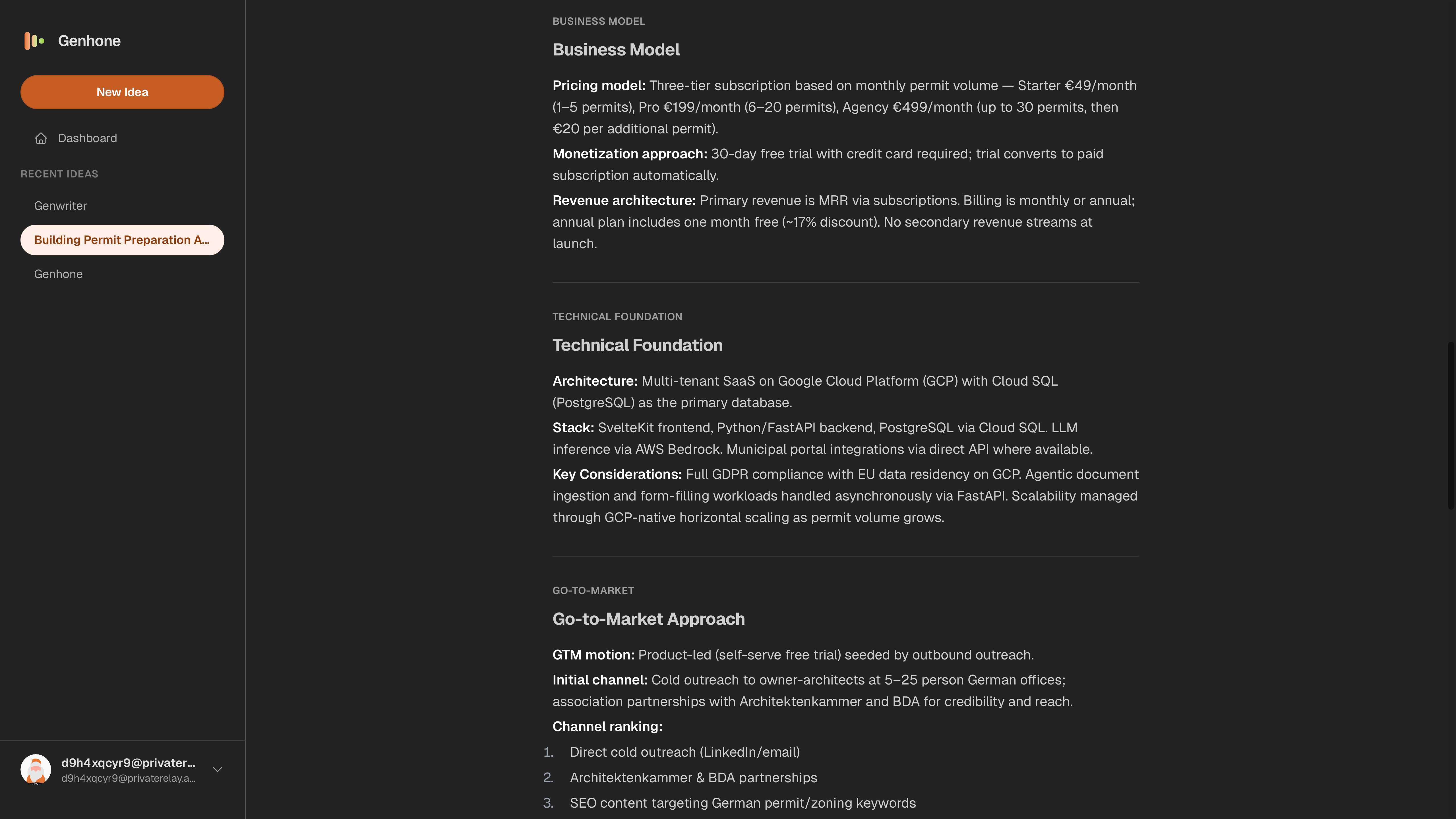
Genhone is not a magic pricing oracle. It helps founders structure the assumptions pricing depends on: Customer Definition, Problem Definition, Value Proposition, Business Model, Go-to-Market Approach, Key Metrics Framework, and Scope and Boundaries.
The Business Model section clarifies pricing model, tiers, price range, monetization approach, revenue architecture, billing structure, and secondary revenue. The evaluation workflow can surface pricing risks in a broader idea score, and saved artifacts make pricing logic easier to compare.
For AI-assisted founders, the pricing artifact should exist before the first build prompt or PRD. Use Genhone to refine the pricing assumptions behind a SaaS idea before turning them into product scope, landing page, or AI build prompt.
If you are using AI to move from idea to code, read how to validate your app idea before building with AI, then use a structured SaaS idea refinement workflow to save the pricing logic.
Refine the pricing logic behind your SaaS idea before you build.
FAQ
How do you validate SaaS pricing before launch?
Define one buyer, confirm the painful workflow, identify alternatives and spend, test the pricing model and package, then test a range with interviews, surveys, fake-door checkout, preorders, paid pilots, or a narrow sales test. Payment-related behavior beats compliments.
How many customers should I talk to before setting SaaS pricing?
For a narrow pre-launch ICP, five to ten focused buyer conversations can reveal useful patterns, especially hard objections. Use them to refine the price hypothesis, then run a payment-related test.
Should I ask customers what they would pay?
Do not rely on that question alone. Ask about alternatives, spend, value, budget ownership, and comparison anchors first. Direct answers are stronger when tied to a clear package and realistic purchase scenario.
What is the best SaaS pricing test before building?
The strongest pre-build test is usually a paid manual pilot, refundable preorder, or fake-door checkout shown to qualified buyers.
Should I copy competitor pricing?
Competitor pricing is useful context, but it should not set your price by itself. Your price depends on buyer, value metric, package, positioning, trust, support expectations, and alternatives.
How do I validate freemium versus free trial?
Test whether buyers understand the paid upgrade trigger. Freemium works when free usage creates a path to paid value. Free trial works when the buyer reaches value quickly. If the upgrade trigger is vague, validate pricing before adding a free plan.
How do I know if my SaaS price is too low?
Warning signs include buyers accepting without tradeoff, no qualified pushback, heavy users getting disproportionate value, or the price failing to support acquisition and support. Test a higher range before assuming cheap is safer.
Can AI validate SaaS pricing?
AI can summarize competitor pricing, suggest price ranges, generate interview prompts, and organize evidence. It cannot prove willingness to pay without real buyer behavior. Use AI output as a hypothesis, then test it with qualified buyers.