How to Evaluate a SaaS Idea Before Building
Technically capable solo founders and AI-assisted builders can start SaaS products faster than ever. Cursor, Claude Code, Lovable, Bolt, v0, ChatGPT, and Claude can make a weak idea feel productive because the prototype appears quickly. But buildability is not evidence.
This guide is about how to evaluate a SaaS idea before building. It is not about valuing an existing SaaS company, calculating ARR multiples, or choosing software to buy. It is the pre-build decision process for one idea: should you build a narrow test, narrow the idea, kill it, or gather better evidence first?
To evaluate a SaaS idea before building, first make the idea specific: buyer, problem, current alternatives, solution, pricing, distribution, MVP scope, and founder constraints. Then inspect the evidence behind the riskiest assumptions, score the idea across demand, feasibility, economics, go-to-market, and founder fit, and decide whether to build, narrow, kill, or gather better evidence.
If the idea is still fuzzy, use the separate guide to validate a SaaS idea before building before you score it. Evaluation works best after the rough hunch has become a structured idea snapshot.
What Evaluating a SaaS Idea Means Before Building
Evaluating a SaaS idea means judging the current idea against the evidence you have today. The output is not a motivational verdict. It is a decision about what to do next.
That distinction matters because founders often mix several nearby concepts:
| Term | Question it answers | Output | Related Genhone page |
|---|---|---|---|
| Evaluation | Is this structured SaaS idea worth the next build cycle, or should it be narrowed, killed, or tested further? | A decision based on current evidence and risk. | This article |
| Validation | What evidence supports or weakens the assumptions behind the idea? | Interviews, research, pricing signals, tests, and exposed assumptions. | Validation guide |
| Scoring | How does the idea perform against a consistent weighted model? | Dimension scores, criterion scores, reasoning, and score labels. | SaaS idea scoring framework |
| Scorecard | Where is the evaluated idea recorded for review or comparison? | A saved artifact with scores, reasoning, and next-action context. | Startup idea scorecard |
| SaaS valuation | What is an existing SaaS company or asset worth? | Company valuation, multiples, acquisition value, or investment analysis. | Not covered here |
Validation gathers evidence. Evaluation judges the current idea using that evidence. Scoring is one part of evaluation, but it is not the whole process. A scorecard records the result, but it is not the process itself.
This page also does not cover SaaS procurement. If you are comparing software tools to buy for your company, you are evaluating vendors. Here, the buyer, product, pricing, distribution, and founder constraints are still part of the idea itself.
Start With a Structured Idea Snapshot
A one-sentence idea is not enough to evaluate. "AI tool for agencies" can sound plausible, but it hides the actual questions: which agencies, what workflow, who pays, what they use today, what the first version does, how it reaches buyers, and whether one founder can support it.
Evaluation should start only after the founder can answer the major sections of the idea. The purpose is clarity before judgment. Without a consistent structure, you get fake precision: one idea receives a detailed buyer, pricing, and channel model while another is scored from a vague hunch that still benefits from imagination.
Before evaluating, the idea needs a named buyer, repeated problem, current workaround, solution mechanic, pricing logic, go-to-market path, MVP boundary, activation model, key metrics, and solo-founder constraints. If those pieces are missing, the next action is refinement, not evaluation. A SaaS idea validation checklist can help expose the assumptions before you judge them.
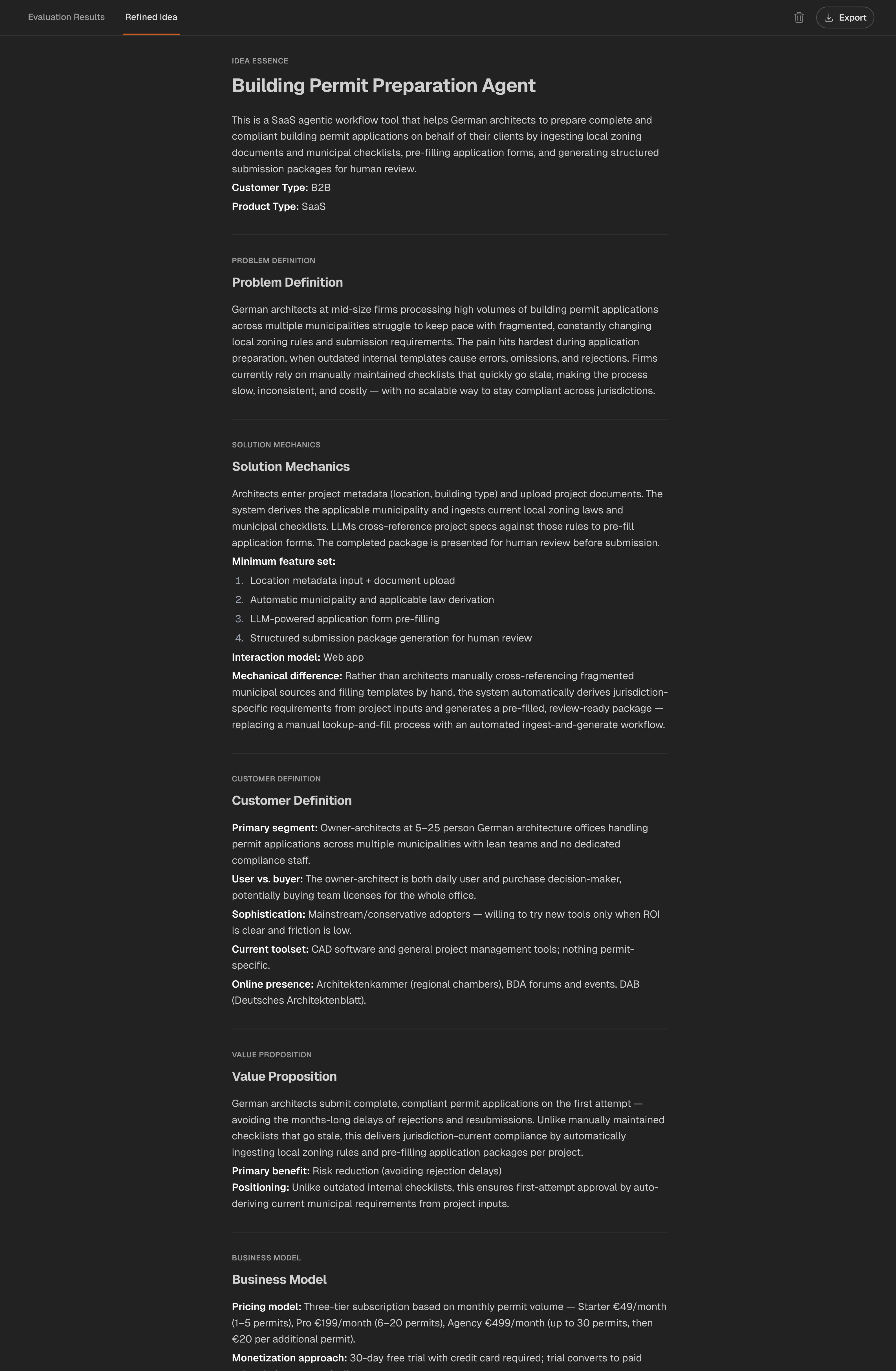
| Structured idea section | What it must make clear before evaluation |
|---|---|
| Idea Essence | What the software is, who it helps, and the outcome it promises. |
| Problem Definition | The specific recurring pain, trigger, context, and current workaround. |
| Solution Mechanics | What the product actually does and the minimum workflow it supports. |
| Customer Definition | The first buyer, user-buyer split, sophistication, tools, and online habitat. |
| Value Proposition | The concrete benefit and why the approach differs from alternatives. |
| Business Model | Pricing logic, activation model, billing structure, and revenue path. |
| Technical Foundation | Architecture direction, core stack, integrations, data, and security constraints. |
| Go-to-Market Approach | The first reachable channel and how buyers discover software like this. |
| Customer Onboarding & Activation | The path from signup to first value and the activation event. |
| Key Metrics Framework | The revenue, retention, efficiency, and usage signals that would matter. |
| Scope & Boundaries | What is in the first version, deferred, and intentionally out of scope. |
| Solo Founder Execution | Build capability, time to MVP, support capacity, operating load, and founder advantage. |
If the idea cannot survive this structure, do not score it yet. Narrow the buyer or workflow first.
The SaaS Idea Evaluation Workflow
Evaluate one idea in order: clarity, evidence, scoring, decision. Do not start by comparing multiple ideas. First, make this idea honest enough to judge on its own.
| Step | Question | Evidence to inspect | Output | Where Genhone supports it |
|---|---|---|---|---|
| 1. Define buyer and pain | Who has the problem, and when does it hurt? | Buyer language, recent incidents, repeated workflow cost. | Named first buyer and painful workflow. | 12-section refinement, especially Customer Definition and Problem Definition. |
| 2. Inspect alternatives | What do they use today, and why is it insufficient? | Tools, spreadsheets, agencies, scripts, manual work, doing nothing. | Alternative map and switching pressure. | Refinement plus criteria-level reasoning around competitive landscape. |
| 3. Check payment logic | Why would this become paid software? | Current spend, time cost, budget owner, paid workarounds, pricing resistance. | Willingness-to-pay risk assessment. | Founder-fit chat and monetization criteria. |
| 4. Estimate build and support | Can one founder ship and operate a narrow first version? | MVP scope, integrations, technical risk, data/security, support burden. | Feasibility and support-risk view. | Technical feasibility scoring and solo-founder constraints. |
| 5. Check distribution | How will the first qualified users find or hear about it? | Communities, search intent, founder network, outbound list, marketplace. | First-channel hypothesis. | Go-to-market refinement and GTM criteria. |
| 6. Add founder fit | Is this idea good for this founder? | Access, credibility, skills, interest, endurance, support capacity. | Founder-specific risk view. | Founder-fit chat for firsthand context. |
| 7. Score and decide | What is the next move? | Demand, feasibility, economics, GTM, founder fit, evidence quality. | Build, narrow, kill, or gather-evidence decision. | 18-criterion scoring, saved reasoning, and comparable artifact. |
1. Define the Buyer and Painful Workflow
Start with the first buyer, not a broad market. "Agencies" is not enough. "Two-to-ten-person B2B content agencies that manually reconcile client approvals across Google Docs, Slack, and email" is closer to something you can evaluate.
The buyer definition should include the repeated workflow and the trigger that makes the pain urgent. Strong evidence appears when the buyer can describe the problem in their own words, has a current workaround, and experiences repeated cost, delay, risk, or embarrassment.
Weak evidence looks like compliments, broad persona labels, or generic interest. If you cannot define the ICP for a SaaS idea, the evaluation should stop at buyer clarity before moving into scoring.
2. Inspect Alternatives and Switching Pressure
Every SaaS idea competes with something: software, spreadsheets, agencies, internal scripts, manual work, or doing nothing. Competition is not automatically bad. Existing alternatives can prove that buyers understand the category and spend effort or money on the problem.
No alternatives can be a warning sign. It may mean the market is undiscovered, but it may also mean the pain is weak, too rare, or not worth paying for.
Switching pressure requires a repeated gap. "Our UI will be better" is not enough. Look for a buyer who repeatedly fights the same limitation in current alternatives. A focused competitor analysis before MVP helps separate real switching pressure from founder preference.
3. Check Willingness to Pay and Business Logic
A SaaS idea needs payment logic before the build decision. The question is not "Would someone use this?" It is "What makes this worth another recurring subscription, and who owns that budget?"
Stronger signals include current spend, measurable time cost, paid workarounds, a clear budget owner, and specific pricing resistance from the right buyer. Weaker signals include "I'd use this," waitlist joins from an unclear audience, or enthusiasm from people who are not buyers.
Preorders and paid pilots can be useful, but they are not mandatory for every SaaS idea. The key is to inspect payment evidence honestly. If pricing is mostly hope, pause and validate SaaS pricing before treating interest as demand.
4. Estimate Build Scope and Support Burden
Evaluate whether the first version is narrow enough for one founder. AI coding tools can reduce implementation cost, but they do not remove operational complexity.
Look at time to MVP, technical complexity, required integrations, data and security risk, support burden, and whether the founder already knows the stack. A product can be technically possible and still too heavy for a solo pre-build bet.
If the first version needs multiple user roles, enterprise integrations, complex permissions, data migration, live collaboration, and high-touch onboarding, the problem may need a smaller wedge before it becomes evaluable.
5. Check Distribution Before Coding
A reachable first audience matters before building. You do not need a complete growth strategy, but you do need a plausible path to the first 20 qualified users.
That path might come from a niche community, founder network, targeted outbound list, search intent, marketplace, partner surface, or an existing audience. The channel should match how the buyer discovers software. A compliance buyer, a Shopify merchant, and an indie creator do not search, trust, or buy in the same way.
Avoid vague channel claims such as "we'll do SEO later" or "we'll run ads" unless you can explain why that buyer uses that channel and why the expected price can support it.
6. Add Founder Fit and Constraints
For solo founders, founder fit is not motivational filler. It changes the quality of the idea.
Founder fit affects access, credibility, skill match, endurance, support sustainability, and speed of learning. A founder who already lives in the buyer community can test faster than one starting cold. A founder who understands the workflow can ask better questions. A founder who can support the edge cases can survive the messy early customers.
Strong founder fit can improve the decision. Weak founder fit can turn a good-looking market into a poor personal bet.
7. Score the Risks and Choose the Next Move
Scoring comes after structured input and evidence review. The point is not to turn uncertainty into a magic number. The point is to make the risk pattern visible.
Genhone scores ideas across demand, feasibility, economics, go-to-market, and founder fit. The final score should lead to action: build a small test, narrow the idea, kill or archive it, or gather better evidence.
If the score depends on unsupported assumptions, the decision is not "build." It is "get better evidence where the score is weakest."
What Strong and Weak Evidence Looks Like
Evaluation quality depends on evidence quality. Strong signals are usually behavioral or tied to real cost: repeated pain, current spend, switching attempts, public complaints, reachable distribution, or a buyer who has already tried to solve the problem.
Weak signals include compliments, survey interest without behavior, founder excitement, generic market trends, and AI-generated confidence. AI can structure the thinking, but it cannot create buyer evidence.
For customer conversations, Rob Fitzpatrick's The Mom Test is a useful reference because it focuses on learning from customer conversations without biasing the answer. Y Combinator's essential startup advice and Paul Graham's Do Things That Don't Scale both reinforce the practical need to learn directly from early users instead of hiding behind scalable-looking plans too early.
| Area | Stronger signal | Weaker signal | If weak, next action |
|---|---|---|---|
| Buyer pain | Buyers describe recent painful incidents and current workarounds without prompting. | Friends or broad audiences say the idea sounds useful. | Interview a narrower buyer group about the last time the workflow happened. |
| Current alternatives | Buyers already use tools, spreadsheets, agencies, scripts, or manual processes. | No known workaround and no clear reason why. | Research substitutes and ask whether the pain is urgent enough to solve. |
| Willingness to pay | Current spend, paid workaround, budget owner, or serious pricing conversation. | "I'd use this" or survey interest without payment context. | Run pricing conversations or a paid manual pilot where appropriate. |
| Market/reach | A visible niche, public buyer language, search/community activity, or active alternatives. | Broad TAM claim or trend narrative. | Narrow the market and look for where buyers already ask for help. |
| Build feasibility | One workflow, known stack, few hard integrations, manageable data/security risk. | Platform scope, multiple personas, or unclear operational burden. | Cut scope to one buyer, one workflow, one outcome. |
| Distribution | A concrete first channel that matches buyer behavior. | "We'll do ads" or "SEO later" without channel evidence. | Build a list of first users or test buyer access before coding. |
| Founder fit | Strong access, credibility, skill match, interest, and support capacity. | The idea is attractive only because it is easy to prototype. | Reassess whether this is your idea to pursue, or narrow around your advantage. |
Some areas will stay uncertain. That is normal. The question is whether uncertainty should change the next action.
Where Scoring Fits Into SaaS Idea Evaluation
Scoring turns evaluation into a comparable decision artifact. It helps the founder see whether the risk is mainly demand, build scope, monetization, distribution, or founder fit.
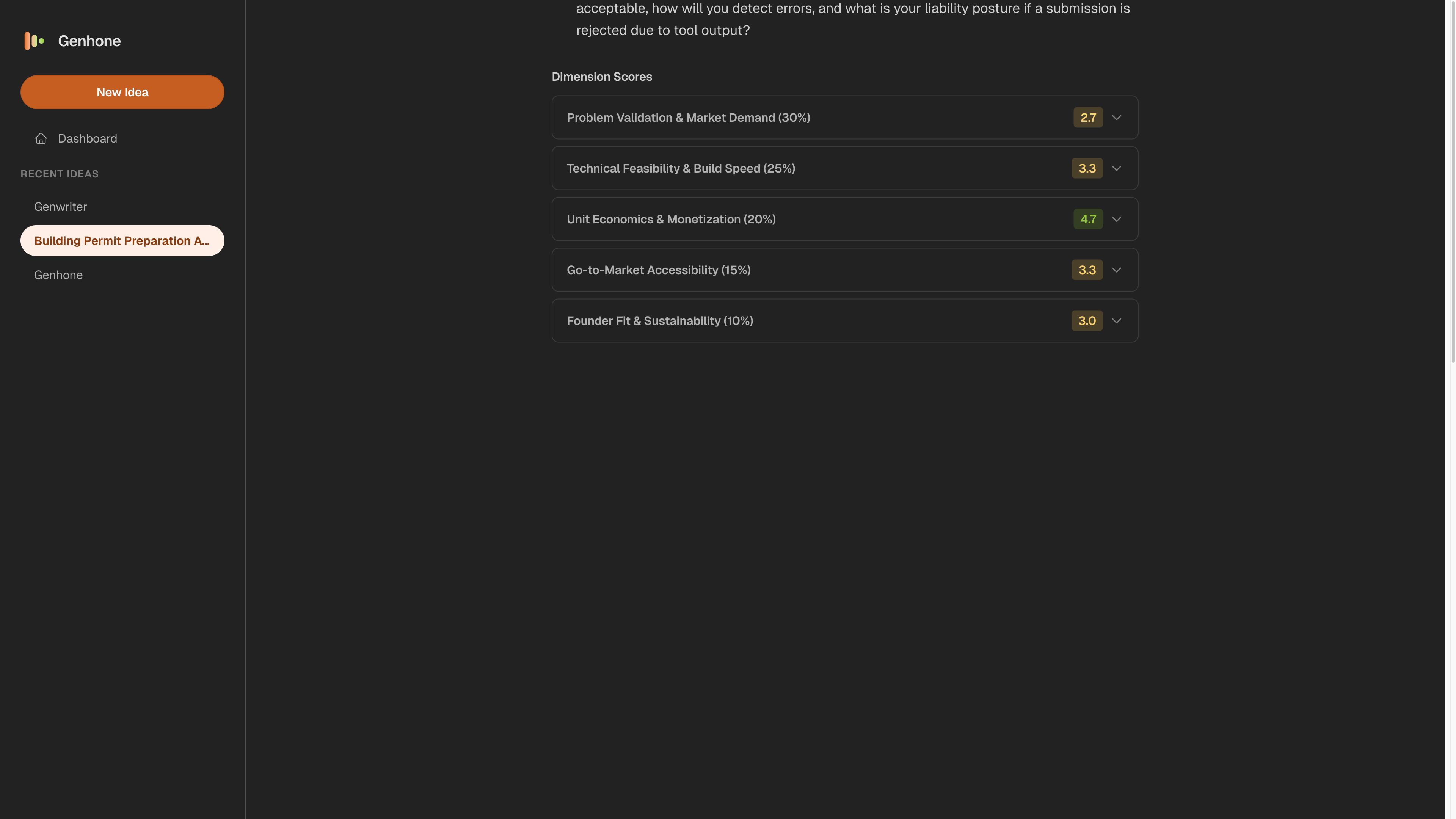
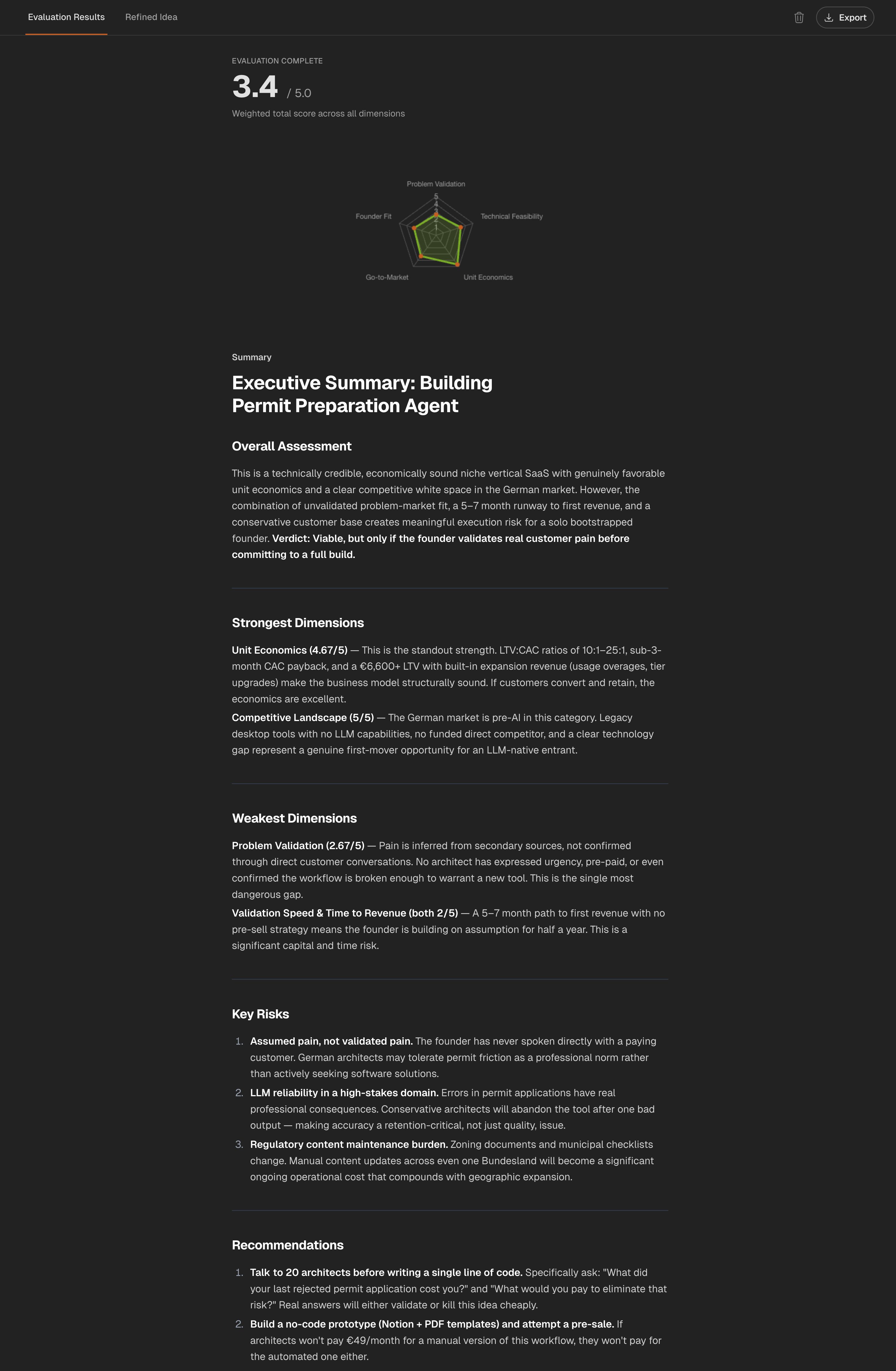
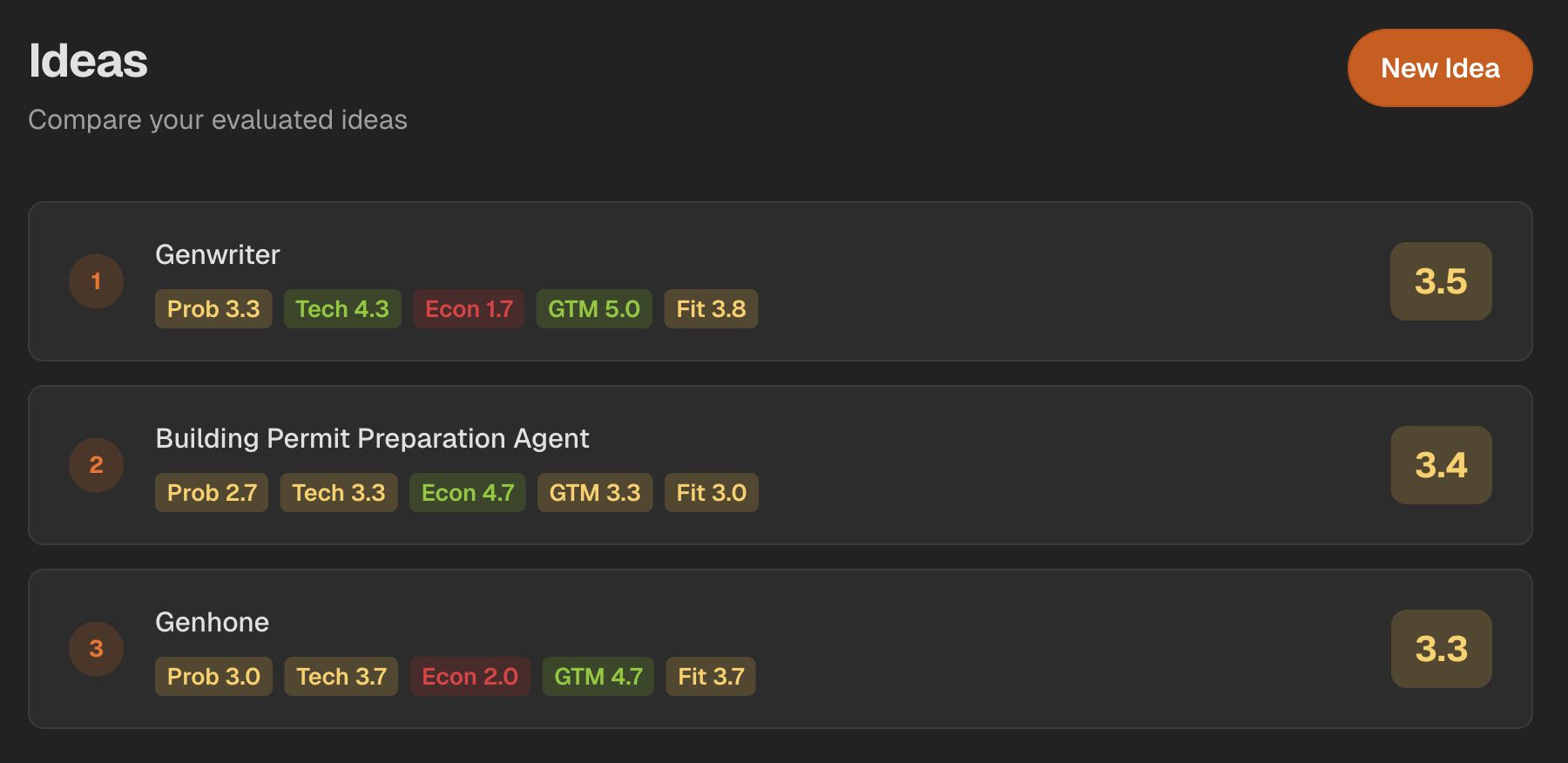
Genhone's current model uses 5 weighted dimensions and 18 criteria. Thirteen criteria are automated: 8 direct automated criteria and 5 research-assisted automated criteria where market context matters. Five founder-fit chat criteria require firsthand founder context. Scores and criteria-level reasoning are saved, and ideas can be compared side by side in a dashboard.
This article will not define every criterion. The SaaS idea evaluation criteria reference owns that depth. The SaaS idea scoring framework explains the full weighted model and score interpretation. The startup idea scorecard explains the artifact and comparison view.
Methodology note: Genhone starts with 12-section structured refinement, evaluates each idea across 18 criteria in 5 weighted dimensions, combines direct automated scoring with research-assisted automated scoring where market context matters, uses founder-fit chat for criteria that require firsthand founder context, and saves the result as a comparable idea artifact. The score is not a prediction and cannot replace buyer evidence.
| Dimension | Weight | Evaluation question | Deeper page |
|---|---|---|---|
| Problem Validation & Market Demand | 30% | Does a specific buyer have painful demand, market context, and payment logic worth testing? | All 18 criteria |
| Technical Feasibility & Build Speed | 25% | Can one founder build and operate a narrow first version quickly enough? | Full weighted model |
| Unit Economics & Monetization | 20% | Could acquisition, retention, pricing, and support load support a SaaS business? | Full weighted model |
| Go-to-Market Accessibility | 15% | Can the founder reach early buyers through plausible channels? | All 18 criteria |
| Founder Fit & Sustainability | 10% | Does the idea fit the founder's access, skills, resources, interest, and operating capacity? | Scorecard artifact |
Use the score to decide what to inspect next. Do not treat a 3.7 as objectively better than a 3.6 without reading the reasoning and evidence quality.
Decide Whether to Build, Narrow, Kill, or Gather Evidence
Evaluation is incomplete until it produces a next decision. Avoid the binary frame of "good idea" or "bad idea." Most early SaaS ideas are not ready or dead. They are too broad, under-evidenced, or missing one critical piece.
The decision should name the next validation action, not only the verdict.
| Evaluation result | When to choose it | What to do next | Internal support link |
|---|---|---|---|
| Build a narrow test or MVP | The idea is structured, the risk profile is acceptable, the weakest assumptions are known, and the next build is small enough to learn. | Build only the smallest version or manual workflow that tests the riskiest remaining assumption. | SaaS idea scoring framework |
| Narrow | The idea has promise, but buyer, workflow, price, channel, or scope is too broad. | Pick one buyer, one painful workflow, one payment logic, and one first channel; then evaluate again. | SaaS idea validation checklist |
| Kill or archive | A fatal assumption is weak and no realistic near-term evidence path exists. | Save the learning, stop investing build time, and move to a stronger problem. | When to kill a startup idea |
| Gather evidence | The idea may be promising, but the current score depends on assumptions. | Run the smallest evidence step: interviews, review mining, pricing conversations, landing page, or manual pilot. | Validate SaaS pricing |
A build decision should still be narrow. "Build the product" is usually too large. Better: "Build the smallest workflow that tests whether this buyer will pay to solve this painful recurring task."
A narrow decision is often the best outcome. It keeps the idea alive while removing the vague parts that made evaluation unreliable.
A kill decision is not failure if the evidence path is broken. It is how you protect the next build cycle from sunk cost.
Turn a rough SaaS idea into a scored, comparable artifact with Genhone.
Common SaaS Idea Evaluation Mistakes
Evaluating a vague idea instead of a structured idea. A rough hunch can sound better than a refined idea because it still contains every imagined future fix. Structure it first.
Treating validation, evaluation, scoring, and valuation as the same thing. Validation gathers evidence. Evaluation judges the idea. Scoring supports the judgment. Valuation is about an existing company or asset.
Letting easy buildability override weak demand. AI coding tools can make prototypes cheaper. They do not make buyers more urgent, budgets clearer, or distribution easier.
Averaging away fatal flaws with a total score. A strong technical score cannot compensate for no buyer, no budget, or no reachable channel. Read the weak dimensions.
Treating AI output as customer evidence. AI can organize assumptions and point to risks. It cannot prove pain or willingness to pay. ChatGPT prompts are not a startup validation process by themselves.
Ignoring founder fit until after the build starts. Support load, interest, buyer access, skill match, and operational complexity matter before code exists.
Comparing ideas refined to different levels of detail. If one idea has a complete buyer and pricing model while another is a one-liner, the comparison is unfair. Refine each idea to a similar level before scoring.
How Genhone Supports This Evaluation Process
Genhone is strategic pre-build evaluation software for solo founders. It helps founders refine, score, compare, and decide what to validate next. It does not code, build, generate PRDs, create roadmaps, generate growth strategies, score investor pitches, or promise product-market fit.
The workflow starts with 12 enforced refinement sections. That means the founder cannot skip from a vague idea to a confident-looking score. The idea first becomes a structured snapshot.
Then Genhone scores the completed idea across 18 criteria in 5 weighted dimensions. Thirteen criteria are automated: 8 direct automated criteria from the refined idea and 5 research-assisted automated criteria where market context matters. Five founder-fit chat criteria require firsthand context from the founder.
Scores and criteria-level reasoning are saved as persistent idea artifacts. When founders have more than one idea, they can compare saved ideas side by side in the dashboard.
Turn a rough SaaS idea into a scored, comparable artifact with Genhone.
FAQ
What does it mean to evaluate a SaaS idea?
Evaluating a SaaS idea means judging a structured idea against demand, feasibility, economics, distribution, and founder fit before building. The output should be a next action: build a narrow test, narrow the idea, kill or archive it, or gather better evidence.
Is evaluating a SaaS idea the same as validating it?
No. Validation gathers evidence about the assumptions behind the idea. Evaluation judges the current evidence and risk profile so you can decide what to do next. They overlap, but they are not identical.
How is SaaS idea evaluation different from SaaS valuation?
SaaS idea evaluation is pre-build decision support for a product that does not exist yet. SaaS valuation assesses the value of an existing company or asset. This article is not about ARR multiples, acquisitions, churn multiples, or procurement.
What evidence matters most before building a SaaS idea?
The strongest evidence usually shows repeated buyer pain, current alternatives, willingness to pay, reachable distribution, manageable build scope, and founder fit. The relative importance depends on the risk profile. A technically easy idea with weak buyer pain is still risky.
Can AI evaluate a SaaS idea without customer discovery?
AI can structure thinking, inspect patterns, score assumptions, and surface research. It cannot replace buyer evidence or prove demand. Customer discovery still comes from interviews, current spend, pricing conversations, paid pilots, competitor behavior, and observed buyer action.
What should I do if my SaaS idea scores poorly?
Do not automatically abandon it. Inspect why it scored poorly. Narrow if the weakness is buyer clarity, scope, price, or channel. Gather evidence if uncertainty is high. Kill or archive it if the core pain, payment logic, or distribution path is weak and there is no realistic evidence path.