SaaS Idea Evaluation Criteria for Solo Founders
Technically capable solo founders and AI-assisted builders have a new problem: more SaaS ideas feel buildable than ever. Cursor, Claude Code, Lovable, Bolt, v0, ChatGPT, and Claude can reduce the cost of starting, but buildability is not the same as worth-building.
SaaS idea evaluation criteria are the specific questions used to judge whether a software idea is worth building, narrowing, killing, or testing further. A useful criteria set inspects problem urgency, market size, willingness to pay, build feasibility, unit economics, distribution access, competition, founder fit, validation speed, and time to revenue before code creates sunk cost.
This article explains the 18 criteria Genhone uses to evaluate SaaS ideas before building. The goal is not to produce a vague "good idea" label. It is to inspect the different risks that can make a solo SaaS idea strong, weak, or not ready yet.
For the full weighted model, see the SaaS idea scoring framework. For how the result becomes a comparable artifact, see the startup idea scorecard. This page stays narrower: which criteria to inspect, what each one means, and what strong or weak evidence looks like.
Criteria support judgment. They do not prove demand, product-market fit, future revenue, or willingness to pay.
What SaaS Idea Evaluation Criteria Are For
Evaluation criteria are the questions a founder uses to inspect an idea before building. Good criteria make the idea easier to judge because each one asks about a specific risk: buyer pain, market focus, payment logic, build scope, acquisition path, competition, founder capacity, or timing.
Weak criteria collapse everything into a single impression. "Is this a good idea?" is too broad. A SaaS idea can be technically easy and commercially weak. It can have a large market and no reachable first buyer. It can sound exciting but require support, integrations, or compliance work that one founder cannot sustain.
Strong SaaS idea evaluation criteria help you decide whether to:
- Build a narrow test.
- Narrow the buyer, problem, pricing, channel, or MVP boundary.
- Kill the idea before sunk cost grows.
- Gather better evidence because the current thesis is still mostly opinion.
For SaaS, the criteria need to inspect recurring pain, payment logic, retention potential, acquisition path, support burden, and solo-founder feasibility. A checklist for generic startup attractiveness is not enough because SaaS depends on repeated usage, recurring revenue, and a distribution path that can support the price.
Apply criteria after the idea has enough structure to judge. If the buyer, problem, pricing logic, and first workflow are still vague, first validate a SaaS idea before building. Otherwise the criteria will produce confident-looking output from weak input.
Use Criteria After the Idea Is Structured
A one-sentence idea can receive a confident-looking score. That does not make the score useful.
"AI compliance tool for finance teams" may sound plausible, but it is not specific enough to evaluate. Which finance teams? What compliance task? What do they use now? Who owns the budget? What must the first version do? What data does it handle? Can one founder support the workflow? How will early buyers be reached?
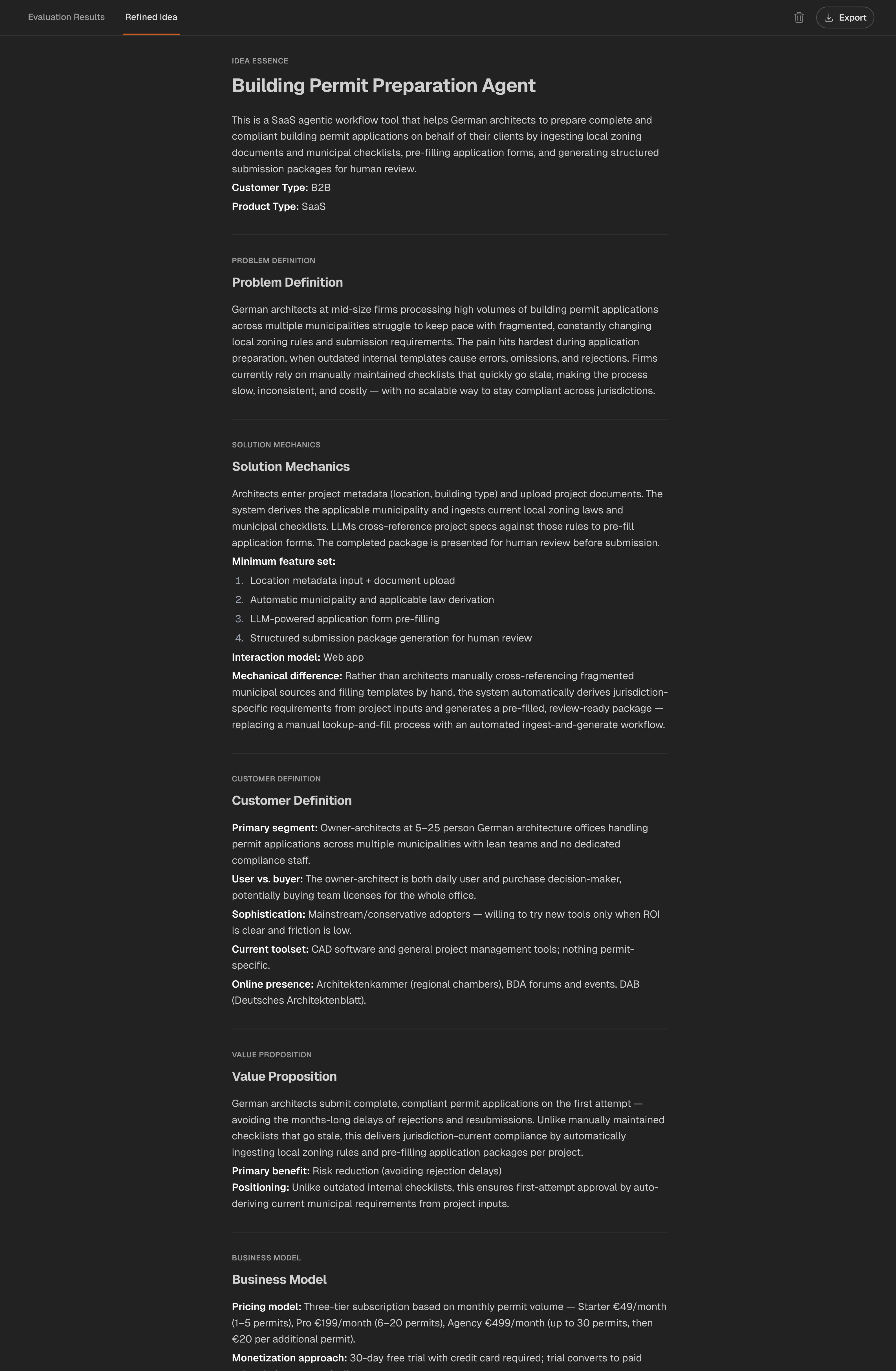
Before evaluation, Genhone enforces a structured snapshot across 12 refinement sections:
- Idea Essence
- Problem Definition
- Solution Mechanics
- Customer Definition
- Value Proposition
- Business Model
- Technical Foundation
- Go-to-Market Approach
- Customer Onboarding & Activation
- Key Metrics Framework
- Scope & Boundaries
- Solo Founder Execution
These sections make the criteria useful because every idea is judged from comparable inputs. One idea should not receive a detailed buyer, pricing, and channel model while another is scored from a vague hunch that still benefits from imagination.
Use a SaaS idea validation checklist to expose the assumptions first. Then use criteria to inspect the quality of those assumptions. The difference matters: validation thinking identifies what must be true; evaluation criteria help you judge the current strength of the idea.
The Five Dimensions Behind the Criteria
Genhone groups SaaS idea evaluation criteria into five weighted dimensions. Each dimension protects against a different class of solo-founder risk.
The weights matter because not every risk has the same impact. Weak buyer pain is usually more dangerous than a slightly harder MVP. A vague go-to-market path can break an otherwise elegant product. Founder fit matters because a solo founder is not only the builder; they are also the researcher, seller, operator, and support function.
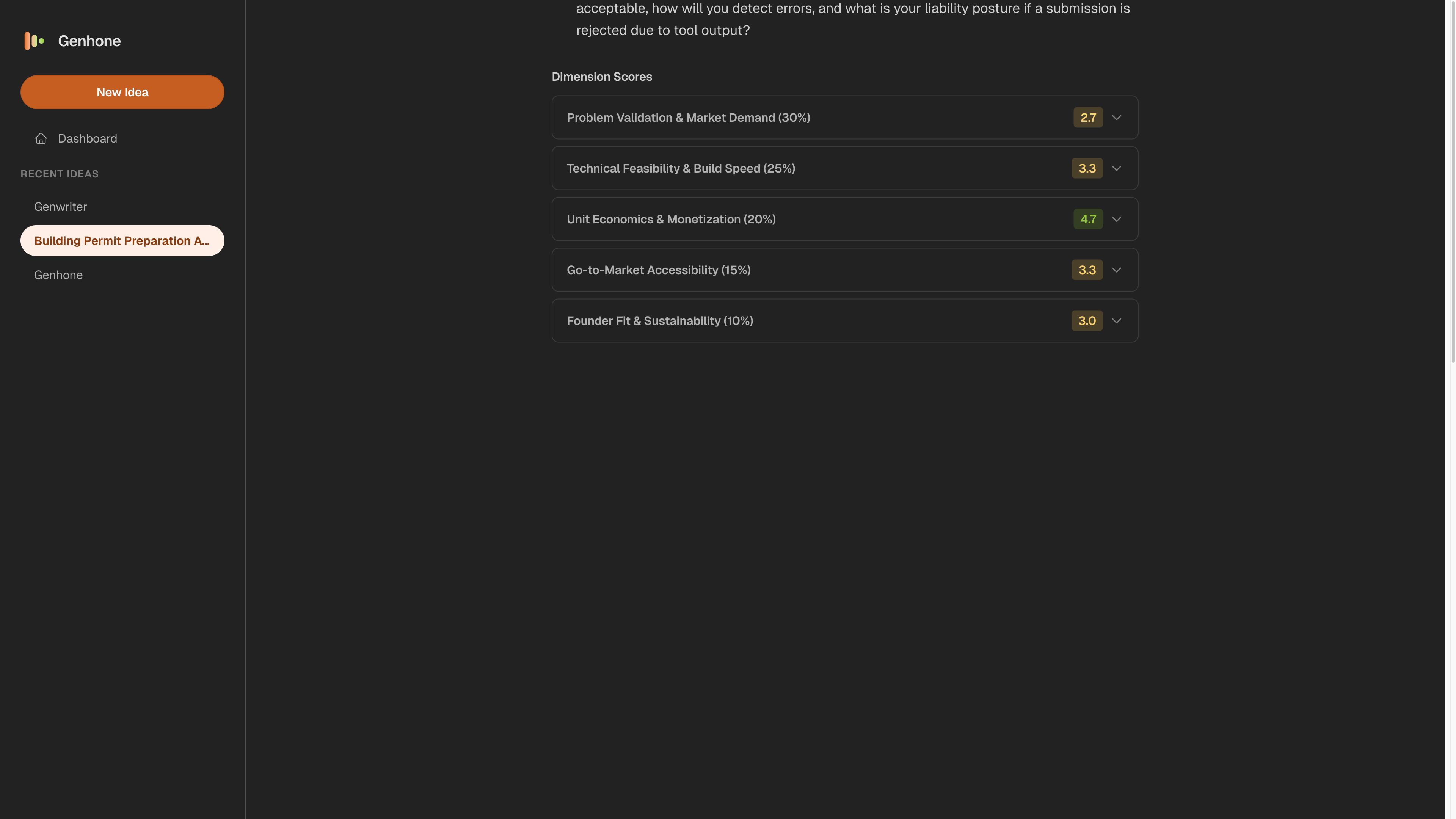
Genhone evaluates ideas across these five weighted dimensions:
| Dimension | Weight | Criteria | What this dimension protects against |
|---|---|---|---|
| Problem Validation & Market Demand | 30% | Problem Criticality, Market Size, Willingness to Pay | Building for weak pain, vague buyers, or markets that cannot support a focused SaaS. |
| Technical Feasibility & Build Speed | 25% | Time to MVP, Technical Complexity, Technical Skill Match | Choosing an idea that one founder cannot ship or maintain in a realistic window. |
| Unit Economics & Monetization | 20% | CAC Expectations, Expected Churn, LTV Potential | Mistaking interest for a subscription business with viable acquisition and retention. |
| Go-to-Market Accessibility | 15% | Channel Accessibility, Organic Discovery, Sales Cycle Complexity | Building for buyers the founder cannot reach affordably or sell to without a team. |
| Founder Fit & Sustainability | 10% | Competitive Landscape, Personal Interest, Resource Requirements, Operational Complexity, Validation Speed, Time to Revenue | Ignoring the founder's constraints, stamina, resources, timing, and competitive wedge. |
Problem Validation & Market Demand receives the highest weight because a clean implementation cannot rescue a product aimed at weak pain. Technical Feasibility & Build Speed comes next because solo founders have limited build and maintenance capacity. Unit Economics & Monetization tests whether the idea can become a subscription business, not just an interesting tool. Go-to-Market Accessibility asks whether early buyers are reachable. Founder Fit & Sustainability makes the founder's constraints explicit.
Founder-conversation criteria are not isolated inside Founder Fit. Genhone uses founder input for criteria across demand, feasibility, and sustainability because firsthand access, skill match, buyer understanding, support capacity, and motivation can change the final decision.
For the deeper weighting methodology, read the SaaS idea scoring framework.
The 18 SaaS Idea Evaluation Criteria
The full criteria set separates 18 different assumptions. That prevents one strong area from hiding a fatal weakness somewhere else.
Genhone uses 13 automated criteria: 8 direct automated criteria plus 5 research-assisted automated criteria. It also uses 5 founder-conversation criteria where firsthand founder input is required.
The source type is methodology transparency, not a backend implementation detail:
- Direct automated criteria are scored from the refined idea.
- Research-assisted automated criteria use external market context where the idea alone is not enough.
- Founder-conversation criteria require honest founder input because they depend on lived access, buyer understanding, skills, interest, or operational capacity.
The 8 direct automated criteria are Time to MVP, Technical Complexity, LTV Potential, Channel Accessibility, Sales Cycle Complexity, Resource Requirements, Validation Speed, and Time to Revenue.
The 5 research-assisted automated criteria are Market Size, CAC Expectations, Expected Churn, Organic Discovery, and Competitive Landscape.
The 5 founder-conversation criteria are Problem Criticality, Willingness to Pay, Technical Skill Match, Personal Interest, and Operational Complexity.
Methodology note: Genhone starts with 12-section structured refinement, evaluates each idea across 18 criteria in 5 weighted dimensions, combines direct automated scoring with research-assisted automated scoring where market context matters, uses founder-conversation input for criteria that require firsthand context, and saves the output as a comparable idea artifact. The score is not a prediction and cannot replace buyer evidence.
| Dimension | Criterion | Source type | What it inspects | Evidence to look for |
|---|---|---|---|---|
| Problem Validation & Market Demand | Problem Criticality | Founder conversation | Whether the problem is urgent, repeated, painful, and behavior-changing. | Recent painful incidents, current workarounds, emotional language, repeated complaints. |
| Problem Validation & Market Demand | Market Size | Research-assisted automated | Whether the reachable market is large enough for a solo SaaS but focused enough to target. | Search demand, community size, competitor presence, identifiable buyer segment. |
| Problem Validation & Market Demand | Willingness to Pay | Founder conversation | Whether buyers have budget, current spend, or economic pain that supports payment. | Existing spend, paid workarounds, owner of the budget, pricing conversations. |
| Technical Feasibility & Build Speed | Time to MVP | Direct automated | Whether a credible first version can be built quickly enough by one founder. | Narrow workflow, small feature set, known stack, few hard integrations. |
| Technical Feasibility & Build Speed | Technical Complexity | Direct automated | Whether the product avoids scope that needs a larger team or risky infrastructure. | Standard CRUD, bounded integrations, known compliance load, simple deployment path. |
| Technical Feasibility & Build Speed | Technical Skill Match | Founder conversation | Whether this founder can build and operate it with current skills. | Existing stack fit, prior domain work, small learning curve, realistic support capability. |
| Unit Economics & Monetization | CAC Expectations | Research-assisted automated | Whether the likely acquisition path can support payback at the expected price. | Low-cost channels, search/community intent, realistic conversion path, no paid-ad dependency. |
| Unit Economics & Monetization | Expected Churn | Research-assisted automated | Whether the product solves a recurring enough problem to retain customers. | Recurring workflow, stored value, switching cost, frequent usage, business-critical job. |
| Unit Economics & Monetization | LTV Potential | Direct automated | Whether price, retention, expansion, and support load can create enough lifetime value. | Pricing logic, tier expansion, usage growth, low support drag, margin discipline. |
| Go-to-Market Accessibility | Channel Accessibility | Direct automated | Whether the founder can reach qualified early users through plausible channels. | Existing communities, direct access, searchable pain, partner or marketplace access. |
| Go-to-Market Accessibility | Organic Discovery | Research-assisted automated | Whether buyers already look for the problem, category, or alternatives. | Search queries, review mining, forums, comparison behavior, public complaints. |
| Go-to-Market Accessibility | Sales Cycle Complexity | Direct automated | Whether the idea can be sold self-serve or low-touch instead of enterprise-heavy. | Clear buyer, low-risk purchase, short evaluation, simple onboarding, low stakeholder count. |
| Founder Fit & Sustainability | Competitive Landscape | Research-assisted automated | Whether competition validates demand while leaving a realistic wedge. | Existing alternatives, review gaps, underserved segment, non-obvious niche angle. |
| Founder Fit & Sustainability | Personal Interest | Founder conversation | Whether the founder will stay interested beyond the first prototype. | Lived problem, domain curiosity, customer empathy, willingness to support the workflow. |
| Founder Fit & Sustainability | Resource Requirements | Direct automated | Whether the idea can be tested and launched without resources beyond the founder. | Low capital need, no early hiring, low compliance burden, manageable infrastructure cost. |
| Founder Fit & Sustainability | Operational Complexity | Founder conversation | Whether ongoing support and operations are sustainable for one person. | Low manual service load, self-serve support, predictable edge cases, manageable data/process ops. |
| Founder Fit & Sustainability | Validation Speed | Direct automated | Whether the riskiest assumptions can be tested before a large build. | Fast interviews, landing page test, manual pilot, pricing test, narrow experiment path. |
| Founder Fit & Sustainability | Time to Revenue | Direct automated | Whether there is a plausible path to first revenue soon enough for a bootstrapper. | Paid pilot path, clear buyer urgency, short onboarding, chargeable first workflow. |
Problem Validation & Market Demand Criteria
Problem Validation & Market Demand criteria ask whether the idea starts from a real market pull, not founder enthusiasm. This dimension carries 30% of the weighted score because weak pain, vague buyers, or poor payment logic can break an idea before technical feasibility matters.
If this section is weak, do not solve it by adding features. Narrow the buyer, sharpen the problem, and define the ICP for a SaaS idea before building.
Problem Criticality
Problem Criticality asks how urgent, repeated, and painful the problem is. A strong SaaS problem changes behavior. The buyer already feels the pain, already works around it, or already loses time, money, accuracy, customers, or control because of it.
Strong signals include current workarounds, repeated workflow pain, recent specific incidents, emotional language, and a high cost of inaction. If a buyer can describe the last time the problem hurt, what they did about it, and why the workaround is still painful, the criterion becomes stronger.
Weak signals include "would be nice," vague productivity gains, no current workaround, no recent incident, and feedback that sounds polite but not urgent. A founder's personal pain can help identify the problem, but personal pain alone is not proof that a market will change behavior.
Because this is a founder-conversation criterion, Genhone uses founder input to understand lived access and problem context. The next step is still buyer evidence.
Market Size
Market Size asks whether the reachable market is large enough for a solo SaaS but focused enough to target. The word "reachable" matters. A broad market with no clear first segment is less useful than a smaller niche with an obvious buyer population and repeated pain.
Strong signals include an identifiable niche, clear buyer population, active communities, existing alternatives, relevant search behavior, and signs that buyers already spend attention or budget in the category.
Weak signals include "everyone needs this," no clear segment, a market so broad that the founder cannot reach it, or zero competitor signal with no other demand proof. No competition can mean undiscovered opportunity, but it can also mean weak demand or poor monetization.
Market Size is research-assisted because external context matters. A founder's opinion about the market should be checked against search behavior, communities, competitors, substitute tools, and visible buyer activity.
Willingness to Pay
Willingness to Pay asks whether the buyer has budget, current spend, or economic pain that supports payment. SaaS ideas often fail here: users like the concept, but no buyer owns the budget or the problem is not expensive enough to justify another subscription.
Strong signals include existing spend, paid workarounds, a clear budget owner, measurable cost, and credible interest in a paid pilot. A buyer who already pays with money, time, labor, or risk is more promising than one who simply likes the product idea.
Weak signals include compliments, survey positivity, "I would use this," feedback from users who are not buyers, and consumer-level willingness to pay for a workflow that would create B2B support demands.
This is a founder-conversation criterion because the founder often knows the buyer context, budget path, and economic pain better than the written idea shows. Still, the criterion should push toward real pricing evidence. If payment logic is weak, validate SaaS pricing before launch before treating demand as commercial proof.
Technical Feasibility & Build Speed Criteria
Technical Feasibility & Build Speed criteria ask whether one founder can ship and maintain the first useful version in a realistic window. This is not about whether the product is technically possible. Most ideas are technically possible with enough time, money, and people. The question is whether this version is feasible for this founder before sunk cost grows.
AI-assisted building can reduce implementation time, but it does not remove integration risk, operational complexity, security constraints, or maintenance work. That is why before building with AI, the idea still needs a sober feasibility check.
Time to MVP
Time to MVP asks whether a credible first version can be built quickly enough by one founder. A high score does not mean the full product is easy. It means the first version can deliver the core value without turning into a platform.
Strong signals include one narrow workflow, a known stack, minimal integrations, a small feature set, and a first version that can create learning without complete automation.
Weak signals include platform scope, multiple user types, mobile plus web plus admin from day one, complex integrations before value exists, or a first version that must support every edge case to be useful.
If Time to MVP is weak, narrow the first workflow. Do not compensate by hoping faster tools will make unclear scope disappear.
Technical Complexity
Technical Complexity asks whether the product requires infrastructure, compliance, AI/data work, integrations, or operations beyond one founder. Complexity is not inherently bad, but unbounded complexity is a poor fit for pre-build SaaS evaluation.
Strong signals include proven patterns, a bounded data model, simple authentication, established APIs, and a deployment path the founder understands.
Weak signals include regulated data, real-time collaboration, multi-sided marketplace dynamics, custom AI infrastructure, enterprise integrations, heavy data ingestion, or uptime expectations that require operational maturity from day one.
If Technical Complexity is weak, the next move is not always to abandon the idea. It may be to choose a smaller wedge, manual pilot, lighter integration path, or narrower data scope.
Technical Skill Match
Technical Skill Match asks whether this founder can build and operate the first version with current skills or a small learning curve. The same idea can be feasible for one founder and unrealistic for another.
Strong signals include prior stack experience, a clear deployment path, a known support model, and experience with similar workflows or data patterns.
Weak signals include learning a new stack while validating, unfamiliar compliance or infrastructure requirements, dependency on contractors for core product logic, or a support burden the founder has never handled.
This is a founder-conversation criterion because it requires honest founder input. The idea alone cannot reveal whether the founder has the right skills, patience, and operational context.
Unit Economics & Monetization Criteria
Unit Economics & Monetization criteria ask whether the idea can become a recurring SaaS business, not just a product someone might try. This dimension inspects acquisition cost, churn risk, and lifetime value.
A SaaS idea can have real pain and still fail as a business if the buyer is too expensive to acquire, the use case churns quickly, the price is too low, or support costs eat the margin. If monetization is uncertain, validate SaaS pricing before expanding the product.
CAC Expectations
CAC Expectations asks whether the expected acquisition path can support the expected price and payback period. A low-price SaaS product cannot usually survive a high-touch sales process. A founder without a reachable channel cannot rely on "we will run ads later" as a plan.
Strong signals include a reachable audience, low-cost channel, specific buying intent, search or community demand, and a conversion path that does not require expensive enterprise sales.
Weak signals include paid ads as the only path, no target channel, a price too low for the acquisition effort, or a broad audience with no clear buyer habitat.
This is research-assisted because market and channel context matter. The founder's channel hypothesis should be tested against visible demand, channel competition, and buyer behavior.
Expected Churn
Expected Churn asks whether the use case suggests recurring value and customer retention. SaaS works best when the product supports a repeated workflow, stores value, or becomes operationally useful over time.
Strong signals include a recurring workflow, stored value, operational dependency, repeated usage, switching cost, and a business-critical job that does not disappear after setup.
Weak signals include one-time setup, occasional curiosity, seasonal need, easy replacement, no ongoing value, or a use case where the user only needs the product once.
Expected Churn is research-assisted because category patterns and alternatives can reveal whether similar products retain customers or suffer from one-off usage. Treat that context cautiously; it is directional, not proof.
LTV Potential
LTV Potential asks whether price, retention, expansion, margin, and support load could produce meaningful lifetime value. This criterion connects the product's commercial model to the reality of serving customers over time.
Strong signals include pricing logic, tiering or usage expansion, a business-critical workflow, low support burden, clear gross margin, and a reason customers might expand usage instead of canceling.
Weak signals include a tiny price point, heavy support, no expansion path, churn-prone usage, or a product that requires human service work for every account.
If LTV Potential is weak, do not hide the issue behind a larger market-size claim. A large market with poor retention and low willingness to pay is still a weak SaaS thesis.
Go-to-Market Accessibility Criteria
Go-to-Market Accessibility criteria ask whether the founder can reach and sell to early buyers before building too much. Distribution is often where otherwise plausible solo SaaS ideas break.
A founder does not need a complete growth strategy at this stage. They need a credible path to first qualified users, a way to observe buyer language, and a channel that matches the price and sales motion.
Channel Accessibility
Channel Accessibility asks whether the founder can reach qualified first users through plausible channels. The best early channel is usually specific: a community, a professional niche, a marketplace, a direct outreach path, a founder audience, a partner surface, or a search behavior tied to pain.
Strong signals include existing community access, a relevant audience, niche directories, marketplace access, partner surfaces, direct buyer lists, or a clear outreach path.
Weak signals include "we will do SEO later," no online buyer habitat, a target buyer who is unreachable without a sales team, or a channel plan that depends on broad awareness before the product has proof.
If Channel Accessibility is weak, narrow the buyer until the founder can name where those buyers already gather or how they can be reached.
Organic Discovery
Organic Discovery asks whether buyers already search, ask, complain, or compare in public places. This criterion is not only about SEO. It is about whether the market has visible language around the pain.
Strong signals include problem queries, review complaints, forum threads, category pages, social posts, competitor comparison behavior, and repeated public questions.
Weak signals include no language match between buyer pain and product pitch, an unclear category, a problem that buyers do not search or discuss, or a solution name that founders understand but buyers never use.
Organic Discovery is research-assisted because external search and community context matter. When alternatives, reviews, and complaints are visible, a competitor analysis before MVP can reveal buyer language and gaps before the founder writes code.
Sales Cycle Complexity
Sales Cycle Complexity asks whether the product can be sold self-serve or low-touch instead of requiring a long enterprise process. A solo founder can sell high-touch deals, but long procurement cycles, security reviews, and multiple stakeholders increase risk before product proof exists.
Strong signals include a clear buyer, low price, low data/security risk, fast trial, simple onboarding, and a small stakeholder count.
Weak signals include procurement, legal review, multiple departments, custom demos, implementation services, high-touch support, or a buyer who cannot purchase without a long approval path.
If Sales Cycle Complexity is weak, the idea may need a smaller entry point, different buyer, lower-risk first workflow, or manual validation path before software buildout.
Founder Fit & Sustainability Criteria
Founder Fit & Sustainability criteria make founder-specific constraints visible. This is not motivational content. For solo founders, the founder's skills, access, stamina, resources, and operational capacity change the quality of the idea.
An idea can be attractive in theory and still be a poor choice for a founder who cannot reach the buyer, build the first version, support the workflow, or stay interested long enough to learn.
Competitive Landscape
Competitive Landscape asks whether competition validates demand while leaving a realistic wedge. Competitors are not automatically bad. In SaaS, existing alternatives often prove that buyers understand the category and spend money in it.
Strong signals include active alternatives with known weaknesses, an underserved subsegment, legacy UX, category spend, review gaps, or a niche angle that competitors ignore.
Weak signals include no competitors and no other demand proof, a saturated market with no wedge, or differentiation based only on "better UI." Better UI can help, but it is rarely enough by itself unless the workflow pain and buyer segment are very specific.
This is research-assisted because external market context matters. The founder needs to understand both alternatives and substitutes, not just direct competitors.
Personal Interest
Personal Interest asks whether the founder has enough genuine interest to keep learning, selling, and supporting the problem beyond the first prototype. This matters because SaaS learning is slow and repetitive. The founder has to talk to users, hear objections, inspect edge cases, and support the workflow.
Strong signals include lived exposure, curiosity about the buyer, willingness to talk to users, customer empathy, and domain stamina.
Weak signals include choosing the idea only because AI can build it, trend-chasing, low empathy for the customer workflow, or boredom once the prototype is done.
This is a founder-conversation criterion because only the founder can answer it honestly. The score should reflect the current founder, not an idealized operator.
Resource Requirements
Resource Requirements asks whether the idea can be tested and launched within the founder's capital, time, tooling, and support constraints. A technically feasible idea can still be resource-heavy if it depends on paid data, contractors, compliance, hardware, partnerships, or expensive infrastructure.
Strong signals include low infrastructure cost, no early hiring, simple tooling, low compliance burden, and a test path that does not require large upfront spend.
Weak signals include heavy data acquisition, paid data dependencies, contractors for core product work, enterprise support load, compliance from day one, or infrastructure costs that rise before revenue exists.
If Resource Requirements is weak, shrink the test. The first evidence step should not require the full resource burden of the imagined product.
Operational Complexity
Operational Complexity asks whether support, manual work, failure modes, and maintenance are sustainable for one person. Many SaaS ideas look simple at the interface level but create hidden operational load behind the scenes.
Strong signals include self-serve setup, repeatable support, limited edge cases, clear failure handling, and no manual service dependency.
Weak signals include concierge operations, case-by-case implementation, constant customer-specific workflows, brittle integrations, or support that requires domain expertise the founder does not have.
This is a founder-conversation criterion because realistic founder capacity matters. The same operational burden may be manageable for one founder and unsustainable for another.
Validation Speed
Validation Speed asks whether the riskiest assumptions can be tested quickly before a full build. This criterion rewards ideas where the founder can learn before committing to a large implementation cycle.
Strong signals include reachable interviewees, a manual pilot, landing page test, pricing test, narrow prototype, review mining, or a small experiment that can change the decision.
Weak signals include needing to build the full platform to learn anything, long sales cycles, no access to buyers, or a product whose core risk only appears after months of usage.
If Validation Speed is weak, the idea may still be worth exploring, but it is more dangerous for a solo founder. Slow learning increases sunk cost.
Time to Revenue
Time to Revenue asks whether first revenue is plausible soon enough for a bootstrapped founder. This does not mean rushing monetization before learning. It means the idea should have a credible path from pain to payment.
Strong signals include a painful paid workflow, clear buyer urgency, a paid pilot path, short onboarding, and a narrow first deliverable that can be charged for.
Weak signals include long procurement, free-user dependency, delayed monetization, marketplace chicken-and-egg dynamics, or a plan that requires scale before any buyer pays.
If Time to Revenue is weak, the founder should be honest about runway, motivation, and opportunity cost before starting the build.
How to Use the Criteria Without False Certainty
Criteria are useful because they slow down overconfidence. They are dangerous when they become a substitute for evidence.
Score the current idea thesis, not the future version you imagine. If the buyer is vague today, the buyer-related criteria should be weak today. If the pricing logic is unsupported today, the monetization criteria should reflect that. Do not silently upgrade the score because you believe you can fix the idea later.
Do not average away fatal flaws. A strong technical score cannot compensate for no buyer, no budget, or no channel. A strong market-size score cannot compensate for an MVP that one founder cannot maintain. The weakest criterion or dimension often matters more than the total.
Separate evidence from opinion. Interviews, current spend, competitor reviews, search behavior, community complaints, paid pilots, and actual usage should carry more weight than founder confidence or AI-generated reasoning.
AI can structure evaluation, surface risks, and keep criteria consistent. It cannot prove buyer pain, budget, switching behavior, or willingness to pay. If your current process is mostly prompt-based, remember that ChatGPT prompts are not a startup validation process.
| Use criteria for | Do not use criteria for |
|---|---|
| Comparing assumptions across ideas. | Predicting startup success. |
| Finding the weakest dimension before building. | Proving demand without customers. |
| Choosing the next evidence test. | Justifying a full unvalidated build. |
| Making founder constraints explicit. | Replacing interviews, pricing tests, pilots, or usage evidence. |
Criteria should change when better evidence arrives. If interviews weaken the pain claim, rescore. If pricing tests show stronger willingness to pay, rescore. If competitor review mining reveals a sharper wedge, rescore.
When the criteria point to a weak thesis, use that signal. The next decision may be to narrow, gather better evidence, or revisit when to kill a startup idea.
How the Criteria Map to Scores and Decisions
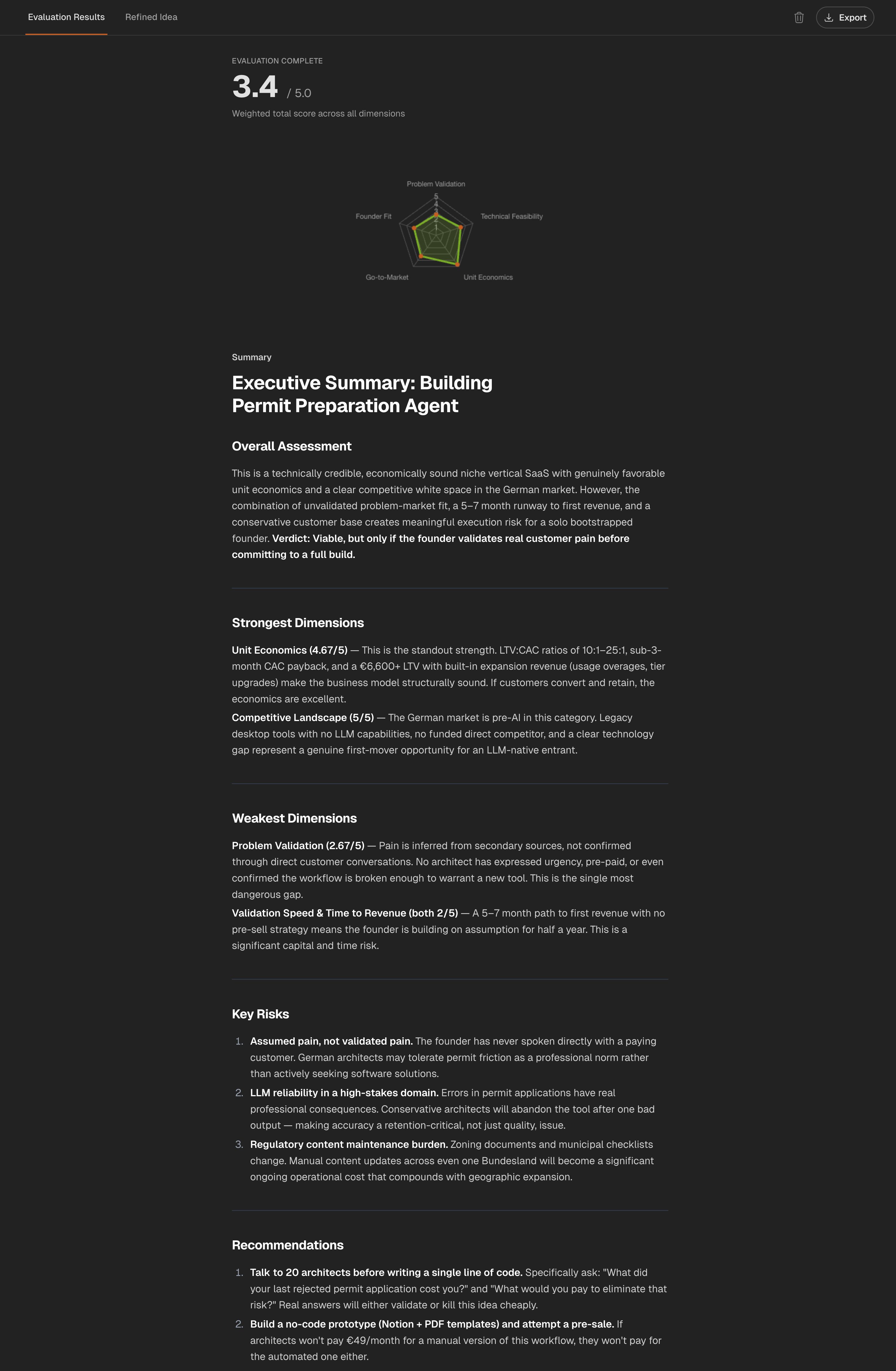
After all 18 criteria are scored, Genhone computes dimension scores and a weighted total on a 1-5 scale. The total gives a quick read, but the dimension pattern and criteria-level reasoning usually explain the next move.
Keep the score in context. The SaaS idea scoring framework explains the full model, while the startup idea scorecard shows how the output becomes a comparable artifact. This criteria page is about what each question inspects before the score is interpreted.
| Weighted score | Label | Practical interpretation | Best next action |
|---|---|---|---|
| 4.0-5.0 | Strong Opportunity | The idea is coherent across demand, feasibility, economics, GTM, and founder fit. | Run the next smallest buyer-evidence test or tightly scoped MVP. |
| 3.0-3.99 | Promising | The idea has real potential but one or more criteria need sharper evidence or narrowing. | Fix the weakest criterion or dimension before building. |
| 2.0-2.99 | Needs Work | The idea has significant risk or vague assumptions. | Narrow the buyer, problem, pricing, channel, or MVP boundary and rescore. |
| Below 2.0 | High Risk | The current thesis is weak for a solo SaaS build. | Kill, archive the learning, or restart from a stronger problem. |
A Strong Opportunity score should still lead to the next smallest buyer-evidence test, not blind confidence. A Promising score usually means the idea deserves more sharpening before a build cycle. Needs Work points to a weak thesis that may be fixable through narrowing. High Risk means the current version should probably be killed, archived, or restarted from a stronger problem.
Turn a rough SaaS idea into a scored, comparable artifact with Genhone.
How Genhone Applies These Criteria
Genhone is a SaaS app for technically capable solo founders refining and evaluating SaaS ideas before building. It is designed for the moment when several ideas feel possible and the founder needs a structured way to decide what deserves the next evidence step.
The workflow enforces 12 refinement sections, so the idea has a consistent snapshot before evaluation. Then Genhone evaluates the idea across 18 criteria in 5 weighted dimensions.
The evaluation uses 13 automated criteria: 8 direct automated criteria plus 5 research-assisted automated criteria where market context matters. It also uses 5 founder-conversation criteria where firsthand input is required: Problem Criticality, Willingness to Pay, Technical Skill Match, Personal Interest, and Operational Complexity.
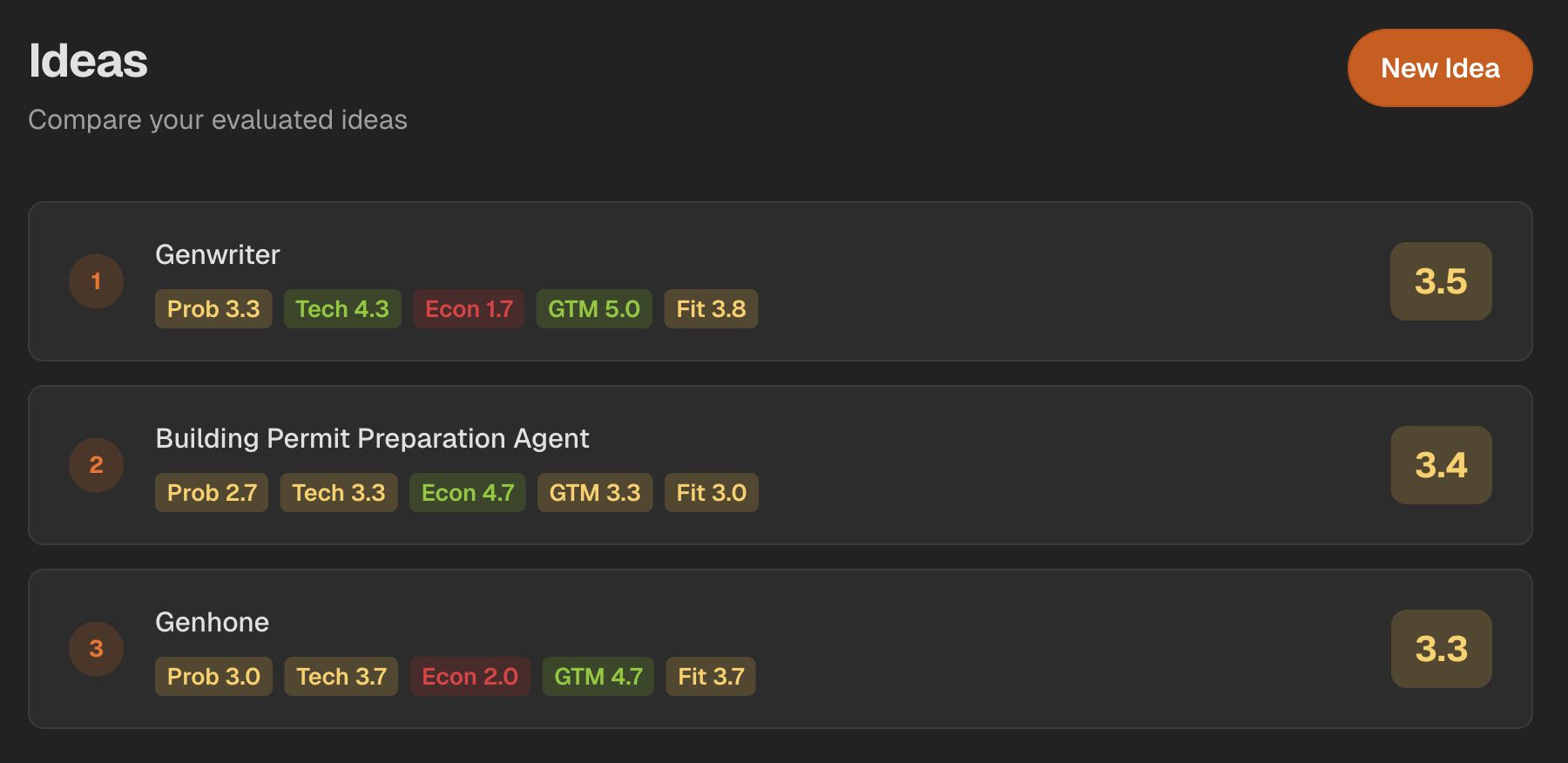
Scores and criteria-level reasoning are saved as comparable idea artifacts. Founders can compare saved ideas side by side instead of losing reasoning inside scattered notes or a one-off chat response.
The boundary is deliberate. Genhone does not build the product, generate a roadmap, create a PRD, produce a growth strategy, replace customer discovery, or prove the idea will work. It helps founders refine, score, compare, and decide what to validate next.
Genhone is a SaaS idea validation tool for pre-build evaluation, not a replacement for buyer evidence.
Turn a rough SaaS idea into a scored, comparable artifact with Genhone.
FAQ
What criteria should I use to evaluate a SaaS idea?
Use criteria that inspect five dimensions: Problem Validation & Market Demand, Technical Feasibility & Build Speed, Unit Economics & Monetization, Go-to-Market Accessibility, and Founder Fit & Sustainability.
Genhone breaks those dimensions into 18 criteria: Problem Criticality, Market Size, Willingness to Pay, Time to MVP, Technical Complexity, Technical Skill Match, CAC Expectations, Expected Churn, LTV Potential, Channel Accessibility, Organic Discovery, Sales Cycle Complexity, Competitive Landscape, Personal Interest, Resource Requirements, Operational Complexity, Validation Speed, and Time to Revenue.
Use the 18-criteria table to see the source type, inspection question, and evidence guidance for each criterion.
What is the most important SaaS idea evaluation criterion?
Problem Criticality is often the first gate because weak pain makes the rest of the idea harder to justify. If the problem is not urgent, repeated, or behavior-changing, technical feasibility and market size matter less.
But the real answer depends on the weakest fatal assumption. A SaaS idea needs demand, feasibility, monetization, distribution, and founder fit to be inspected together. The most important criterion is often the one that could break the current thesis.
How many criteria should a SaaS idea scorecard include?
Genhone uses 18 criteria because they separate distinct risks without collapsing everything into a generic score. More criteria are not automatically better if they duplicate the same question.
A useful criteria set should be specific enough to expose weak assumptions, but not so broad that the founder spends more time maintaining the rubric than learning from the market.
Can AI evaluate a SaaS idea without customer discovery?
No. AI can structure assumptions, identify risks, apply criteria consistently, and suggest what evidence to gather next. It cannot prove buyer pain, budget, switching behavior, willingness to pay, or retention.
Customer discovery still comes from interviews, current spend, pricing tests, paid pilots, usage, and observed buyer behavior. Use AI-supported evaluation to decide what to test next, not to skip the test.
Should founder fit affect SaaS idea evaluation?
Yes, especially for solo founders. Skill match, buyer access, personal interest, support capacity, resource constraints, and operational complexity change whether an idea is executable.
A SaaS idea can be attractive in theory and still be wrong for a founder who cannot reach the buyer, build the first version, sustain the support load, or stay interested long enough to learn from the market.
How do I compare multiple SaaS ideas with the same criteria?
First, structure every idea to a similar level of detail. Then score each idea against the same criteria and weights.
Compare dimension patterns, weak criteria, and next evidence tests, not only the total score. One idea may score higher because it is easy to build, while another has stronger buyer pain and a clearer path to revenue. The useful comparison is the one that shows which idea deserves the next validation step.