What Makes a SaaS Idea Worth Building?
If you are a technically capable solo founder, AI coding tools make almost every SaaS idea feel buildable. Cursor, Claude Code, Lovable, Bolt, v0, ChatGPT, and Claude can help you start faster. They do not tell you whether the idea deserves the next build cycle.
A SaaS idea is worth building when it has a specific painful buyer problem, a reachable market, credible willingness to pay, a narrow first workflow one founder can ship, viable subscription economics, an accessible distribution path, and founder fit strong enough to sustain the work. A score can support the decision, but it should point to the next evidence step, not replace customer proof.
This article helps you turn structured scoring into a build, narrow, kill, or gather-evidence decision. It does not prove demand, product-market fit, future revenue, or willingness to pay.
For the full method, read the SaaS idea scoring framework. For criterion definitions, use the SaaS idea evaluation criteria. For the artifact and comparison view, see the startup idea scorecard.
Malte Hedderich is building Genhone for this exact AI-assisted solo-founder problem: too many ideas are easy to start, and too few are clear enough to justify building.
The Short Answer: A SaaS Idea Is Worth Building When the Next Step Is Obvious
A SaaS idea worth building is not necessarily worth building into the full product. It is worth the next constrained step: a buyer-evidence test, a paid pilot attempt, a narrower prototype, or a tightly scoped MVP that can change the decision.
The clearest sign of a SaaS idea worth building is that the next step gets smaller, not bigger. You know who the buyer is, what pain matters, what workflow to start with, what price logic may work, and what evidence would make you stop.
Weak ideas often ask you to build more before learning anything. The founder needs a platform before testing pain. The product needs several integrations before anyone can see value. The market is "everyone." The buyer says nice things but shows no payment signal. These are not build decisions. They are ambiguity signals.
A strong idea usually has enough structure to survive seven questions:
| Worth-building signal | What it means | Genhone dimension or criterion family |
|---|---|---|
| Specific buyer and painful problem | A real person or role has a repeated pain that changes behavior. | Problem Validation & Market Demand |
| Credible willingness to pay | There is current spend, budget ownership, or economic pain behind the need. | Problem Criticality, Willingness to Pay, Unit Economics |
| Narrow first workflow | One founder can build a useful first version without platform scope. | Technical Feasibility & Build Speed |
| Viable subscription logic | Price, retention, support load, and expansion can support SaaS economics. | Unit Economics & Monetization |
| Reachable first users | The founder can access the first qualified buyers without unrealistic spend or sales complexity. | Go-to-Market Accessibility |
| Founder fit | The idea matches the founder's skills, access, interest, resources, and support capacity. | Founder Fit & Sustainability |
| Next evidence step is clear | The founder knows what test would change the decision before sunk cost grows. | Validation Speed, Time to Revenue |
If those signals point in the same direction, the idea may deserve action. If one of them is dangerously weak, the decision is usually to narrow or gather evidence before building.
Start With a Structured Idea, Not a One-Line Concept
A one-sentence idea can sound worth building because it still contains every imagined future fix. "AI assistant for consultants" can be anything. "Workflow automation for agencies" can hide any buyer, any price, any onboarding path, and any technical scope.
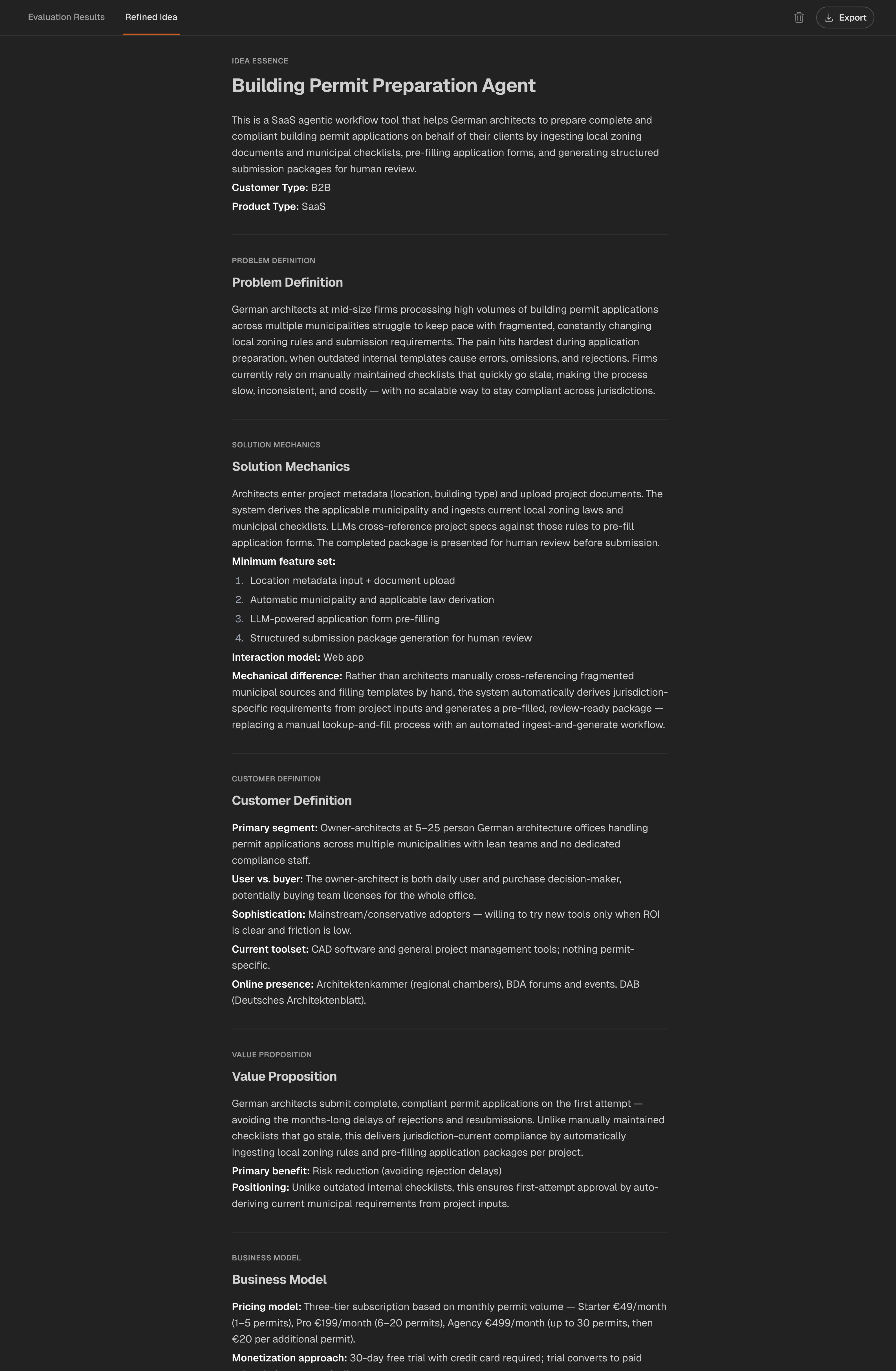
A real decision starts only when the idea is structured enough to judge. Before scoring, Genhone turns rough ideas into a consistent snapshot across 12 refinement sections:
- Idea Essence
- Problem Definition
- Solution Mechanics
- Customer Definition
- Value Proposition
- Business Model
- Technical Foundation
- Go-to-Market Approach
- Customer Onboarding & Activation
- Key Metrics Framework
- Scope & Boundaries
- Solo Founder Execution
Those sections are not paperwork. They force the founder to say what is being built, who it is for, how the first version works, how customers might find it, what the business model assumes, and what the founder can realistically support.
That matters because scores can create fake precision. A vague idea can receive a confident-looking label, but the score only reflects the input underneath it. If one idea has a clear buyer, price, workflow, and channel while another is still a loose category, the comparison is not fair.
If the idea is still fuzzy, first validate a SaaS idea before building or work through a SaaS idea validation checklist. Then use scoring to interpret whether the current version deserves the next step.
Use Scores to Decide Build, Narrow, Kill, or Gather Evidence
Genhone computes weighted dimension scores and a weighted total on a 1-5 scale. The total gives a fast read. The dimension pattern usually tells you what to do next.
The current score labels are:
| Weighted score | Label | Worth-building decision | Best next action |
|---|---|---|---|
| 4.0-5.0 | Strong Opportunity | Worth the next buyer-evidence test or tightly scoped MVP if no fatal dimension is weak. | Run the smallest test that can confirm or falsify the riskiest assumption. |
| 3.0-3.99 | Promising | Potentially worth pursuing, but usually not ready for a build sprint until the weakest area is narrowed. | Fix the weakest dimension, collect evidence, then rescore. |
| 2.0-2.99 | Needs Work | Not worth building in its current form. | Narrow the buyer, problem, pricing, channel, or MVP boundary. |
| Below 2.0 | High Risk | Usually not worth the next build cycle. | Kill, archive the learning, or restart from a stronger problem. |
A Strong Opportunity score is not permission to build the whole product. It means the current thesis is coherent enough to justify the next smallest test. That might be a paid pilot conversation, a concierge workflow, a landing page with pricing, or a narrow MVP around one buyer job.
A Promising score is the common middle case. The idea may be worth pursuing, but one dimension is likely soft. Do not average away a fatal weakness. A 3.7 with weak willingness to pay is not build-ready. A 3.4 with one fixable GTM gap may be better than a higher-scoring idea that requires the full product before learning anything.
Needs Work means the current form is too broad, unsupported, or uneven. High Risk means the honest move is usually to kill, archive, or restart from a stronger problem unless new evidence changes the thesis.
Confidence matters too. A score backed by interviews, current spend, competitor review patterns, pricing tests, or buyer behavior deserves more weight than a score based mostly on founder assumptions.
For the artifact view behind this interpretation, use the startup idea scorecard.
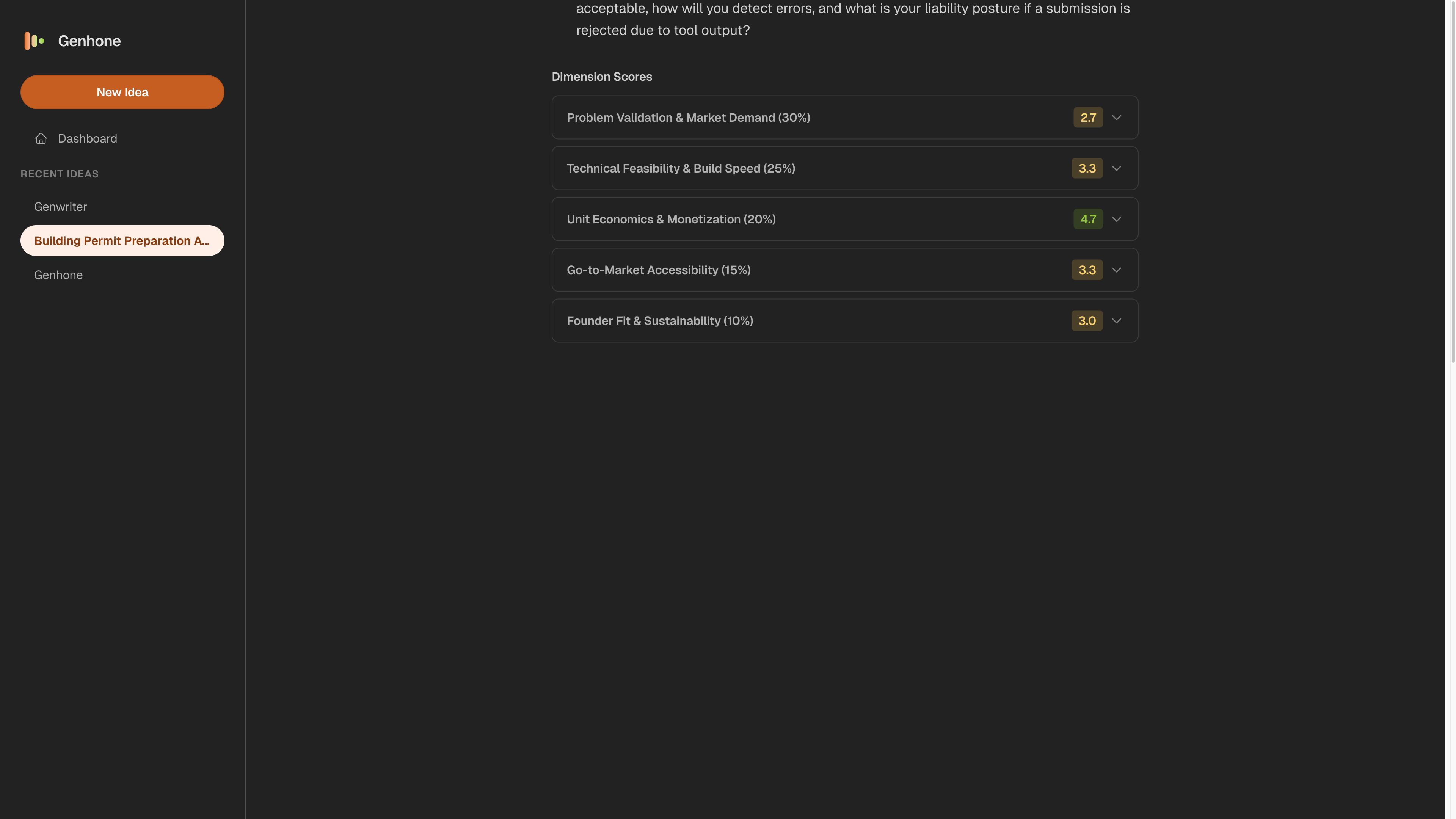
Turn a rough SaaS idea into a scored, comparable artifact with Genhone.
The No-Build Conditions That Make an Idea Look Better Than It Is
Some ideas feel worth building because they are exciting, familiar, AI-buildable, or easy to prototype. Those signals are not enough.
A no-build condition does not always mean the idea is permanently bad. Often it means the next action is to narrow, inspect, or gather evidence before code creates sunk cost.
| No-build condition | Why it is dangerous | Better next move |
|---|---|---|
| Broad buyer definition | Broad markets hide weak targeting and weak messaging. | Define the ICP and narrow to one reachable buyer segment. |
| Weak payment evidence | Compliments do not prove budget or switching behavior. | Run pricing conversations, paid pilot tests, or current-spend research. |
| AI-buildable MVP | Build speed can hide weak demand. | Score demand and GTM before writing code. |
| Vague competitive wedge | "Better UI" rarely overcomes switching costs by itself. | Run competitor review mining and define a specific underserved segment. |
| Inaccessible first users | A good idea with no reachable buyers is not ready for a solo build. | Choose a narrower channel or buyer habitat. |
| Platform-sized first version | Large scope increases sunk cost before evidence arrives. | Reduce to one first workflow. |
| Founder mismatch | The idea may be good in theory but wrong for this founder. | Reassess skill match, interest, resource needs, and support load. |
"Everyone could use this" is usually a warning, not a market size argument. Start by learning how to define the ICP for a SaaS idea.
If people like the concept but nobody owns the budget, validate SaaS pricing before launch. If competitors exist but the wedge is vague, run SaaS competitor analysis before MVP. If the risks stay fundamental after narrowing, revisit when to kill a startup idea.
How to Tell Whether a Promising Idea Needs Narrowing or Building
Most real ideas are not obvious Strong Opportunities or obvious High Risk ideas. They are Promising but uneven.
The decision depends on which dimension is weak. Use the SaaS idea evaluation criteria to inspect the weak area before deciding what to do next.
If demand is weak, do not fix it with features
Weak demand is not a feature problem. If buyers are vague, pain is soft, current alternatives are unknown, or willingness to pay is unsupported, building more product usually creates more sunk cost.
Narrow the buyer. Find the painful workflow. Look for current spend, repeated complaints, manual workarounds, or economic cost. If that evidence does not exist, the idea is not ready for a build sprint.
If build scope is weak, cut to one first workflow
An idea may have strong demand but too much first-version scope. Multiple user types, integrations, permissions, dashboards, and automations can turn a validation step into a platform build.
Cut the first version to one workflow that can produce evidence. If the product cannot create learning without the full platform, the idea is not ready yet.
If GTM is weak, narrow until first users are reachable
A strong product idea still fails if the founder cannot reach qualified buyers. "SEO later," "ads later," or "launch on Product Hunt" is not a distribution path by itself.
Narrow until you can name where buyers gather, what language they use, what alternatives they compare, and how the first conversations will happen.
If founder fit is weak, treat it as a real decision factor
Founder fit is not a motivational afterthought. If you cannot reach the buyer, do not understand the workflow, dislike the customer, lack the technical skill match, or cannot support the operational load, the idea may be wrong for you even if it is good in theory.
The right move might be to adjust the wedge, choose a closer customer, reduce scope, or stop.
Founder Fit Can Make the Same SaaS Idea Worth Building or Not
The same SaaS idea can be worth building for one founder and not another.
A founder with buyer access, domain knowledge, a familiar stack, and genuine interest can learn faster. A founder without access may need months just to find the right conversations. A founder with operational experience may be able to support a high-touch workflow. Another founder may burn out supporting the same product.
The decision changes with:
- Customer access
- Domain knowledge
- Technical skill match
- Interest in the customer and problem
- Resource constraints
- Support and operational capacity
- Time to revenue expectations
Genhone captures founder-specific input through five founder-conversation criteria:
- Problem Criticality
- Willingness to Pay
- Technical Skill Match
- Personal Interest
- Operational Complexity
These criteria are not limited to the Founder Fit & Sustainability dimension. Founder input affects demand, feasibility, and sustainability. If you deeply understand the buyer, your read on pain and payment may be stronger. If your skill match is poor, technical feasibility is weaker. If the support burden does not fit your constraints, the idea is less sustainable even if the market looks attractive.
Example: A Worth-Building Decision Memo
The example below is fictional. It is not a customer story, testimonial, or anonymized Genhone user artifact.
Imagine a solo founder considering an invoice follow-up assistant for freelance design studios. The product would help small studios track overdue invoices, send polite reminders, and see which clients repeatedly pay late.
The idea is not simply good or bad. It has a decision.
| Decision memo field | Example content |
|---|---|
| Idea | [Fictional] Invoice follow-up assistant for freelance design studios. |
| Buyer/problem | Freelance design studios lose time and cash-flow predictability chasing overdue client invoices. |
| Score pattern | Strong demand and feasibility; weaker unit economics until payment urgency is proven. |
| Current label | Promising, not yet Strong Opportunity. |
| Weakest assumption | Studios may feel the pain but may not pay enough for a standalone tool. |
| Decision | Do not build the full app yet. Narrow and gather payment evidence. |
| Next test | Interview 10 studio owners, test pricing language, and attempt paid pilot commitments. |
The lesson is the weak point. The founder may be able to build the first version quickly. The pain may be real. But if the product cannot command a price that supports acquisition, retention, and support, the build decision is premature.
The best next step is smaller than the product: prove payment urgency with the exact buyer segment most likely to care. If studio owners already pay for bookkeeping help, spend hours chasing invoices, or agree to a paid pilot, the score can improve. If they like the concept but will not pay, the founder should narrow, bundle the workflow into a different wedge, or stop.
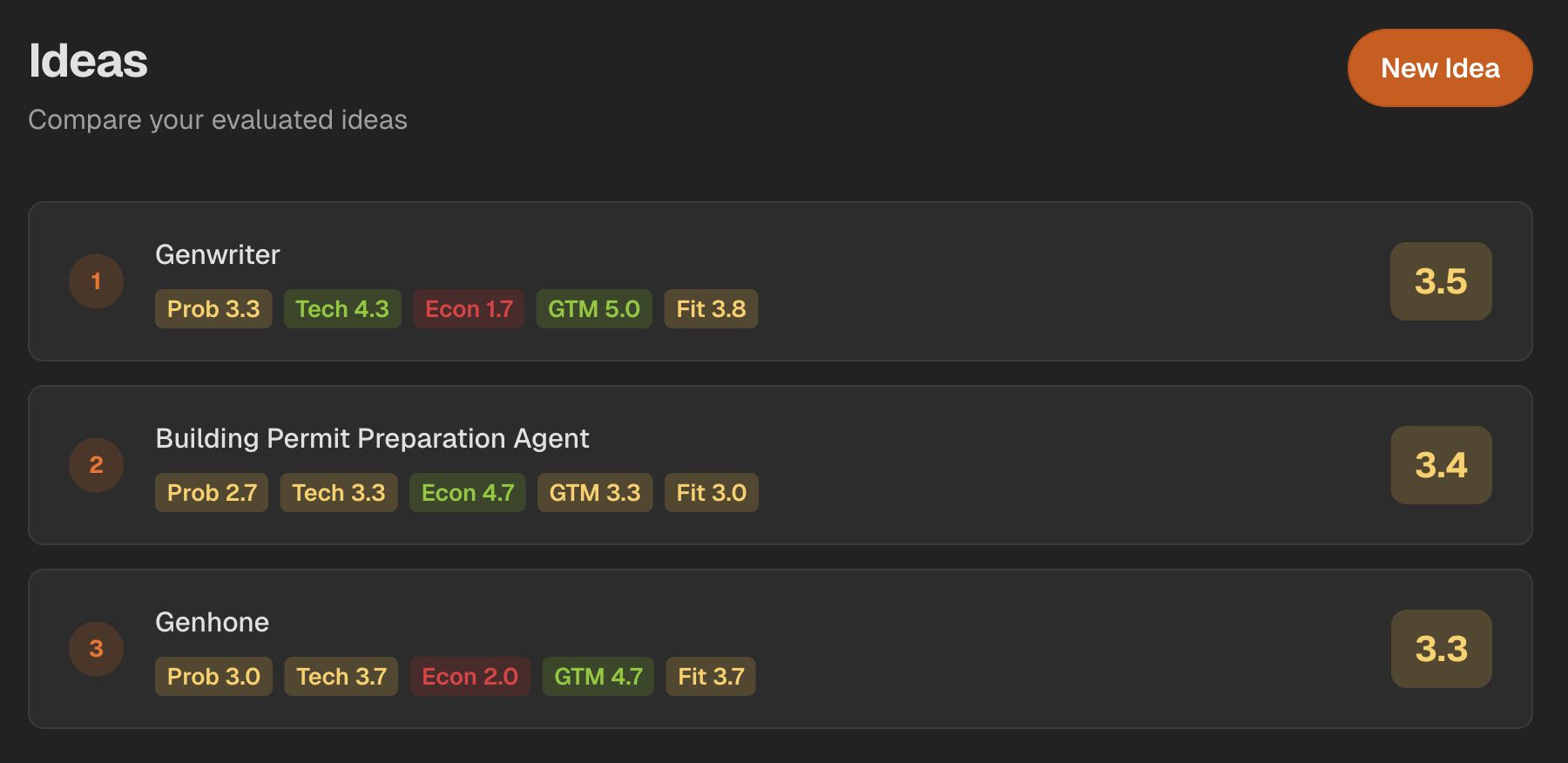
How to Compare Multiple SaaS Ideas Before Choosing One
AI-assisted builders often have several buildable ideas. The mistake is choosing the idea that feels most exciting today, or the one with the highest total score.
Compare only ideas refined to similar detail. A fully structured idea should not compete against a one-line concept that still benefits from imagination.
Then compare the pattern, not only the total. A lower total score with a fixable weakness can be better than a higher total score with a fatal flaw. For example, an idea with strong demand and weak first-channel clarity may deserve a quick channel test. An idea with a higher total but no credible payment signal may not deserve a build sprint.
Saved artifacts matter because they preserve the reasoning. You can revisit the score, weak assumptions, and next action instead of relying on memory or scattered chat threads.
For the artifact format, see the startup idea scorecard.
| Comparison question | Why it matters |
|---|---|
| Which idea has the strongest painful buyer problem? | Strong demand can justify harder execution. |
| Which idea has the clearest first revenue path? | Bootstrapped founders cannot ignore time to revenue. |
| Which idea has the fastest evidence step? | Fast learning reduces sunk cost. |
| Which idea has the weakest fatal assumption? | The total score can hide one broken area. |
| Which idea best fits this founder? | Skills, access, and support capacity change the real decision. |
How Genhone Helps Decide Whether a SaaS Idea Is Worth Building
Genhone is a SaaS web app for solo founders to refine and evaluate SaaS ideas through guided AI conversations and automated scoring.
The workflow is intentionally narrow: refine, score, compare, decide. Genhone enforces 12 refinement sections before scoring, then evaluates each idea across 18 criteria in five weighted dimensions:
| Dimension | Weight |
|---|---|
| Problem Validation & Market Demand | 30% |
| Technical Feasibility & Build Speed | 25% |
| Unit Economics & Monetization | 20% |
| Go-to-Market Accessibility | 15% |
| Founder Fit & Sustainability | 10% |
The evaluation uses 13 automated criteria and five founder-conversation criteria. The automated group includes direct scoring from the refined idea and research-assisted checks where market context matters. The result is saved as an artifact with scores, reasoning, a summary, and comparison value.
That output is decision support. Genhone does not build the product, generate a roadmap, create a PRD, produce a growth strategy, replace customer discovery, or prove the idea will work. It helps founders create a structured artifact before AI-assisted building makes every option feel plausible.
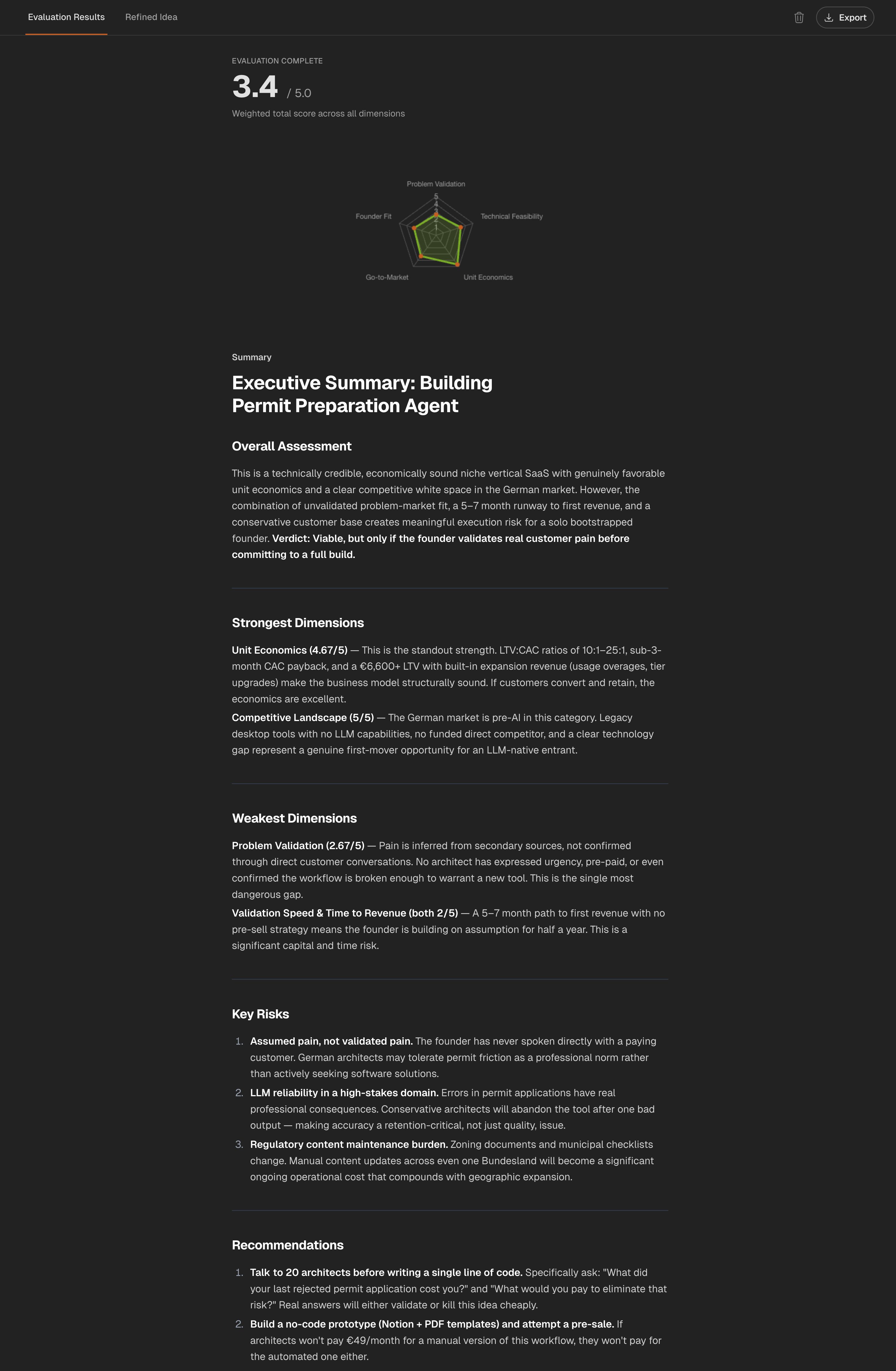
Turn a rough SaaS idea into a scored, comparable artifact with Genhone.
What to Do After the Decision
If the idea is Strong Opportunity, run the next smallest buyer-evidence test or a tightly scoped MVP. Do not expand into the full product before the riskiest assumption has been tested.
If the idea is Promising, fix the weakest dimension first. That may mean buyer clarity, pricing, scope, GTM, or founder fit.
If the idea is Needs Work, narrow and rescore. Change the buyer, problem, pricing logic, channel, or MVP boundary before building.
If the idea is High Risk, kill it, archive the learning, or restart from a stronger problem.
Route the next action by weakness:
- Buyer clarity: define the ICP for a SaaS idea.
- Pricing or payment: validate SaaS pricing before launch.
- Competitive wedge: run SaaS competitor analysis before MVP.
- General validation: validate a SaaS idea before building.
- Kill decision: review when to kill a startup idea.
- Product workflow: use the SaaS idea validation tool.
The goal is not to keep every idea alive. It is to spend the next build cycle only where the evidence, score pattern, founder fit, and next test justify it.
FAQ
What score means a SaaS idea is worth building?
In Genhone, 4.0-5.0 is Strong Opportunity. That can justify the next buyer-evidence test or a tightly scoped MVP if no fatal dimension is weak.
A 3.0-3.99 Promising idea may be worth pursuing, but it usually needs narrowing first. A 2.0-2.99 Needs Work idea is not worth building in its current form. Below 2.0 is High Risk and usually points to killing, archiving, or restarting from a stronger problem.
No score proves success.
Is a high SaaS idea score enough to start building?
It can be enough to start the next constrained build or evidence step. It is not enough to build the full unvalidated product.
The score should identify what the next test is meant to learn. If willingness to pay is the riskiest assumption, the next step should test payment. If GTM is weak, the next step should test reachability. If scope is weak, the next step should cut the product to one workflow.
Should I build if AI can make the MVP quickly?
Not by itself. AI build speed lowers implementation cost, but it does not prove buyer pain, payment, distribution, retention, or founder fit.
Fast building can make weak ideas more expensive because the founder creates sunk cost before evidence. If the idea is AI-buildable but the buyer, payment, and channel are vague, use a pre-build decision process first. The guide to validate an app idea before building with AI covers that caveat in more detail.
What if my idea is promising but one dimension is weak?
Fix the weakest dimension before building.
If buyer clarity is weak, narrow the ICP. If willingness to pay is weak, test pricing or paid pilots. If technical feasibility is weak, cut integrations and scope. If GTM is weak, choose a reachable first segment. If founder fit is weak, adjust the wedge, choose a closer customer, or stop.
The weakest dimension often matters more than the total score.
Should founder fit change whether a SaaS idea is worth building?
Yes. For solo founders, founder fit changes the real decision.
Skills, buyer access, domain knowledge, interest, support capacity, resource constraints, and time to revenue affect whether the idea is executable. A SaaS idea can be attractive in theory and still be wrong for a founder who cannot reach the buyer, build the first version, support the workflow, or stay interested long enough to learn.
How do I compare multiple SaaS ideas before choosing one?
Refine each idea to the same level of detail, score them with the same rubric, and compare dimension patterns, weak assumptions, validation speed, and founder fit.
Do not sort only by total score. A lower-scoring idea with one fast, fixable weakness can be better than a higher-scoring idea with no buyer access or no payment signal. Saved artifacts help because the reasoning stays visible instead of disappearing into memory or old chat threads.