Best Startup Idea Validation Tools for SaaS Founders
If you searched for startup idea validation tools, you are probably not looking for another generic list of startup advice. You are trying to decide which idea deserves your next build cycle.
That decision is harder now because Cursor, Claude Code, Lovable, Bolt, v0, ChatGPT, Claude, and similar tools make more ideas feel buildable. But buildability is not validation. A technically capable solo SaaS founder can start three products faster than they can honestly judge whether any of them should exist.
Startup idea validation tools help founders structure an idea, inspect market and execution risks, score assumptions, and decide what evidence to gather before building. The best tool depends on the job: use a fast AI validator for rough sanity checks, a scorecard for transparent criteria, an AI report for packaged analysis, an idea database for prioritization, and a saved scoring workflow when you need to compare multiple SaaS ideas over time.
This guide compares tools by best-fit use case, not by unsupported winner-takes-all claims. It builds on the deeper Genhone guides about validation, scoring, scorecards, and founder fit; this page is about choosing the right tool type for the decision in front of you.
The trust boundary matters. Tools can help you validate a SaaS idea before building by structuring judgment and prioritizing evidence. They cannot prove demand, product-market fit, willingness to pay, future revenue, or startup success.
How to Choose a Startup Idea Validation Tool
The best startup idea validation tool depends on the decision you need to make now.
A founder with a one-line idea needs a rough sanity check. A founder with a specific buyer, problem, and monetization assumption needs a transparent scorecard. A founder who wants a compact analysis artifact may prefer an AI report. A founder with dozens of product ideas may need a database or prioritization board. A solo SaaS founder choosing the next build may need saved, comparable scoring artifacts.
That is why feature lists can mislead. More features do not automatically mean better validation. A tool that generates PRDs, pitch decks, landing pages, build prompts, or team voting workflows may be useful for a different job, but those features are not the same as pre-build SaaS idea validation.
Use the methodology below before trusting any score.
| Evaluation criterion | What to look for | Why it matters |
|---|---|---|
| Structured inputs | Does the tool ask enough about customer, problem, alternatives, solution, pricing, GTM, scope, and founder constraints? | Vague inputs create falsely confident scores. |
| Transparent criteria | Does it show the rubric, dimensions, weights, or criteria behind the score? | Founders need to audit why an idea scored well or poorly. |
| Evidence boundaries | Does it explain what is assumption, AI inference, market context, or buyer evidence? | A score is not proof of demand. |
| Founder fit | Does it account for the founder's skills, access, interest, constraints, and support capacity? | The same idea can be strong for one founder and weak for another. |
| Saved artifact/comparison | Can the founder revisit the reasoning and compare multiple ideas consistently? | Solo founders often have too many plausible ideas. |
| Price/access model | Is it free, credit-based, subscription-based, browser-only, solo, Pro, or team-oriented? | Access model affects how the tool fits repeated decision-making. |
| Privacy/data handling | Does the tool disclose local/browser processing or data handling where relevant? | Early ideas may include sensitive strategy, market, or product details. |
| Next-action clarity | Does it say what to build, narrow, kill, or validate next? | The output should reduce uncertainty, not just produce a score. |
This is also where a startup idea scorecard and a SaaS idea scoring framework become useful. A scorecard makes the output inspectable. A scoring framework explains which risks the score is actually measuring.
Methodology note: this comparison uses official product pages and the supplied June 20, 2026 source refresh. Tools are evaluated by fit for the founder's job: rough sanity check, structured scorecard, AI report, idea database, or saved scored artifact. Genhone starts with 12-section structured refinement, scores 18 criteria across five weighted dimensions, combines direct automated, research-assisted, and founder-conversation scoring, and saves comparable artifacts. No validation tool can replace buyer evidence.
Quick Comparison of Startup Idea Validation Tools
The table below uses official pages and the June 20, 2026 source refresh. Competitor claims are phrased as official positioning, not independently verified proof. Pricing, access, and privacy details can change quickly, so verify those details from official pages immediately before publication or purchase.
If you are looking for an AI startup idea validator, some of these tools fit that category. Others are better understood as scorecards, report products, databases, or saved SaaS scoring workflows.
| Tool | Best fit | Validation style | Notable official positioning to cite | Access/pricing note | Main caveat |
|---|---|---|---|---|---|
| Genhone | Solo SaaS founders who need refined, scored, comparable decision artifacts before building. | 12-section guided refinement, 18-criterion scoring, founder conversation, saved comparison artifacts. | Scores ideas across five weighted SaaS dimensions using direct automated, research-assisted, and founder-conversation scoring. | No pricing claim is made here; verify the current Genhone pricing or trial page if a pricing note is added before publication. | Requires completing structured refinement; it does not prove demand or build the product. |
| IdeaValidator | Fast first-pass AI validation and verdict-style feedback. | AI business idea validator with clarifying questions and scored verdicts. | IdeaValidator positions itself around market opportunity, competitive density, execution complexity, monetization fit, verdicts such as Worth Doing, Proceed with Caution, or Pass, and optional 17-section PRD generation. | Official positioning references credit-based pricing, free monthly credits, a Pro plan, and mobile apps; verify current details. | Broad business-idea and PRD scope; not the same as a SaaS-specific saved comparison workflow. |
| SaaSValidatr | SaaS/AI builders who want fast scoring with competitor and revenue-model signals. | Claude-powered SaaS idea scoring and competitor scan. | SaaSValidatr says it scores dimensions such as simplicity, market viability, revenue potential, uniqueness, and feasibility, and mentions competitor mapping, market sizing, revenue models, blind team voting, solo/free use, public examples, live competitor scan, and Pro/Team features. | Official positioning references free solo access and paid team features; verify current limits and pricing. | Broader team and builder features mean recommendations should be use-case specific. |
| Meysam SaaS Idea Validator | Lightweight browser-based SaaS scorecard self-assessment. | Browser-based 0-100 score across 20 criteria. | The official page positions it as a SaaS idea validator covering Market, Problem, Solution, Distribution, and Founder Fit, with thresholds, category breakdowns, and recommendations. | Official page says browser-based; verify if access changes. | Best framed as lightweight and transparent, not as a persistent comparison system unless the page confirms it. |
| Idealyzer | Founders or teams managing and prioritizing many product ideas. | AI-powered idea database and prioritization workspace. | Idealyzer positions itself around pain/ROI scoring, market tags, effort/confidence scoring, clustering/deduplication, priority tiers, and a Notion-style table. | Official positioning references free and Pro tiers; verify current limits and pricing. | Broader product-idea database; less focused on solo SaaS pre-build validation. |
| Idea Score | Founders who want packaged AI validation reports and visual scoring breakdowns. | AI product idea validation reports. | Idea Score positions reports around market signals, competitor landscape, scoring breakdowns, visual charts, sample reports, next actions, comparison across a consistent rubric, and credit-based pricing. | Official positioning references one free report and prepaid report credits; verify current details. | Generic product/startup framing; do not imply independent accuracy. |
| ValidatorAI | Free broad startup feedback and step-by-step advice exploration. | Free AI startup idea scoring plus related AI tools. | ValidatorAI positions itself around scoring startup ideas, finding customers, analyzing competition, step-by-step advice, and company-stated founder-behavior data. | Verify current free/tool access before publication or purchase. | Treat scale and data claims cautiously as company claims, not independently verified proof. |
The short version: choose the tool by job. Do not choose by the biggest promise on the page. A fast AI verdict, browser scorecard, visual report, idea database, and saved SaaS scoring workflow all answer different founder questions.
Best for Rough Sanity Checks: Fast AI Validators
Fast AI validators are useful when you want an outside view before investing more time. They can surface obvious gaps, ask clarifying questions, and give you initial objections.
That is a real job. Early ideas are often too vague for a full scoring process. A quick validator can help you notice that the buyer is unclear, the market sounds crowded, monetization is hand-wavy, or the solution is really a feature rather than a business.
IdeaValidator and ValidatorAI are examples from the official source pack. IdeaValidator positions itself as a free AI business idea validator with clarifying questions and verdict-style scoring. ValidatorAI positions itself as a broad startup idea validation tool with scoring, customer-finding, competition analysis, and step-by-step advice.
Those tools fit an early stage. The risk is treating a fast score as if it came from buyer behavior.
When This Tool Type Fits
Use a fast AI validator when you are still in early brainstorming and need first-pass friction.
This tool type fits when you want to:
- Get objections to a one-line idea.
- See which assumptions are missing.
- Generate initial questions before deeper validation.
- Decide whether the idea is worth refining further.
This is also the stage where generic AI prompts can help. A good ChatGPT startup idea validation prompt can expose weak assumptions, draft discovery questions, and organize desk research. But the founder still owns the structure, evidence standard, and go/no-go decision.
Where It Can Mislead
Fast scores can mislead when they are based on vague prompts. A polished one-sentence pitch can receive confident feedback even if the customer, pain, current alternative, pricing logic, and channel are missing.
Verdict labels can also feel more certain than the evidence deserves. "Worth doing" or "pass" is useful shorthand, but it should not replace evidence from real buyers. Broad startup advice can also be less useful for solo SaaS founders because SaaS risk often depends on recurring willingness to pay, reachable distribution, support load, technical scope, and founder constraints.
Use fast validators before deeper structured scoring, not as the final build decision.
Best for Transparent Criteria: Structured Scorecards
A structured scorecard is useful when you want to see the criteria behind the number.
The main benefit is auditability. If a tool says an idea scored 72/100, you need to know why. Was the score pulled up by technical feasibility but dragged down by weak distribution? Did the tool inspect willingness to pay or only general market interest? Did founder fit affect the result? Did the score come from the idea text, market research, or founder input?
Transparent scoring should inspect demand, problem urgency, solution fit, distribution, monetization, feasibility, and founder fit. The total score is less important than the weak dimension it reveals.
Meysam SaaS Idea Validator is a source-pack example of this positioning. Its official page presents a browser-based SaaS scorecard with 20 questions across Market, Problem, Solution, Distribution, and Founder Fit, plus a 0-100 score, thresholds, category breakdowns, and recommendations.
Genhone also belongs in the transparent-criteria category, but with a deeper saved-artifact and comparison workflow. It is not only a number. It starts with structured refinement, scores 18 criteria, saves criteria-level reasoning, and lets founders compare ideas side by side.
For the broader model behind this kind of scoring, use the SaaS idea evaluation criteria guide and the practical startup idea scorecard reference.
Best for Packaged AI Reports: Validation Report Tools
Validation report tools fit founders who want a packaged summary rather than an interactive scoring workflow.
The useful version of this output is compact and decision-oriented: market signals, competitor landscape, scoring breakdowns, visual charts, and next actions. A report can help you see the idea from several angles in one artifact. It can also make the thinking easier to share with an advisor, cofounder candidate, or collaborator.
Idea Score is the required source-pack example. Its official page positions the product around structured AI reports with market signals, competitors, scoring, charts, sample reports, and clear next steps.
The upside is speed and packaging. You can move from rough concept to a readable report without manually assembling a spreadsheet, research memo, and scorecard.
The limitation is evidence quality. A report can organize AI inference and market context, but it still does not prove customers will pay. Treat report output as a thinking aid. Use it to decide which assumptions deserve interviews, current-spend research, pricing tests, manual pilots, or rejection before you build.
Best for Managing Many Ideas: Idea Databases and Prioritization Boards
Some founders are not validating one idea. They are triaging many possible product ideas.
In that case, the immediate problem is not deep validation. It is idea volume. Notes are scattered across Notion, Slack, voice memos, GitHub issues, and half-written docs. The founder needs clustering, deduplication, priority tiers, and a way to decide which ideas deserve deeper validation.
Idealyzer is the required source-pack example. Its official page positions the product as an AI-powered database for product ideas with pain/ROI scoring, market tags, effort and confidence scores, clustering, duplicate detection, priority tiers, and a Notion-style table.
That workflow can be useful when you are choosing from a large backlog. It can help identify patterns, remove duplicates, and rank which concepts deserve attention.
The limitation is depth. A database can organize ideas without forcing deep SaaS-specific refinement, founder-fit scoring, or a consistent pre-build decision artifact. If the question is simply "which ideas are in my backlog?", an idea database may fit. If the question is "which SaaS idea should I build next?", move from organization into structured scoring and evidence.
For that broader selection problem, use the guide on how to choose between startup ideas.
Best for Solo SaaS Founders Before Building: Genhone
Genhone is built for technically capable solo SaaS founders and AI-assisted builders who can build quickly but need a structured decision checkpoint before building.
The product does not generate PRDs, roadmaps, landing pages, pitch decks, code, investor scores, growth strategies, team votes, or proof of demand. Its narrower job is refine, score, compare, and decide.
That narrower scope matters. Solo founders often do not fail because they cannot start building. They fail because the build starts before the idea is specific enough to judge. Genhone slows down the decision at the right point: before code creates sunk cost.
The workflow works like this:
- The founder starts with a rough SaaS idea.
- Genhone guides the founder through 12 refinement sections.
- Automated evaluation scores direct and research-assisted criteria.
- A founder conversation collects founder-fit inputs.
- Genhone synthesizes dimension scores, weighted total, interpretation, and summary.
- The result becomes a saved scored artifact.
- The founder can compare saved ideas side by side.
The 12 refinement sections are:
- Idea Essence
- Problem Definition
- Solution Mechanics
- Customer Definition
- Value Proposition
- Business Model
- Technical Foundation
- Go-to-Market Approach
- Customer Onboarding & Activation
- Key Metrics Framework
- Scope & Boundaries
- Solo Founder Execution
After refinement, Genhone scores the idea across 18 criteria in five weighted dimensions:
- Problem Validation & Market Demand: 30%
- Technical Feasibility & Build Speed: 25%
- Unit Economics & Monetization: 20%
- Go-to-Market Accessibility: 15%
- Founder Fit & Sustainability: 10%
The 18 criteria use three source types. There are 13 automated criteria: 8 direct automated criteria scored from the refined idea and 5 research-assisted automated criteria where market context matters. The remaining 5 are founder-conversation criteria because the idea text alone cannot reliably infer founder-specific context.
The founder-conversation criteria are:
- Problem Criticality
- Willingness to Pay
- Technical Skill Match
- Personal Interest
- Operational Complexity
Current Genhone score labels are Strong Opportunity, Promising, Needs Work, and High Risk. Those labels are decision support. They are not predictions and not proof of demand.
| Genhone step | What happens | Output |
|---|---|---|
| Rough SaaS idea | Founder enters the starting idea. | Starting thesis. |
| 12-section refinement | The idea is clarified across customer, problem, solution, GTM, scope, and founder constraints. | Structured idea snapshot. |
| Automated scoring | Direct and research-assisted criteria are evaluated. | Criteria scores and reasoning. |
| Founder conversation | Founder-specific context is collected where the idea text is not enough. | Founder-fit scoring inputs. |
| Synthesis | Dimension scores, weighted total, interpretation, and summary are generated. | Scored decision artifact. |
| Saved artifact | The refined idea and evaluation are stored. | Durable record. |
| Comparison | Saved ideas can be compared side by side. | Better idea selection over time. |
This makes Genhone a SaaS idea validation tool for solo founders who need a repeatable decision artifact, not another one-shot AI opinion. It also connects to founder-idea fit, because some questions can only be answered by the person who has to research, build, sell, support, and keep learning from the idea. For deeper scoring context, see the SaaS idea scoring framework.
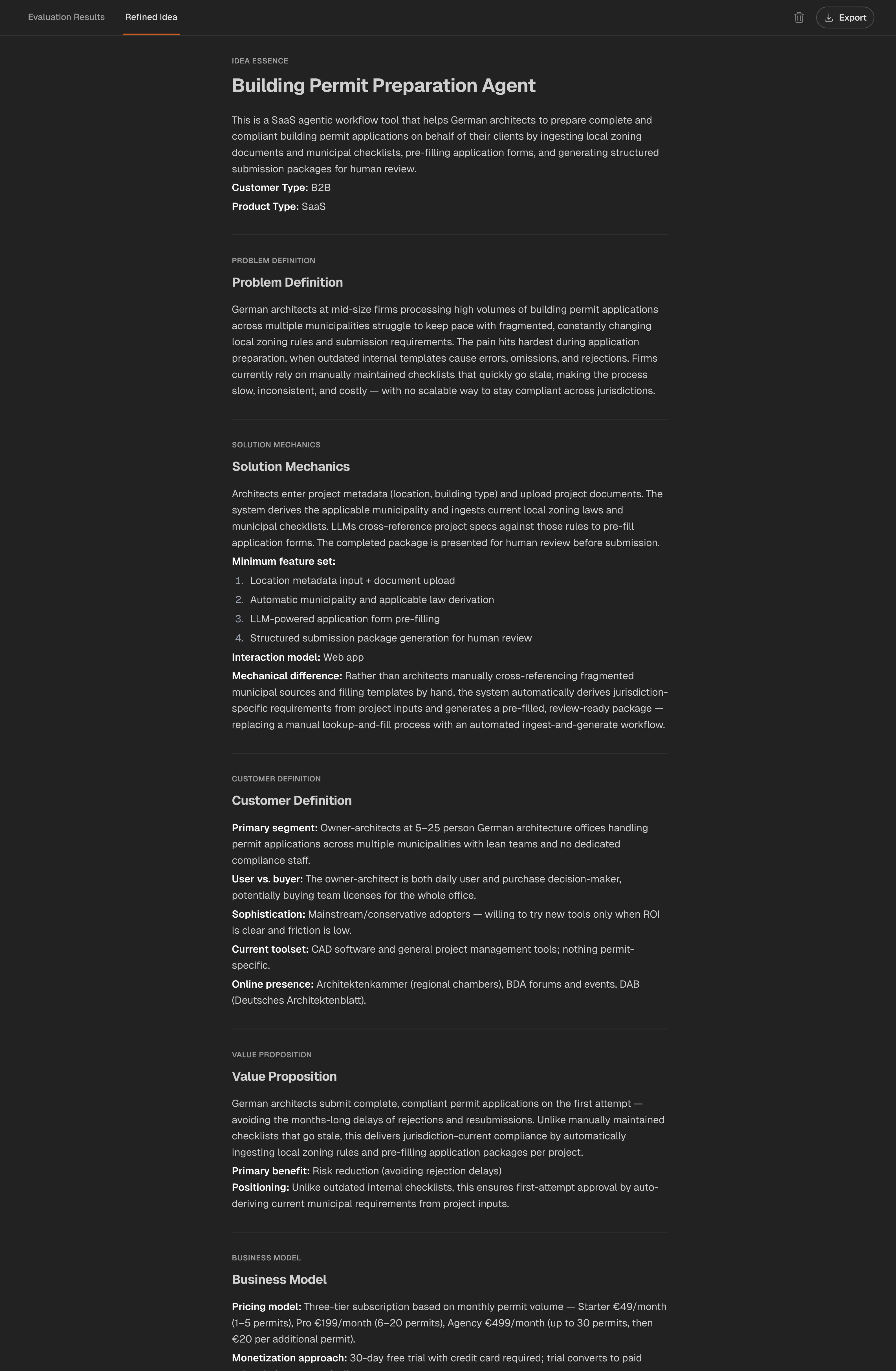
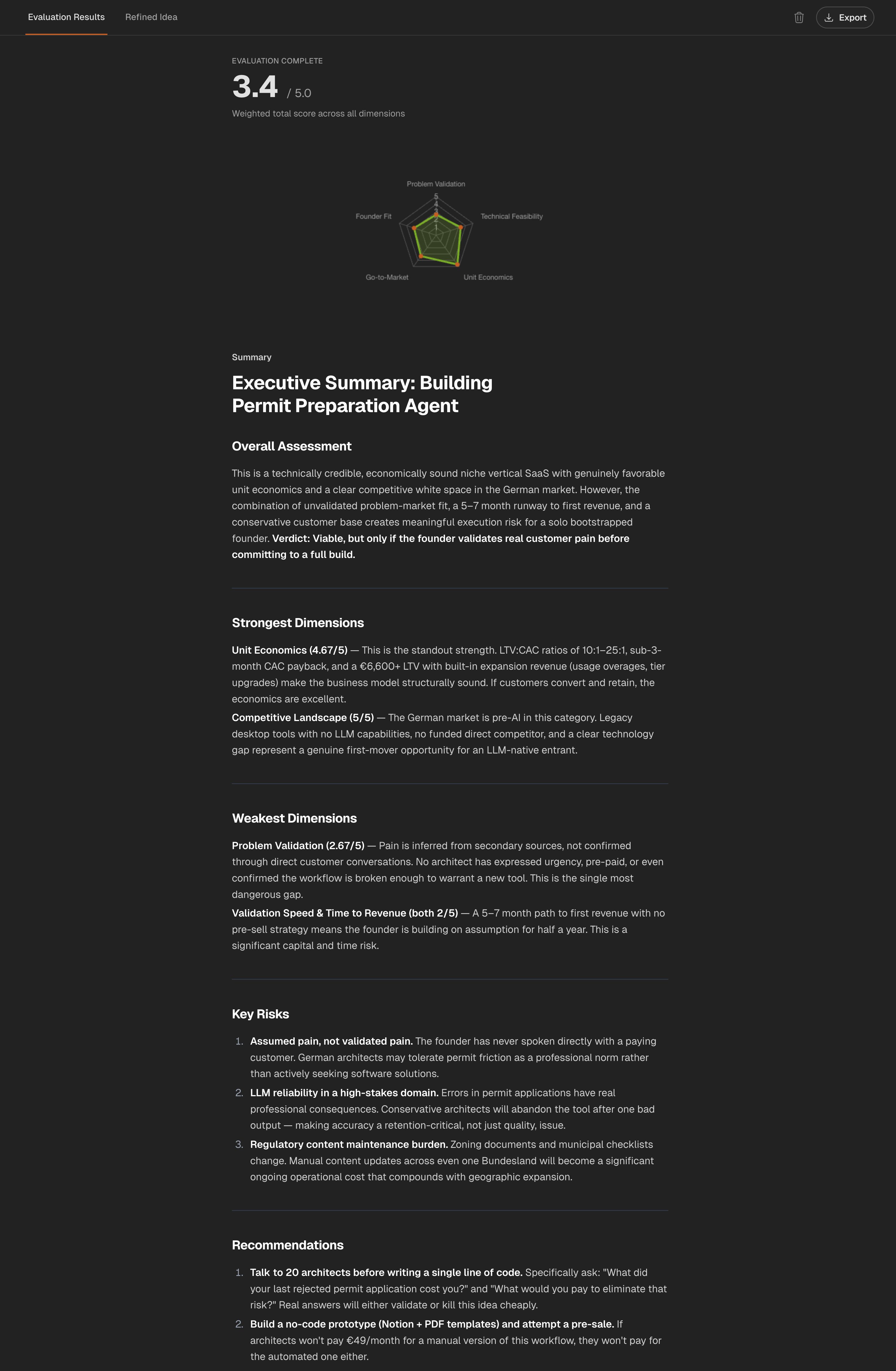
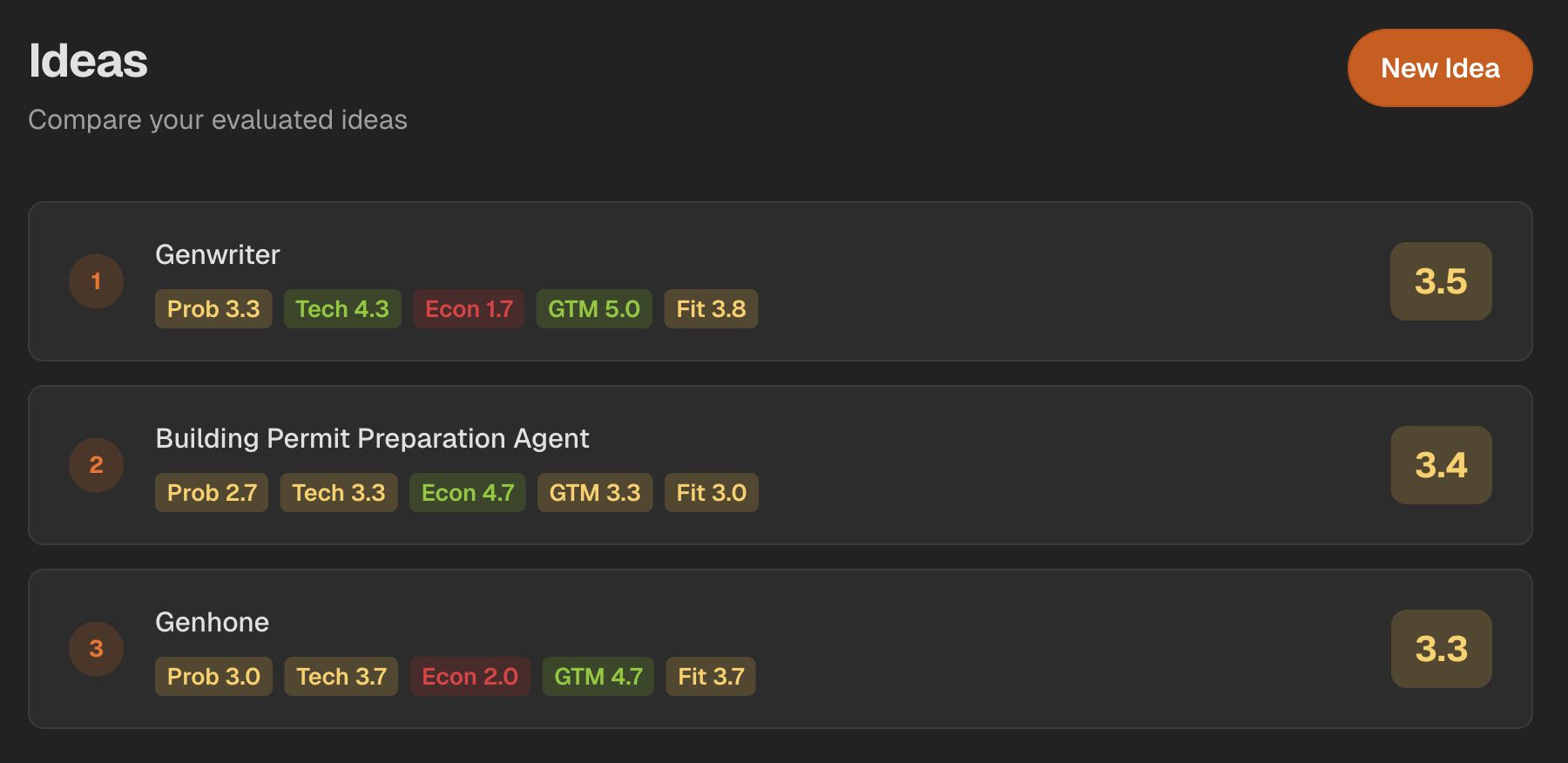
Turn a rough SaaS idea into a refined, scored, and comparable artifact with Genhone.
Which Tool Should You Use First?
Use the tool that matches your current uncertainty.
If you have not named the buyer, use a fast validator or prompt to get objections. If the idea is specific enough to judge, use a scorecard. If you want a packaged artifact, use a report tool. If you have a backlog of ideas, use an idea database. If you are deciding which SaaS idea deserves the next build cycle, use a saved scoring workflow.
Using more than one tool is fine if each tool has a different job. The trap is using tool after tool to avoid real buyer evidence.
| If your situation is... | Use this tool type first | Why | Next step |
|---|---|---|---|
| You have a one-line idea and want quick objections. | Fast AI validator or ChatGPT/Claude prompt. | You need initial questions before deeper work. | Refine the buyer, problem, alternatives, and monetization assumptions. |
| You want to see the criteria behind the score. | Structured scorecard. | Transparent criteria make the judgment auditable. | Inspect weak dimensions before trusting the total score. |
| You want a packaged analysis artifact. | AI validation report. | Reports can summarize market signals, competitors, charts, and next actions. | Separate AI inference from real buyer evidence. |
| You have many product ideas to organize. | Idea database or prioritization board. | Clustering and priority tiers help manage idea volume. | Choose which ideas deserve deeper validation. |
| You are a solo SaaS founder choosing what to build next. | Genhone-style saved scoring workflow. | Structured refinement, founder-fit input, and saved comparison support repeatable decisions. | Compare the scored artifact against other ideas and gather the next evidence. |
The next step after any tool output is not always "build." It may be narrow, kill, or gather better evidence. If you are comparing several concepts, read how to choose between startup ideas. If a tool exposes fatal weakness, use when to kill a startup idea to avoid turning a weak score into a sunk-cost build.
Turn a rough SaaS idea into a refined, scored, and comparable artifact with Genhone.
What Validation Tools Can and Cannot Prove
Validation tools are useful when they reduce ambiguity. They are dangerous when they create fake certainty.
A good tool can help you:
- Structure a rough idea.
- Surface assumptions.
- Score risks consistently.
- Compare ideas.
- Identify next evidence steps.
- Reduce build-before-validation risk.
A tool cannot prove:
- Customers will pay.
- The market is large enough.
- Product-market fit exists.
- The founder will execute well.
- Future revenue or startup success.
Real evidence still comes from buyer behavior. That can include buyer conversations, current spend, pricing tests, manual concierge tests, competitor review mining, and waitlist or landing-page tests when the offer is specific enough.
For willingness to pay, use tool output to decide what to test next, then validate SaaS pricing with actual buyer conversations, payment signals, or current-spend evidence. For market and alternative claims, use SaaS competitor analysis before MVP to inspect what customers already use and complain about. If you need a checklist-style next step, the AI SaaS idea validation checklist can help turn weak assumptions into evidence tasks.
Every useful output should point to one of four decisions: build a narrow test, narrow the idea, kill or archive it, or gather better evidence.
FAQ
What is a startup idea validation tool?
A startup idea validation tool is a tool or workflow that helps founders structure an idea, inspect assumptions, score risk, and decide what evidence to gather before building.
A useful tool does more than encourage you. It gives criteria, reasoning, evidence boundaries, and next actions.
What is the best startup idea validation tool for a solo SaaS founder?
It depends on the stage.
For a fast rough check, a free AI validator or a structured ChatGPT/Claude prompt can help you find objections. For a repeatable SaaS decision, a structured scoring workflow with saved artifacts and side-by-side comparison is more useful.
Genhone is best framed as a fit for solo SaaS founders who need refine, score, compare, and decide support before building.
Can AI startup validation tools prove demand?
No. AI startup validation tools can structure thinking, compare assumptions, and point to evidence gaps. They cannot prove demand by themselves.
Demand is proven through buyer behavior: current spend, pricing conversations, usage, qualified replies, willingness to switch, manual pilots, and repeated evidence that a specific buyer cares enough to act.
How should I compare startup idea validation tools?
Compare structured inputs, criteria transparency, evidence boundaries, founder fit, saved artifacts, access model, privacy disclosures, and next-action clarity.
Then match the tool to the job. A fast validator, scorecard, report, database, and saved scoring workflow are not interchangeable.
When should I use a fast AI validator instead of a structured scorecard?
Use a fast AI validator when the idea is still early and you need objections, questions, or a first-pass sanity check.
Use a structured scorecard when the idea is specific enough to evaluate and compare. If you can name the buyer, problem, current alternative, solution mechanics, monetization assumption, channel, scope, and founder constraints, the scorecard becomes more useful.
How is Genhone different from ChatGPT prompts or one-shot AI validators?
Genhone enforces 12-section refinement, scores 18 criteria across five weighted dimensions, uses direct automated, research-assisted, and founder-conversation scoring, saves artifacts, and lets founders compare ideas.
That does not mean Genhone is always more accurate than every prompt or validator. It means Genhone is built for a different job: turning a rough SaaS idea into a structured, scored, comparable decision artifact.
Should I use more than one startup idea validation tool?
Yes, if each tool has a different job.
For example, use a prompt or fast validator for initial objections, then use a structured scorecard or Genhone-style workflow for a saved decision artifact. Just do not keep using tools as a way to avoid buyer evidence. The output should lead to action: build a small test, narrow the idea, kill it, or collect better evidence.