Startup Idea Validator vs ChatGPT
Technically capable solo SaaS founders and AI-assisted builders have a new problem: Cursor, Claude Code, Lovable, Bolt, v0, ChatGPT, Claude, and similar tools make more ideas feel buildable. But buildability is not validation.
If you are comparing a startup idea validator vs ChatGPT, the question is not whether ChatGPT is useful. It is. The better question is whether you need flexible exploration or a repeatable pre-build decision workflow. For deeper prompt-specific guidance, see the guide to ChatGPT startup idea validation.
Use ChatGPT for flexible startup brainstorming, assumption mapping, prompts, synthesis, and research assistance. Use a startup idea validator when you need a repeatable pre-build decision workflow with structured inputs, a transparent scoring rubric, evidence boundaries, founder-fit context, saved artifacts, and side-by-side idea comparison. ChatGPT helps you explore an idea; a dedicated validator helps you decide what to build, narrow, kill, or validate next.
Neither ChatGPT nor a validator can prove demand, product-market fit, future revenue, retention, or startup success. Customer and market behavior still create the evidence. A useful tool should help you decide what evidence to gather before the next build cycle.
The core lesson is practical: AI can make startup thinking faster, but it should not turn a plausible idea into an unexamined build.
Quick Answer: Startup Idea Validator vs ChatGPT
The answer is not "ChatGPT is bad and validators are good." The tools fit different jobs.
ChatGPT is better for flexible brainstorming, assumption mapping, prompt-driven exploration, discovery-question generation, source-labeled synthesis, research assistance, and drafting validation artifacts. It is a strong thinking partner when the idea is still rough or when you need to challenge your first framing.
A startup idea validator is better when the decision needs structure. That means guided intake, consistent rubric-based scoring, evidence boundary labeling, founder-fit input, saved artifacts, and comparison across multiple ideas. This matters when the founder is choosing what deserves the next build cycle, not just exploring what might be interesting.
| Need | ChatGPT fit | Dedicated startup idea validator fit | Practical recommendation |
|---|---|---|---|
| Brainstorming possible ideas | Strong | Useful only after an idea exists | Use ChatGPT first. |
| Mapping assumptions | Strong if prompted well | Strong if the workflow asks structured questions | Use either, but save the output. |
| Getting a quick outside reaction | Strong | Strong in one-shot validators | Treat as hypothesis generation, not validation. |
| Scoring against a consistent rubric | Manual and founder-managed | Strong | Use a validator when comparing ideas. |
| Separating AI inference from buyer evidence | Manual and easy to skip | Should be built into the workflow | Prefer tools that label evidence limits. |
| Founder-fit input | Possible but unstructured | Strong if captured separately | Prefer a validator for solo-founder decisions. |
| Saved comparable artifacts | Weak unless manually exported | Strong if product supports it | Use a validator when choosing between ideas. |
If you are still choosing between categories, the broader guide to best startup idea validation tools compares validators, scorecards, reports, databases, and saved scoring workflows. This page stays narrower: when to use ChatGPT, when to use a dedicated validator, and how Genhone fits after the brainstorm.
flowchart LR
    A["ChatGPT exploration"] --> B["Structured validator workflow"]
    B --> C["Evidence task"]
    C --> D["Build, narrow, or kill decision"]
What ChatGPT Is Actually Good At During Startup Validation
ChatGPT's official overview positions it broadly around getting answers, finding inspiration, being more productive, writing, brainstorming, editing, web search, uploaded file analysis, coding, data analysis and charts, images, and agent mode. That is a broad general-purpose assistant, not a dedicated startup validation workflow.
For startup validation, those capabilities are still useful. ChatGPT can help turn a vague idea into an assumption map. It can generate discovery questions, challenge a founder's first framing, summarize competitor pages or uploaded notes, organize interview notes, draft outreach, and help interpret source-labeled evidence.
The boundary is evidence quality. ChatGPT can assist research, but the founder remains responsible for source quality, currentness, and interpretation. A clean answer can still rest on broad assumptions, incomplete context, stale sources, or evidence that has not come from the target buyer.
This article does not include a full prompt pack because the ChatGPT startup idea validation guide already owns that job. The useful comparison here is where ChatGPT helps and where a dedicated validator removes manual process work.
Use ChatGPT for exploration, not the final verdict
Use ChatGPT before and after evidence collection.
Before evidence collection, it can help you express the idea as buyer, problem, current alternative, pricing assumption, first channel, risky assumptions, and possible tests. After evidence collection, it can help summarize notes, identify contradictions, and draft the next research step.
What it cannot do is create buyer evidence from a prompt. Longer prompts and newer models improve structure, not proof. A more polished answer does not show that a reachable buyer has urgent pain, current spend, willingness to switch, or willingness to pay.
The safest pattern is to ask ChatGPT for options, objections, and missing assumptions, then use real-world evidence to decide. If the response sounds like a verdict, translate it into evidence tasks.
Keep source labels when ChatGPT summarizes evidence
ChatGPT becomes more useful when it summarizes labeled evidence instead of generic notes.
Use labels such as interview, competitor, pricing, community, search, support, usage, payment, and founder assumption. Then ask ChatGPT to separate facts, quotes, patterns, objections, unresolved assumptions, and interpretation.
Source-labeled synthesis is better than asking for a generic verdict because it keeps the evidence boundary visible. "Three interviewees described this workflow last week" is different from "this seems like a common problem." "A competitor charges $99/month for a related workflow" is different from "users would probably pay."
The founder's job is to preserve that distinction.
What ChatGPT Does Not Enforce by Default
ChatGPT can be used well, but disciplined process is external to the general chat experience.
It does not inherently enforce a repeatable startup-validation process. It does not force the founder to answer uncomfortable sections unless the founder prompts for them and maintains the structure. It does not apply the same rubric across every idea unless the founder supplies and preserves that rubric manually.
It also does not automatically separate market context, AI inference, founder input, and buyer evidence. It can summarize evidence if you provide it carefully, but it does not create buyer behavior by itself. And it does not naturally save ideas as durable comparable artifacts unless the founder exports, names, versions, and maintains the system elsewhere.
That is why founders who use ChatGPT well often still need a separate decision workflow to validate a SaaS idea before building.
| Missing by default | Why it matters | What a validator should add |
|---|---|---|
| Required input structure | Vague ideas get confident but weak answers | Guided sections before scoring |
| Stable rubric | Different prompts produce different judgments | Same criteria and weights across ideas |
| Evidence boundaries | AI inference can sound like validation | Labels for direct, research-assisted, and founder-input scoring |
| Founder-fit context | The same idea can fit one founder and fail another | Separate founder conversation or explicit founder-fit input |
| Persistence | Good reasoning gets lost in chat threads | Saved scored artifacts |
| Comparison | Founders compare vibes instead of criteria | Side-by-side idea comparison |
The limitation is not that ChatGPT cannot help. It can. The limitation is that the founder has to supply the process, preserve the artifacts, and keep evidence separate from inference.
What a Startup Idea Validator Should Add
A startup idea validator should not merely be "ChatGPT with a wrapper." It should add a decision process that a founder can repeat across ideas.
The useful output is a decision artifact, not only a score. A score can rank assumptions, reveal weak dimensions, and suggest the next evidence task. It cannot prove buyers will pay, switch, retain, or recommend the product. A serious validator should make that boundary clearer, not hide it.
There are several validator patterns:
| Validator pattern | Useful for | Main limit |
|---|---|---|
| Quick AI verdict | Getting early friction from a rough idea | Thin inputs can create false confidence |
| Scorecard | Seeing transparent criteria and thresholds | Persistence and comparison may be manual |
| Data-backed validator | Adding external market or community signals | Public signals are not buyer commitment |
| Saved decision workflow | Refining, scoring, saving, and comparing ideas | Requires more input before scoring |
A strong AI startup idea validator should enforce structure, rubric, evidence boundaries, founder-fit input, saved artifacts, and comparison. A lightweight startup idea scorecard can still be useful when the founder wants transparent questions and thresholds.
Structure before scoring
Scoring a one-line idea is risky because the model fills in missing context.
A useful validator should clarify the buyer, problem, current alternative, solution mechanics, pricing, go-to-market path, scope, and founder constraints before scoring. Without that structure, the score may reward the idea that sounds most polished instead of the idea that is most coherent.
For AI-assisted builders, this matters because implementation can start immediately. A vague idea can become a working prototype before the founder has named the buyer, pricing logic, current alternative, or validation threshold.
Evidence boundaries before confidence
A validator should distinguish AI inference, desk research, founder claims, and buyer behavior.
Data-backed tools can add useful external signals such as search demand, trend movement, competitor pages, or community conversations. Those signals help shape discovery questions. They still do not prove that the specific buyer you can reach will pay or switch.
The right sequence is evidence boundaries before confidence. A score that labels its limits is more useful than a verdict that sounds certain but hides the source type.
Comparison before commitment
AI-assisted builders often have too many plausible ideas.
One ChatGPT session can produce a list of ideas. One weekend can produce a prototype. The scarce resource is no longer only build speed; it is judgment. Saved comparable artifacts help founders choose which idea deserves the next build cycle.
The comparison should inspect weak dimensions, evidence gaps, founder fit, and next validation tasks. It should not only sort ideas by excitement or by the fluency of the original brainstorm.
Compare ChatGPT, One-Shot Validators, Scorecards, Data-Backed Validators, and Genhone
This is a category comparison, not a ranking. The right tool depends on the job you need done now.
The official source examples below were checked against the June 20, 2026 source pack and are used only for official positioning. They are not independent endorsements, performance claims, accuracy claims, or rankings. Competitor pages can change quickly, so refresh official positioning before publication if this draft sits for long.
| Source-pack example | Official positioning used here | Boundary in this article |
|---|---|---|
| ChatGPT | ChatGPT's official overview positions it broadly around answers, inspiration, productivity, writing, brainstorming, editing, web search, uploaded file analysis, coding, data analysis and charts, images, and agent mode. | Treated as a flexible general-purpose assistant, not a dedicated validation workflow. |
| IdeaValidator | IdeaValidator positions itself as a free AI business idea validator with clarifying questions, four scored dimensions, verdict language, market data, competitor analysis, go-to-market planning, and optional PRD generation. | Used as evidence that validator products contrast structured scores with a general ChatGPT opinion. PRD scope is outside Genhone's current boundary. |
| SaaSValidatr | SaaSValidatr mentions SaaS-specific AI scoring, competitor analysis, market sizing, revenue-model support, team voting, and a comparison path for ChatGPT. | Used as SaaS-specific validator positioning. Team voting and revenue projections are outside Genhone's current scope. |
| Meysam SaaS Idea Validator | Meysam presents a browser-based scorecard with 20 questions across Market, Problem, Solution, Distribution, and Founder Fit, plus a 0-100 score, category breakdown, and action plan. | Used as evidence that transparent scorecards are a common alternative. |
| DontBuildYet | DontBuildYet positions its workflow around search demand, Google Trends signals, real conversations, traceable insights, and a contrast against generic AI. | Used as evidence for the "real data vs generic AI" comparison pattern. Public signals still do not prove buyer willingness to pay. |
For broader tool selection, use the full guide to startup idea validation tools. The table below focuses on the job-to-be-done behind each option.
| Option | Best job-to-be-done | What it gives you | Where it can mislead | Best next step |
|---|---|---|---|---|
| ChatGPT | Explore and sharpen an idea flexibly | Brainstorming, assumptions, prompts, synthesis, research assistance | A confident answer can feel like evidence | Use it to map assumptions, then preserve evidence separately. |
| One-shot AI validator | Get a fast outside reaction | Clarifying questions, quick scores, verdict language | Thin inputs can create false confidence | Use it for early friction, not the final build decision. |
| Browser scorecard | Score yourself against transparent criteria | Questions, categories, score thresholds, action plan | No persistence or comparison unless the tool supports it | Use it when you want a lightweight rubric. |
| Data-backed validator | Add external market or community signals | Search demand, trends, community conversations, traceable insights | Public signals do not prove your buyer will pay | Use it to prioritize discovery questions. |
| Genhone | Turn a SaaS idea into a saved, scored, comparable decision artifact | 12-section refinement, 18 criteria, founder conversation, saved score, side-by-side comparison | Requires completing the structured workflow; still not proof of demand | Use it when deciding which SaaS idea deserves the next build cycle. |
Turn a ChatGPT brainstorm into a refined, scored, and comparable Genhone artifact.
How Genhone Fits After a ChatGPT Brainstorm
Genhone is for technically capable solo SaaS founders who build quickly with AI coding tools but need a structured decision checkpoint before building.
It fits after ChatGPT creates ideas, assumptions, or a plausible but unverified plan. ChatGPT can help the founder explore. Genhone helps turn the best candidate into a refined, scored, saved, comparable artifact.
The workflow is intentionally narrower than broad product planning. Genhone does not generate PRDs, roadmaps, pitch decks, landing pages, code, team votes, investor scores, or growth strategies. It does not prove demand and does not replace customer discovery. Its job is refine, score, compare, and decide what deserves evidence next.
As a SaaS idea validation tool, Genhone currently works like this:
- The founder starts with a rough SaaS idea.
- Genhone guides 12-section refinement before scoring.
- Automated scoring runs for direct and research-assisted criteria.
- A separate founder conversation gathers founder-fit input.
- Genhone synthesizes five weighted dimension scores, a weighted total, interpretation, and criteria-level reasoning.
- The result is saved as a scored artifact.
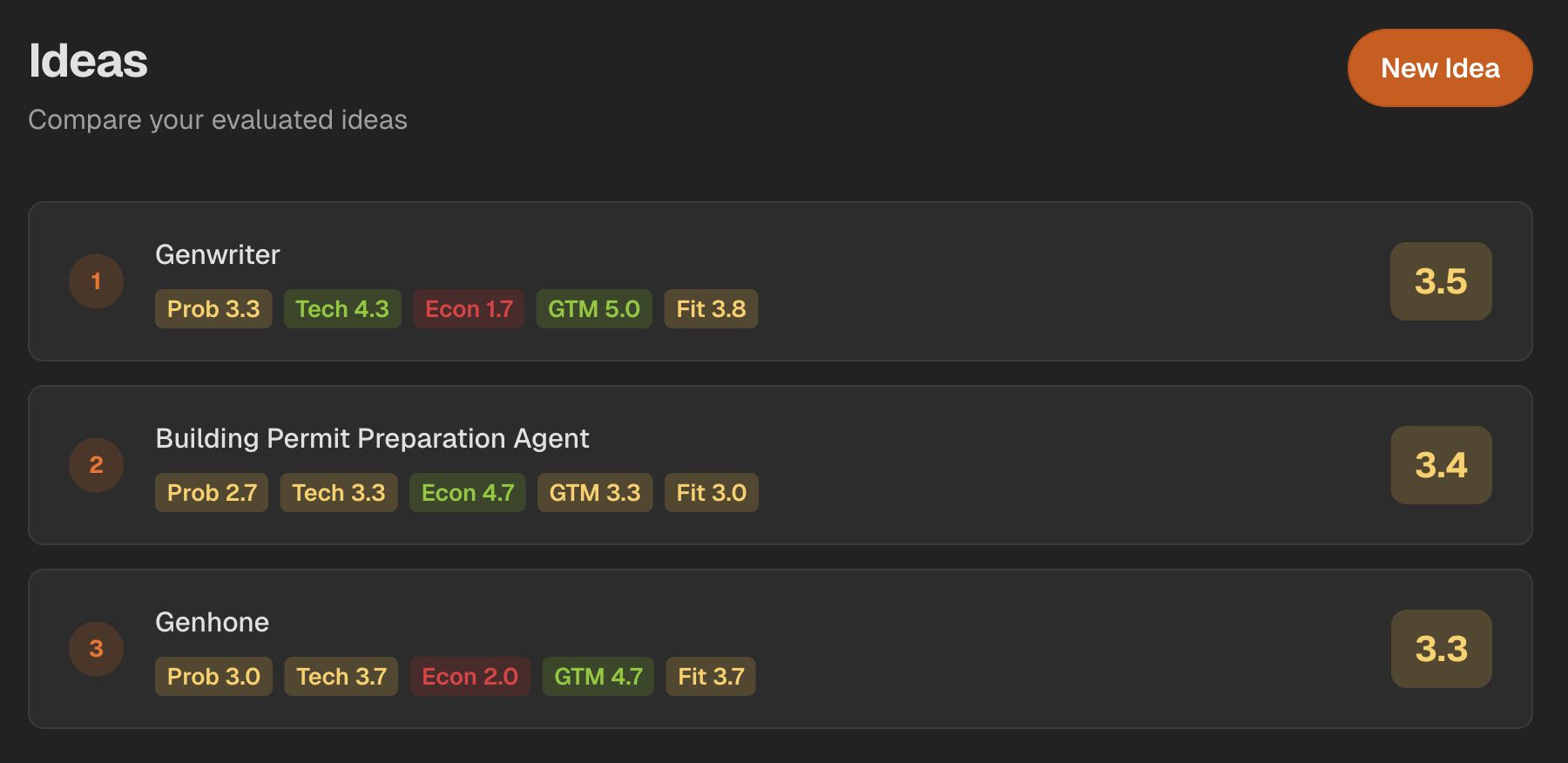
- The founder can compare ideas side by side.
| Genhone step | What it does | Why it matters vs ChatGPT |
|---|---|---|
| 12-section refinement | Guides the founder through idea essence, problem, solution, customer, value proposition, business model, technical foundation, GTM, onboarding, metrics, scope, and solo-founder execution | The founder does not have to maintain the process manually in a chat thread. |
| 18-criterion scoring | Scores the refined idea across five weighted dimensions | Every idea is judged against the same rubric. |
| Direct and research-assisted scoring | Uses refined idea content directly and uses research where market context matters | The score is not only a generic opinion from a vague prompt. |
| Founder conversation | Gathers founder-specific inputs where the idea text is not enough | The same idea can be strong for one founder and weak for another. |
| Saved artifact | Stores scores and reasoning | The decision can be revisited after new evidence. |
| Side-by-side comparison | Compares saved ideas | The founder can choose between ideas using criteria, not excitement. |
For deeper rubric context, see the SaaS idea scoring framework. For the founder-specific part of the decision, use the guide to founder-idea fit.
Methodology note: Genhone starts with 12-section structured refinement, scores 18 criteria across five weighted dimensions, combines direct scoring from the refined idea with research-assisted scoring where market context matters, gathers founder-fit input through a separate founder conversation, and saves the result as a comparable idea artifact. The score is decision support. It is not a prediction and cannot replace customer discovery.
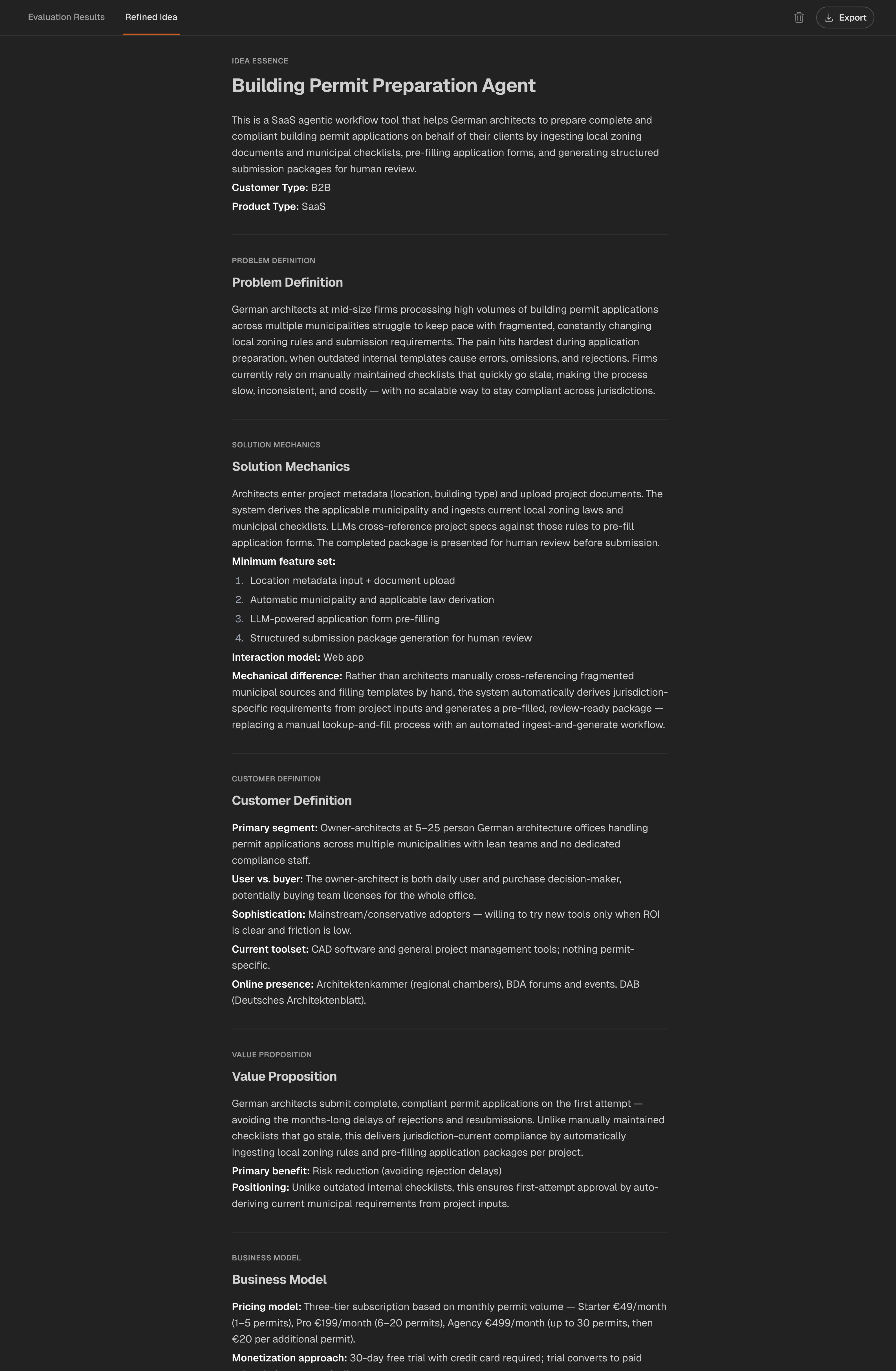
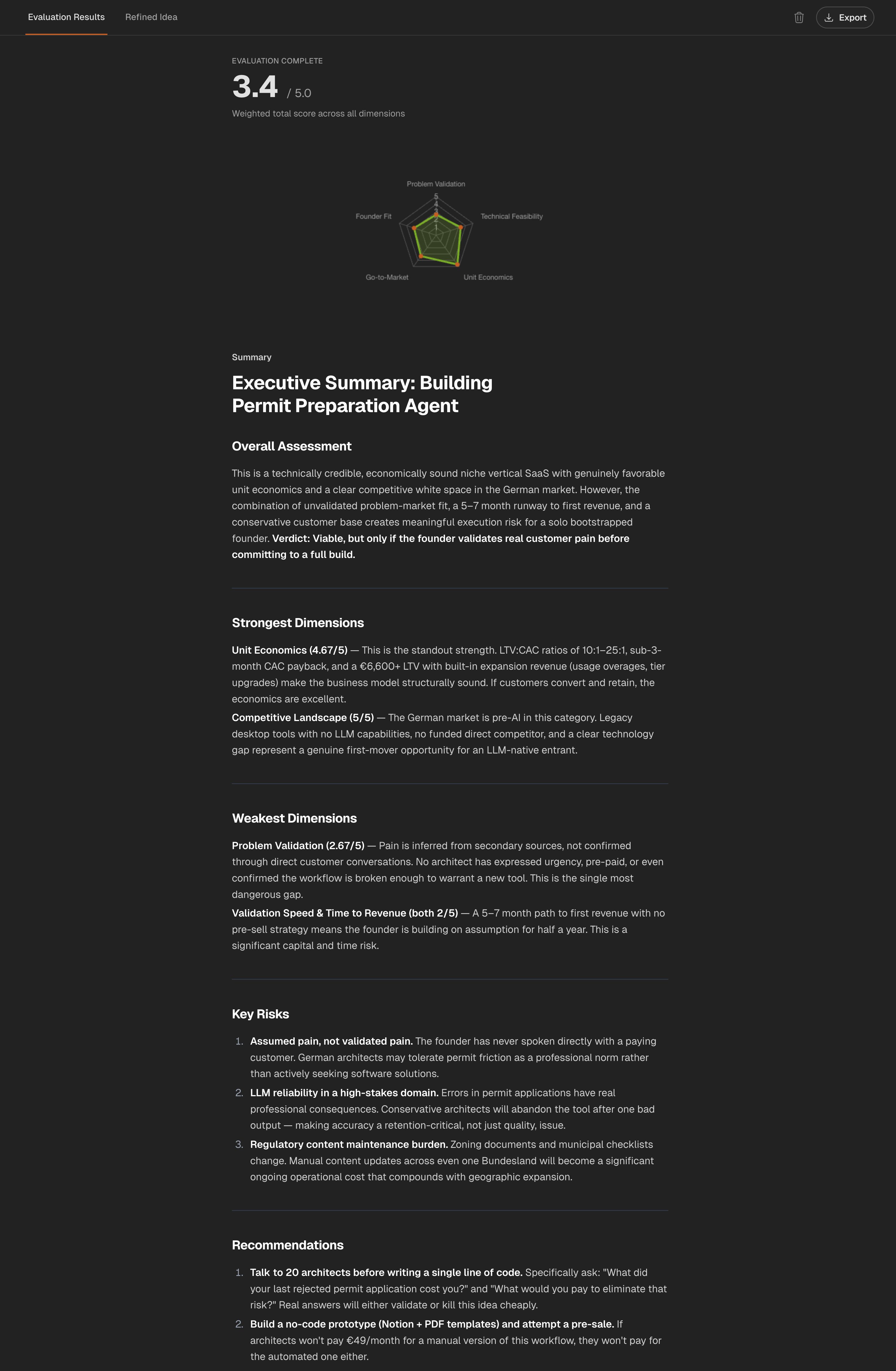
Turn a ChatGPT brainstorm into a refined, scored, and comparable Genhone artifact.
Use ChatGPT and a Startup Idea Validator Together
The best workflow is often sequential, not either/or.
Use ChatGPT to explore, then use a validator to make the decision artifact repeatable. After that, use customer and market evidence to reduce uncertainty. If the evidence changes the idea, update the artifact and compare again.
A practical sequence:
- Use ChatGPT for rough exploration and assumption mapping.
- Move the best candidate into a structured validator.
- Score the refined version.
- Use weak dimensions to choose evidence tasks.
- Bring source-labeled evidence back into ChatGPT for synthesis if useful.
- Rescore or compare ideas after new evidence.
| Stage | Better tool | Output |
|---|---|---|
| Brainstorm possible wedges | ChatGPT | Idea list and assumption map |
| Decide if an idea is specific enough to evaluate | ChatGPT or validator intake | Missing-input list |
| Build a comparable decision artifact | Startup idea validator | Structured score and reasoning |
| Choose the next validation task | Startup idea validator plus founder judgment | Build, narrow, kill, or gather-evidence decision |
| Summarize collected evidence | ChatGPT, if notes are source-labeled | Evidence summary with unresolved assumptions |
| Compare several ideas | Validator with saved artifacts | Side-by-side idea ranking and next steps |
This is where saved artifacts matter. A founder who keeps every idea in a chat thread has to compare memory, excitement, and scattered notes. A founder with saved scored artifacts can compare weak dimensions, evidence gaps, and next tasks. For the broader decision process, read how to compare startup ideas.
What Neither ChatGPT Nor a Validator Can Prove
Neither ChatGPT nor a startup idea validator can prove customers will pay, the market is large enough, product-market fit exists, retention will hold, a founder will execute well, future revenue will appear, or the startup will succeed.
That is not a flaw in one tool. It is the nature of startup validation.
Useful evidence still comes from buyer behavior:
- Interviews about recent behavior.
- Current alternatives and workarounds.
- Competitor review mining.
- Pricing conversations.
- Waitlists from qualified traffic.
- Paid pilots or deposits.
- Manual concierge tests.
- Usage and retention signals.
ChatGPT helps explore. Validators help structure and compare. Customers and market behavior create validation evidence.
The right decision standard is not "the AI liked it." It is: what is the weakest important assumption, what evidence would change the decision, and what is the cheapest test that can produce that evidence?
If willingness to pay is weak, validate SaaS pricing before launch. If the alternative landscape is unclear, run SaaS competitor analysis before MVP. If the score and evidence show the idea is not worth another build cycle, use a deliberate process for when to kill a startup idea.
A Genhone score should point to the next evidence task. It should not become a permission slip to build everything.
Move from a ChatGPT brainstorm to a structured Genhone score.
FAQ
Is ChatGPT good for startup idea validation?
Yes, if you use it for brainstorming, assumption mapping, research assistance, prompt-driven exploration, and synthesis.
No, if you treat its answer as buyer evidence or a final verdict. ChatGPT can help you think faster, but demand still needs evidence from real buyer behavior, pricing signals, current alternatives, or usage.
Is a startup idea validator better than ChatGPT?
A startup idea validator is better when you need a repeatable workflow, consistent scoring rubric, evidence boundaries, founder-fit input, saved artifacts, and side-by-side comparison.
ChatGPT is better for flexible exploration. Use it when the idea is still rough, when you want alternate framings, or when you need help organizing notes.
When should I use ChatGPT instead of a validator?
Use ChatGPT when the idea is still forming, when you want to generate possible wedges, when drafting discovery questions, or when summarizing source-labeled notes.
Move into a validator when the idea is specific enough to judge and you need the output to be comparable against other ideas.
What does a dedicated startup idea validator add?
A dedicated startup idea validator adds structured intake, scoring criteria, rubric consistency, evidence limits, founder-fit input, persistent artifacts, and side-by-side comparison.
The best validators do not only give a score. They show what the score is based on, where the evidence is weak, and what the founder should test next.
Can ChatGPT or a startup idea validator prove demand?
No. Demand needs buyer behavior.
Useful evidence can include current spend, interviews about recent workflows, switching signals, pricing conversations, paid pilots, deposits, qualified waitlists, manual service tests, or usage that repeats over time.
How is Genhone different from ChatGPT?
Genhone enforces 12-section refinement before scoring, evaluates ideas across 18 criteria in five weighted dimensions, includes direct, research-assisted, and founder-conversation inputs, saves scored artifacts, and supports side-by-side comparison.
It does not build the product, generate PRDs, create roadmaps, write code, replace customer discovery, or prove demand.
Should I use ChatGPT and a startup idea validator together?
Yes. Use ChatGPT to explore and synthesize. Use a validator to structure, score, save, and compare before committing to a build.
Then use customer and market evidence to update the decision. The best answer is not "ChatGPT or validator forever." It is ChatGPT for exploration, validator for repeatable decision artifacts, and customer evidence for validation.