Founder-Market Fit for SaaS Ideas
Technically capable solo founders and AI-assisted builders can start more SaaS products than ever. Cursor, Claude Code, Lovable, Bolt, v0, ChatGPT, and Claude can make many ideas feel buildable. That does not mean the market is a good fit for this founder.
The practical question behind founder-market fit for SaaS is not "would a VC fund this?" It is: should you spend your next build cycle on this market, with your access, skills, credibility, stamina, and support capacity?
Founder-market fit for a SaaS idea is the match between a specific founder and a specific market opportunity. It asks whether the founder has enough buyer access, domain insight, credibility, build skill, stamina, support capacity, and validation speed to understand the problem and reach early customers before committing to a full build.
Founder-market fit is decision support. It does not prove demand, product-market fit, revenue, willingness to pay, or future success. It should help you decide whether to build a narrow test, narrow the market, kill the idea, or gather better evidence before code creates sunk cost.
What Founder-Market Fit Means for a SaaS Idea
Founder-market fit is the match between this founder and this market opportunity. For a SaaS idea, it asks whether you can understand the buyer, validate the problem, build a credible first workflow, reach early customers, and support the product long enough to learn.
That is different from product-market fit. In Marc Andreessen's classic framing, product-market fit is about being in a good market with a product that can satisfy that market. The Superhuman PMF article from First Round also shows how PMF thinking often depends on user signals after a product is already in use.
Founder-market fit sits earlier. Before you have real usage, retention, buying, or pull, you can still ask whether you are unusually well positioned to learn from this market. Can you reach buyers? Do you understand their workflow? Will they believe you understand their problem? Can you build and support a narrow version without a team?
Founder-market fit overlaps with founder-idea fit, but it should stay market-specific. Founder-idea fit asks whether the idea fits your skills, interests, constraints, and context. Founder-market fit asks whether you fit the buyer, workflow, distribution path, and support reality of the market.
The term is often popularized in investor contexts. For example, Scott Kupor's VC framing in WIRED describes founder-market fit around the founding team's unique characteristics relative to an opportunity. This article translates that idea away from fundraising and into solo SaaS idea selection.
| Concept | Core question | When it is judged | What it should decide |
|---|---|---|---|
| Product-market fit | Does the product satisfy a market strongly enough that usage, retention, buying, or pull shows up? | Mostly after a product has real users or buyers. | Whether the product and market are working together. |
| Founder-market fit | Is this founder unusually suited to pursue this market opportunity? | Before and during early validation. | Whether the founder should build, narrow, kill, or gather evidence for this idea. |
| Founder-idea fit | Does the founder's background, skills, interests, and constraints match this idea? | Before committing to the idea. | Whether the idea is a good personal and execution fit. |
The point is not to create another abstract founder label. Founder-market fit should change the next action on a specific SaaS idea.
Why Founder-Market Fit Matters Before You Build
A solo SaaS founder is not only the builder. You are also the customer researcher, sales function, support function, product owner, and operator. Founder-market fit matters because every one of those jobs depends on how close you are to the market.
Buyer access changes validation speed. If you can talk to real buyers this week, you can learn faster than a founder who only has a broad market label and no path to conversations.
Domain insight changes evidence quality. A founder who understands the workflow can ask sharper questions, notice edge cases, and avoid mistaking polite interest for urgent pain. That still does not replace customer discovery, but it helps you interpret what you hear.
Technical skill match changes build scope. A market may require integrations, compliance, deployment, data handling, or support workflows that one founder cannot maintain. A product can be technically possible and still be a poor solo-founder bet.
Stamina matters because SaaS does not end at the prototype. You have to talk to customers repeatedly, handle support, hear objections, inspect edge cases, and keep improving a workflow that may be less exciting than the demo.
AI-assisted building raises the stakes. When implementation feels cheaper, weak-fit ideas become easier to rationalize. Before you evaluate a SaaS idea before building, ask whether you are actually close enough to the market to learn from it.
The 8 Founder-Market Fit Signals to Inspect
You do not need a perfect score on every signal. A founder can compensate for weak domain expertise with fast learning and strong buyer access. A founder can compensate for limited technical skill by narrowing scope. But weak signals should change the next action. They should not be ignored because the idea is easy to prototype.
Personal experience can help you notice a problem, but it is not validation by itself. The useful question is whether your experience gives you better access, better questions, better interpretation, or a faster path to evidence.
| Signal | Question to ask | Strong indicators | Weak indicators |
|---|---|---|---|
| Buyer access | Can you reach the people who feel this problem now? | Existing community access, warm intros, customer list, professional network, active niche forums, reachable interviewees. | Buyer is abstract, no direct access, only broad market labels, no place to find first conversations. |
| Lived or domain insight | Do you understand the workflow well enough to spot real pain and edge cases? | Firsthand exposure, repeated observation, prior work in the domain, close relationship to users, specific workflow language. | Trend-chasing, surface-level category interest, cannot describe current alternatives or daily workflow. |
| Buyer credibility | Will buyers believe you understand enough to ask good questions and earn trust? | Relevant background, visible work, credible empathy, ability to speak buyer language, proof of understanding. | Founder must constantly explain why they are in the market, lacks context, or sounds like an outsider with a generic AI tool. |
| Technical skill match | Can you build and operate the first useful version with your current skills? | Known stack, small learning curve, bounded integrations, clear deployment path, manageable maintenance. | New stack plus new domain plus complex integrations, compliance, AI/data risk, or support-heavy implementation. |
| First-customer reach | Can you reach the first 10-20 qualified users or buyers without a large budget? | Specific channel, community, marketplace, direct outreach list, founder audience, partner surface, searchable pain. | "SEO later," paid ads without economics, no buyer habitat, or a sales motion that requires a team. |
| Long-term interest | Can you keep learning, selling, and supporting this problem for years? | Durable curiosity, respect for the customer, willingness to handle repeated objections and edge cases. | Interest comes mainly from novelty, trend, or ease of prototype; boredom appears once the demo exists. |
| Support and operational fit | Can you support the customer and workflow alone if the product starts working? | Self-serve onboarding, predictable support, low manual service load, manageable edge cases, clear failure modes. | High-touch implementation, customer-specific workflows, heavy compliance, brittle integrations, or constant manual operations. |
| Validation speed and revenue path | Can you learn and possibly charge quickly enough to avoid long blind building? | Fast interviews, manual pilot, pricing conversation, paid workflow, clear budget owner, narrow first deliverable. | Must build full platform to learn, long procurement, unclear buyer, free-user dependency, or no path to first revenue. |
Read the signals as a chain. Buyer access determines whether you can learn quickly. Lived or domain insight helps you understand current alternatives, which is where a focused competitor analysis before MVP can sharpen the idea. Buyer credibility affects whether prospects will have serious conversations with you. If access or credibility is weak, step back and define the ICP for a SaaS idea before changing product scope.
Technical skill match and support fit control whether the first version is sustainable. First-customer reach controls whether the idea can get in front of the right people without a large budget. Long-term interest matters because SaaS learning is repetitive. Validation speed and revenue path matter because interest is not the same as payment logic. If commercial evidence is weak, validate SaaS pricing before building.
Use Founder-Market Fit to Decide Build, Narrow, Kill, or Gather Evidence
Founder-market fit should change the next action. It is not useful if it only produces self-awareness.
Strong fit does not mean "build everything." It usually means you can run the next evidence step faster than a random capable builder. You may be able to build a narrow manual workflow, run better interviews, test pricing, or ship a tightly scoped MVP because you already understand the buyer and can reach them.
Weak fit does not always mean kill. It may mean narrowing to a buyer you can access, choosing a smaller workflow, partnering carefully, or gathering evidence before building. The decision should follow the weakest signal.
| Founder-market fit pattern | What it means | Best next action |
|---|---|---|
| Strong access, insight, skill match, and first-customer reach | The founder is well positioned to test the idea quickly. | Build the next smallest validation test or tightly scoped MVP. |
| Strong problem insight but weak buyer access | The founder understands the pain but cannot yet reach buyers reliably. | Gather evidence by building a prospect list, joining communities, or narrowing to a reachable segment. |
| Strong build skill but weak market insight | The founder can prototype quickly but may build the wrong workflow. | Narrow and interview before coding; do not let build speed substitute for evidence. |
| Strong interest but weak payment or revenue path | The founder likes the market, but commercial proof is thin. | Validate pricing, current spend, budget owner, or paid pilot path before building. |
| Strong market but poor founder fit | The opportunity may be real, but this founder is poorly positioned. | Kill, archive, partner only with caution, or choose a closer market. |
| Weak support or operational fit | The idea may work but become unsustainable for one person. | Reduce scope, remove manual operations, choose a self-serve wedge, or kill if support is inherent. |
This is where founder-market fit connects to score-backed decisions. If the weak signal is fatal and there is no realistic evidence path, revisit when to kill a startup idea. If the weak signal is specific and testable, gather evidence instead of starting a full build.
Turn a rough SaaS idea into a scored, comparable artifact with Genhone.
How Founder-Market Fit Shows Up in Genhone's Scoring
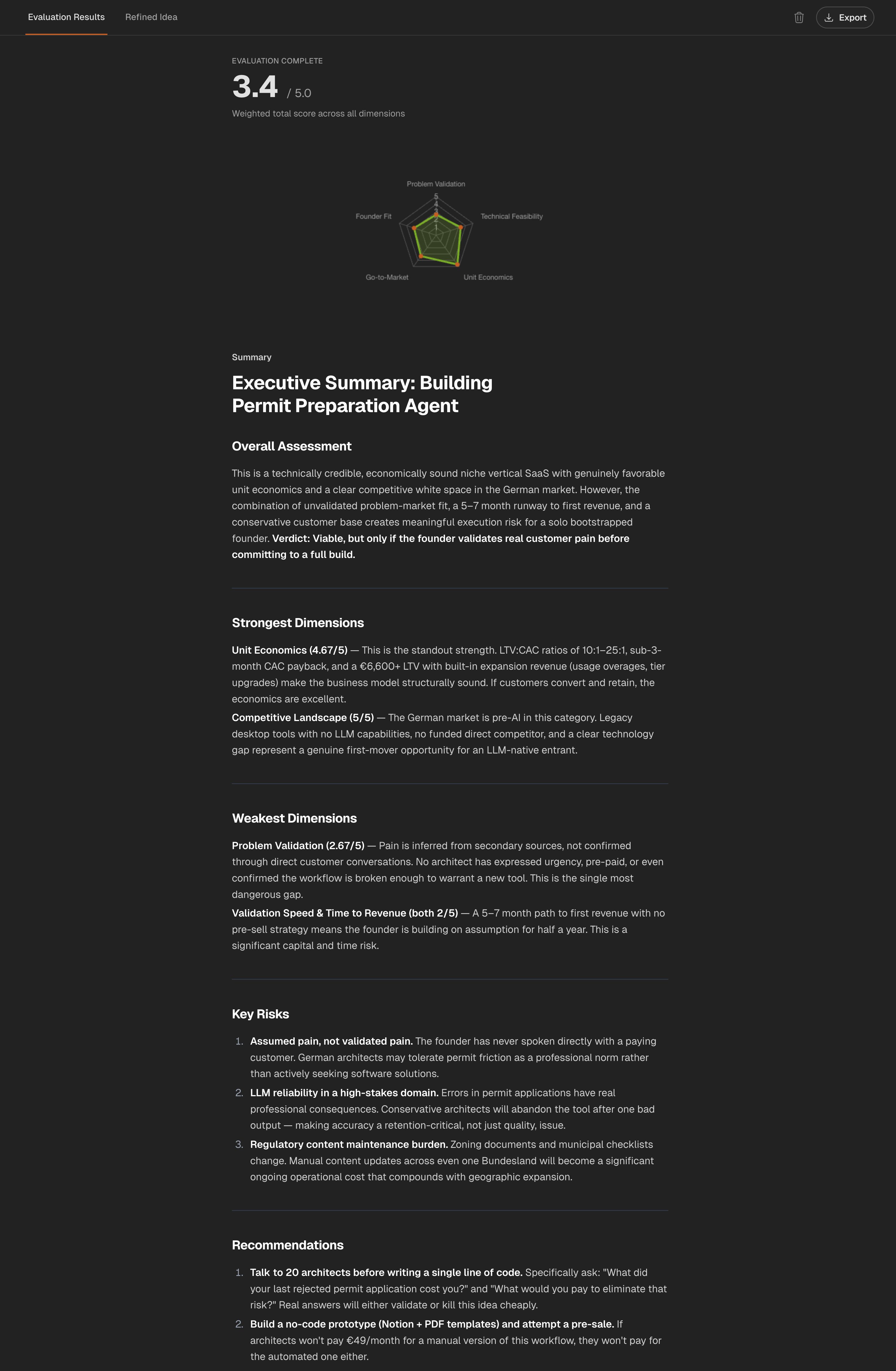
Genhone is strategic pre-build evaluation software for technically capable solo founders. It helps founders refine, score, save, and compare SaaS ideas before building.
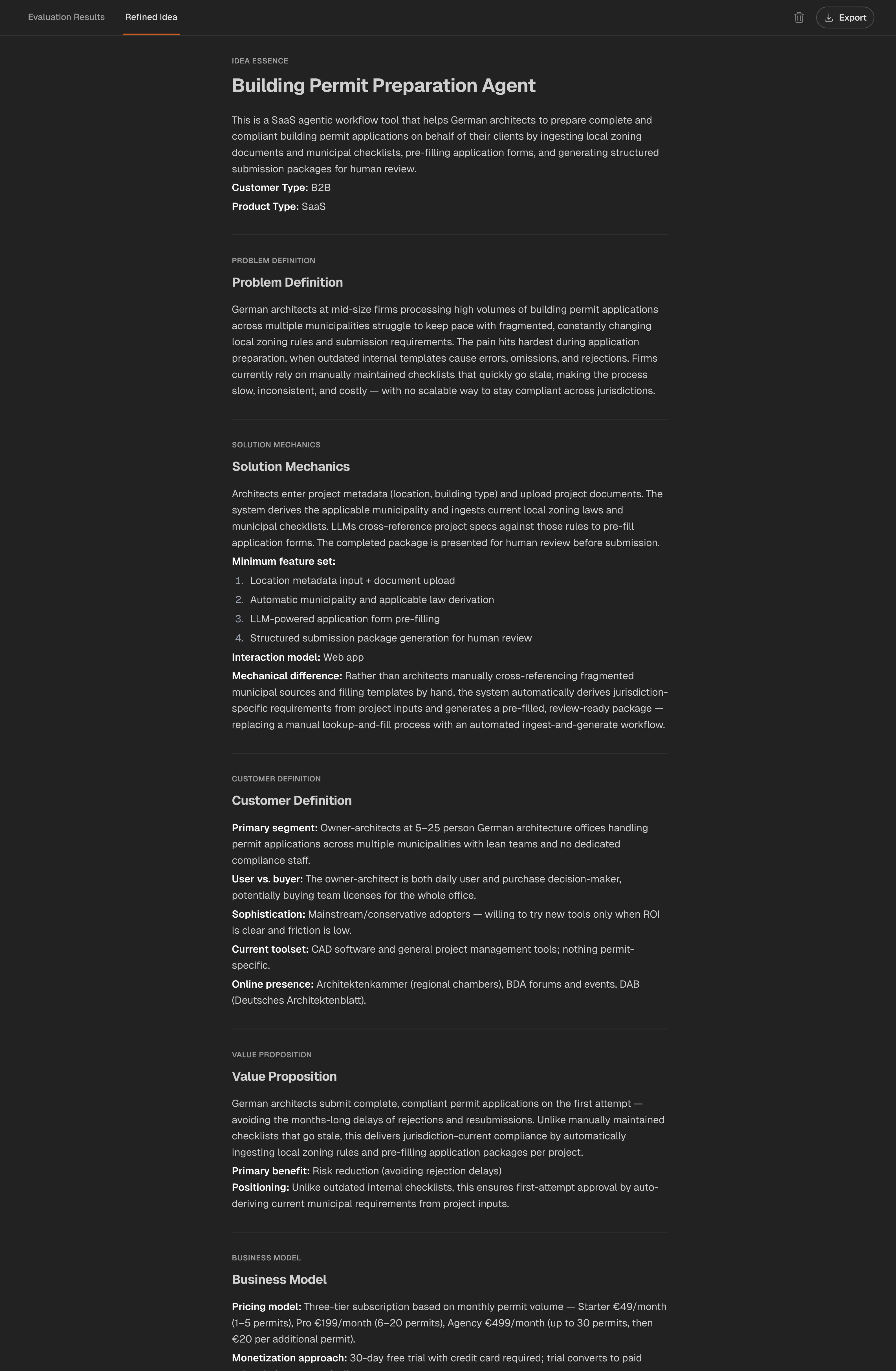
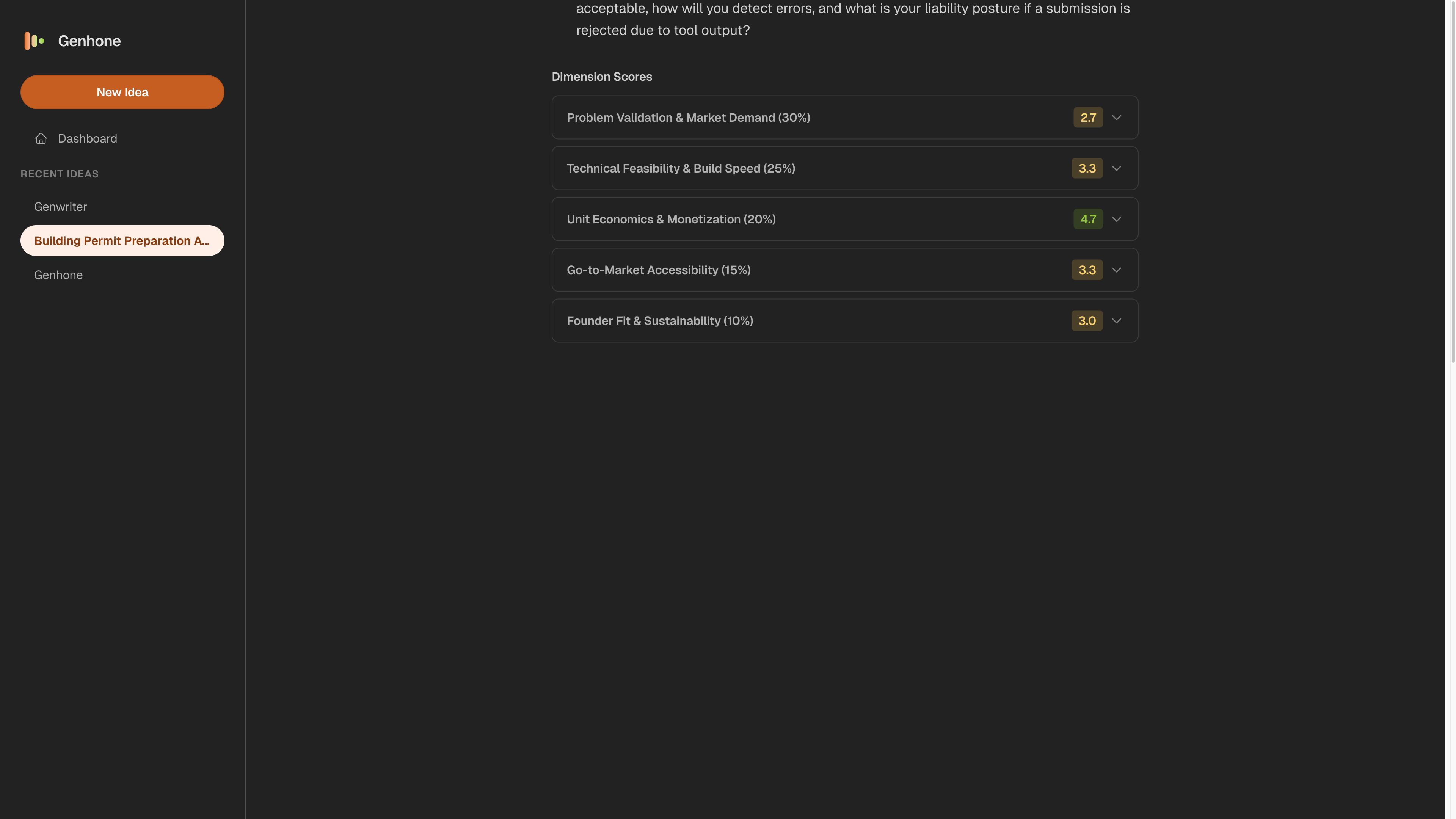
The workflow starts with 12 enforced refinement sections, so founder fit is judged against a structured idea, not a vague hunch. Then Genhone scores each idea across 18 criteria in 5 weighted dimensions:
| Dimension | Weight |
|---|---|
| Problem Validation & Market Demand | 30% |
| Technical Feasibility & Build Speed | 25% |
| Unit Economics & Monetization | 20% |
| Go-to-Market Accessibility | 15% |
| Founder Fit & Sustainability | 10% |
Founder Fit & Sustainability contains Competitive Landscape, Personal Interest, Resource Requirements, Operational Complexity, Validation Speed, and Time to Revenue.
But founder-conversation input is not limited to that dimension. Five criteria require founder conversation or personal insight: Problem Criticality, Willingness to Pay, Technical Skill Match, Personal Interest, and Operational Complexity. Those five criteria span demand, feasibility, and sustainability. They do not all belong only to Founder Fit & Sustainability.
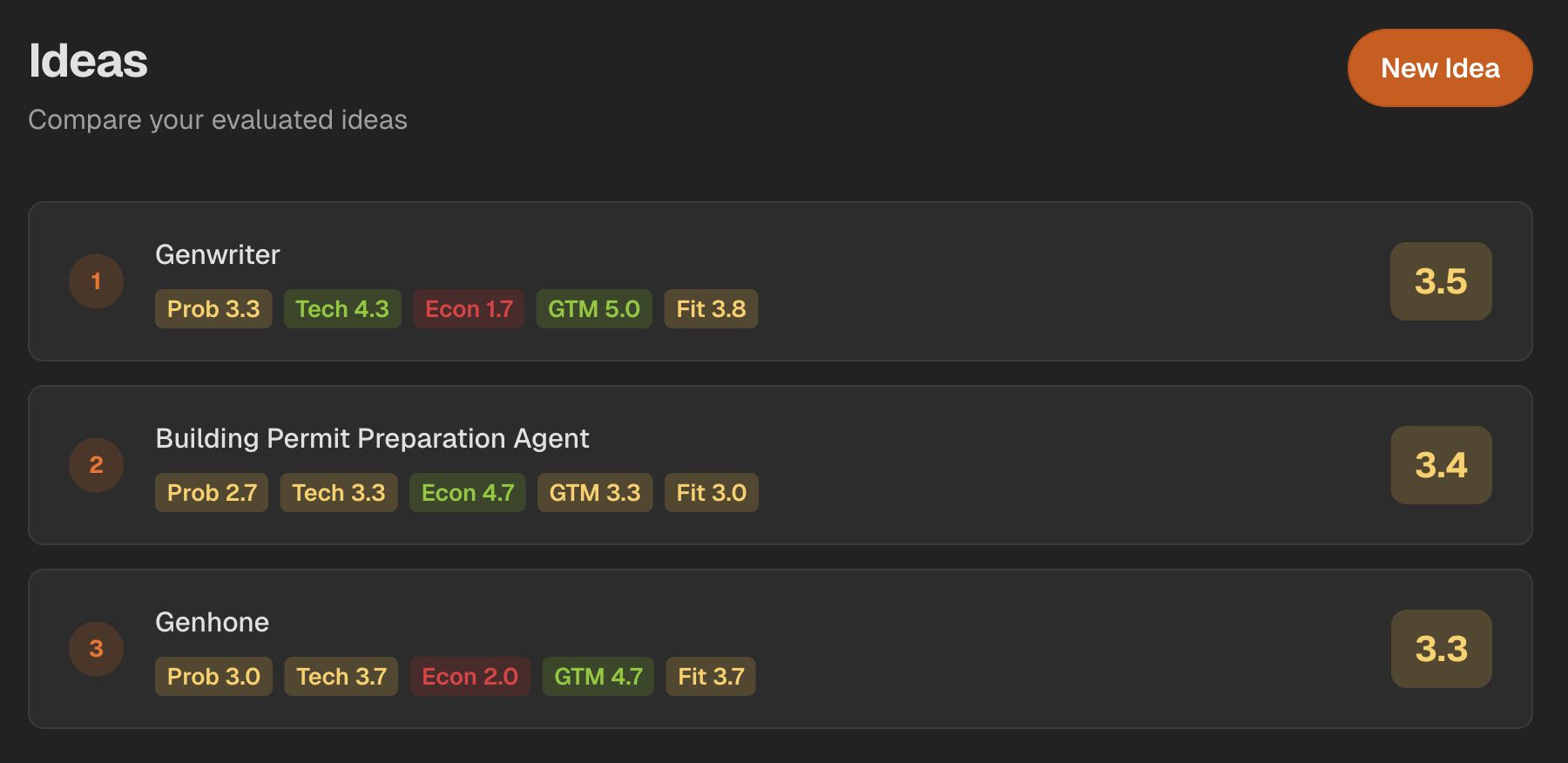
Genhone uses 13 automated criteria: 8 direct automated criteria scored from the refined idea and 5 research-assisted automated criteria where market context matters. It saves criteria-level reasoning and comparable idea artifacts, so founders can compare saved ideas side by side instead of losing the decision in scattered notes.
When a full idea is scored, Genhone's score labels are Strong Opportunity, Promising, Needs Work, and High Risk. The label is decision support. It is not proof of product-market fit.
Methodology note: Genhone starts with 12-section structured refinement, evaluates each SaaS idea across 18 criteria in 5 weighted dimensions, combines direct automated scoring with research-assisted automated scoring where market context matters, uses founder conversation for criteria that require firsthand founder context, and saves the result as a comparable idea artifact. The score is not a prediction and cannot replace buyer evidence.
| Founder-market fit question | Genhone criterion or area | Dimension | Source type |
|---|---|---|---|
| Do buyers feel the problem urgently enough to change behavior? | Problem Criticality | Problem Validation & Market Demand | Founder conversation |
| Is there payment logic or current spend behind the problem? | Willingness to Pay | Problem Validation & Market Demand | Founder conversation |
| Can this founder build and operate the first version? | Technical Skill Match | Technical Feasibility & Build Speed | Founder conversation |
| Will this founder stay interested enough to learn through repeated customer feedback? | Personal Interest | Founder Fit & Sustainability | Founder conversation |
| Can this founder handle the support and operating burden? | Operational Complexity | Founder Fit & Sustainability | Founder conversation |
| Does the market have competitors or substitutes that signal demand while leaving a wedge? | Competitive Landscape | Founder Fit & Sustainability | Research-assisted automated |
| Can the idea be tested quickly? | Validation Speed | Founder Fit & Sustainability | Direct automated |
| Is there a plausible path to first revenue soon enough? | Time to Revenue | Founder Fit & Sustainability | Direct automated |
| Can the founder reach buyers through plausible channels? | Channel Accessibility / Organic Discovery | Go-to-Market Accessibility | Direct automated / research-assisted automated |
For the full criteria reference, see the SaaS idea evaluation criteria. For the saved output and comparison use case, see the startup idea scorecard.
Questions to Test Founder-Market Fit Before Building
Answer these questions after a rough idea has been structured. They are not a replacement for refinement, customer discovery, or scoring. They help you expose evidence gaps before you spend the next build cycle.
Use them alongside a SaaS idea validation checklist. The goal is to identify which assumption should be tested next.
Access and Customer Understanding
- Which exact buyers can I talk to this week?
- Where do these buyers already gather or ask for help?
- Can I describe their current workflow without guessing?
- What alternatives, workarounds, or tools do they use now?
If these answers are vague, the issue is not product scope yet. The issue is market access and customer understanding.
Credibility and Distribution
- Why would this buyer take my conversation seriously?
- What proof do I have that I understand their context?
- What is my first channel for 10-20 qualified conversations?
- Would this channel still work if I had no product yet?
A channel that only works after the product is polished is not enough for pre-build learning. You need a path to conversations before the product exists.
Build, Support, and Sustainability
- Can I build the first credible workflow with tools I know?
- What operational burden appears if the product works?
- Which support cases would drain my time?
- Would I still care about this customer and workflow after the prototype novelty wears off?
This is where many AI-assisted ideas break. The demo is cheap. The support burden may not be.
Validation and Revenue Timing
- What evidence could change my mind in the next 2-4 weeks?
- Can I test payment logic before a full build?
- What must be true for first revenue to be plausible?
- Which answer would make me kill or narrow the idea?
Good founder-market fit gives you a faster path to learning. If every important answer requires a full platform, the idea is dangerous for a solo pre-build bet.
Example: Same SaaS Market, Different Founder-Market Fit
The examples below are fictional. They are not customer stories, testimonials, anonymized Genhone artifacts, or evidence that these markets are attractive.
The point is that founder-market fit is founder-specific. The same SaaS opportunity can be a strong fit for one founder and a weak fit for another.
| Fictional SaaS opportunity | Founder profile | Founder-market fit read | Decision |
|---|---|---|---|
| Client approval tracker for small design agencies | Former agency operator with designer network and full-stack skills | Strong buyer access, workflow insight, credible outreach, and manageable first workflow. | Gather pricing evidence or build a narrow manual/MVP test. |
| Client approval tracker for small design agencies | Backend engineer with no agency access and little interest in client-service workflows | Build skill is strong, but buyer access, credibility, and long-term interest are weak. | Narrow to a market the founder can access or gather buyer evidence before coding. |
| HIPAA-heavy workflow automation for clinics | Solo founder with no healthcare compliance experience or buyer access | Market may be real, but support, compliance, and access risks are too high for current founder. | Kill or archive unless a credible wedge and access path appears. |
The first founder may be able to get conversations quickly, understand the workflow, and spot a narrow approval use case. The second founder may ship faster but learn from the wrong signals because they cannot reach the buyer. The third founder may be staring at a real market, but not one that fits their current constraints.
Common Founder-Market Fit Mistakes
Confusing founder-market fit with passion. Interest helps, but it is not enough. You also need access, credibility, workflow understanding, and a path to evidence.
Confusing founder-market fit with product-market fit. Founder-market fit can support better early decisions. Product-market fit requires market response to a real product.
Treating founder-market fit as a VC pitch narrative. The question here is not whether your backstory sounds fundable. It is whether your founder context improves the next SaaS idea decision.
Assuming technical ability equals founder-market fit. Building quickly is useful only if you are building the right workflow for a reachable buyer.
Treating personal pain as proof of market demand. Personal pain can identify a useful lead. It does not prove that other buyers feel the pain, own the budget, or will switch.
Overvaluing domain expertise without buyer access. Knowing the domain helps less if you cannot reach real prospects or hear current objections.
Ignoring support and operational burden until after launch. A product that works can still become unsustainable if every customer needs custom setup, manual operations, or high-touch support.
Using founder-market fit to rationalize weak pain or payment logic. Strong founder context cannot fix a market that does not care enough. And ChatGPT prompts are not a startup validation process if they only make your assumptions sound more complete.
What to Do When Founder-Market Fit Is Weak
Weak fit is a signal, not an insult. It means the idea, as currently framed, may not be the best use of your next build cycle.
Some weaknesses are fixable. You can narrow the buyer, choose a smaller workflow, build access before product, run interviews, test pricing, or pick a market closer to your existing network.
Other weaknesses should cause a kill or archive decision. If you cannot name reachable buyers, cannot understand the workflow, cannot support the product alone, and cannot find payment evidence, do not hide behind a prototype. Save the reasoning and compare the idea against a stronger option.
| Weak signal | Better next move than building |
|---|---|
| You cannot name reachable buyers | Define a narrower ICP and build a list of real prospects. |
| You do not understand the workflow | Interview users, observe current alternatives, or choose a closer market. |
| You can build but cannot distribute | Test customer access before product scope. |
| You like the idea but not the customer | Kill or choose a market you are willing to serve. |
| Support burden looks high | Remove manual operations, reduce scope, or choose a self-serve wedge. |
| Payment logic is weak | Run pricing conversations or paid-pilot tests before coding. |
If buyer access is weak, define the ICP for a SaaS idea and build a real prospect list. If payment logic is weak, validate SaaS pricing. If the core evidence path is broken, read the separate guide on when to kill a startup idea.
You can still validate a SaaS idea before building. Just do not pretend weak founder-market fit is solved because the first version is easy to code.
How Genhone Helps Evaluate Founder-Market Fit
Genhone helps technically capable solo founders refine and evaluate SaaS ideas before building. It is designed for the moment when several ideas feel possible and the founder needs a structured way to decide what deserves the next evidence step.
The workflow enforces 12 refinement sections so founder fit is judged against a structured idea, not a vague hunch. Then Genhone scores ideas across 18 criteria in 5 weighted dimensions.
Five founder-conversation criteria require personal insight: Problem Criticality, Willingness to Pay, Technical Skill Match, Personal Interest, and Operational Complexity. Those criteria help capture founder context that the idea text alone cannot reliably provide.
Genhone saves criteria-level reasoning and comparable idea artifacts. Founders can compare saved ideas side by side in the dashboard, which makes weak-fit patterns harder to forget or rationalize later.
The workflow supports build, narrow, kill, or gather-evidence decisions. It does not code or build apps, generate PRDs, generate roadmaps, generate growth strategies, score investor pitches, promise product-market fit, or prove demand, revenue, or willingness to pay.
For the product-backed workflow, see Genhone's SaaS idea validation tool.
Turn a rough SaaS idea into a scored, comparable artifact with Genhone.
FAQ
What is founder-market fit in SaaS?
Founder-market fit in SaaS is the match between a specific founder and a specific SaaS market opportunity. It asks whether the founder has enough buyer access, domain insight, credibility, skill match, support capacity, stamina, and first-customer reach to pursue the market before committing to a full build.
It is not a generic founder trait. The same founder can have strong fit with one SaaS market and weak fit with another.
How is founder-market fit different from product-market fit?
Product-market fit is about a product satisfying a market. It usually depends on real market response: usage, retention, buying, referrals, or pull.
Founder-market fit is about whether the founder is well positioned to pursue and validate the opportunity before or during early building. It can improve the quality and speed of early learning, but it does not prove product-market fit.
Do I need domain expertise to have founder-market fit?
Not always. Domain expertise helps, but it is not the only path. Buyer access, curiosity, credibility, fast learning, technical fit, and a narrow wedge can also create founder-market fit.
Lack of domain expertise becomes risky when you cannot reach buyers, understand their workflow, interpret current alternatives, or earn enough trust to ask useful questions.
Should founder-market fit change my SaaS idea score?
Yes. For solo founders, founder-market fit should affect the decision. Skill match, buyer access, personal interest, operational complexity, validation speed, and time to revenue can change whether an idea is worth pursuing.
That does not mean every founder-fit signal belongs in one score bucket. In Genhone, founder-conversation criteria span demand, feasibility, and sustainability because founder context affects several parts of SaaS idea quality.
Can AI evaluate founder-market fit?
AI can structure the questions, compare founder context against the idea, and surface risks. Research such as Founder-GPT has explored founder profile and idea-context evaluation, but that should be treated cautiously.
AI cannot prove buyer access, willingness to pay, stamina, market demand, or support capacity without real-world evidence. Use AI-supported evaluation to decide what to test next, not to skip the test.
What should I do if I like the idea but have weak market access?
Do not start with a full build. Narrow the buyer, find real prospects, run conversations, join the market's communities, or choose a closer opportunity if access stays weak.
If you still cannot reach qualified buyers, the idea may be better to archive than build. Liking the market is not enough if you cannot learn from it.