How to Track Growth Experiments as a Solo SaaS Founder
Disconnected tactics create activity without a durable decision record. A solo founder can publish content, message prospects, and change onboarding for weeks without knowing which assumption changed or what to do next.
To track growth experiments as a solo founder, turn one business assumption into a testable hypothesis, choose one metric and numeric target, rank the bet against your backlog, record its status, compare the actual result with the target, assign a win, loss, or inconclusive verdict, and save the learning before choosing the next bet.
A growth experiment is a bounded test of an assumption, not a tactic or task by itself. The tracker described here records that test manually. It does not execute experiments or collect analytics.
What a Growth Experiment Tracker Should Record
A useful tracker preserves everything needed for the next decision. Templates from Rows and Todoist likewise make fields and lifecycle stages visible rather than leaving results in scattered notes.
| Field | What it should answer |
|---|---|
| Title | Which concrete bet is this? |
| Hypothesis | What change do you expect, for whom, and why? |
| Channel | Where will the test run? |
| Metric | Which observable outcome represents the assumption? |
| Target | What numeric result will count as success? |
| ICE inputs and score | Why should this bet run before another one? |
| Status | Is it in the backlog, running, completed, or abandoned? |
| Actual result | What numeric outcome occurred? |
| Verdict | Was it a win, loss, or inconclusive? |
| Learning | What changed in your belief, and what happens next? |
A solo founder usually does not need owners, approval meetings, implementation tickets, or a complex baseline model. Genhone stores created, started, and completed timestamps as part of the lifecycle, but its form does not ask the founder to configure a formal baseline or test duration.
Step 1: Start With One GTM Assumption
Begin with an evaluated idea’s go-to-market approach, buyer-access risk, price assumption, activation friction, or channel assumption. If those inputs are still vague, first work through how to evaluate a SaaS idea before building.
Turn broad tactics into questions:
| Tactic | Testable question |
|---|---|
| Do SEO | Will one page for a high-intent buyer problem produce qualified trial starts? |
| Post on LinkedIn | Will pain-specific posts prompt conversations with the named buyer? |
| Try outbound | Will a narrow message to reachable prospects produce qualified replies? |
A tactic is not an experiment
A task says what to do: “Send 40 emails.” An experiment states what change is expected, for whom, how it will be measured, and why the result should occur.
That difference creates a decision. Finishing the task tells you only that the emails were sent.
Step 2: Write a Testable Hypothesis
Use this pattern:
If we do X, we expect Y because Z.
Name the audience, action, expected observable result, and rationale.
Weak: Send cold emails to SaaS companies.
Strong: If we send a pain-specific message to support leads at small B2B SaaS companies, we expect qualified replies because those leads already review support conversations manually.
The target belongs in the next field. The hypothesis explains the expected relationship without pretending it is already true.
Step 3: Choose One Metric and Target
Pair one metric with a numeric target before execution. Keep it close to the assumption: qualified replies, booked interviews, completed activations, or paid-pilot commitments.
“Send 40 messages” measures activity. “Receive five qualified replies” measures the intended response. Impressions are not success unless reach itself is the assumption being tested.
Use directional tests honestly when traffic is low
Interviews, outreach, message tests, concierge pilots, price conversations, and manual onboarding tests can create decision-relevant evidence without being randomized A/B tests.
A small result can update your belief and justify a next step. It cannot, by itself, prove causality, general market demand, or product-market fit. Do not invent a universal sample-size threshold; judge whether execution, exposure, and measurement were credible enough for the limited decision being made.
Step 4: Rank the Backlog With Lightweight ICE Scoring
Score each bet from 1 to 10 on:
- Impact: How much would a positive result matter?
- Confidence: How strong is the current evidence?
- Ease: How little time, cost, and setup does the test require?
Genhone displays the arithmetic mean of the three inputs, rounded to one decimal. An 8 for Impact, 6 for Confidence, and 7 for Ease produces an ICE score of 7.0.
ICE is not measurement truth. It makes constraints discussable and creates a relative order. Decimal differences should not override a major risk, weak evidence, or founder capacity.
Step 5: Prefer One Active Bet at a Time
One running bet usually protects focus and makes interpretation easier when the same founder must build, sell, support, and measure. This is recommended operating discipline, not a Genhone-enforced limit. The product permits multiple running records.
The normal lifecycle is:
backlog → running → completed or abandoned
A completed or abandoned item can be reopened to the backlog. These are manual status changes. Genhone does not schedule work, manage audiences, or orchestrate execution.
Step 6: Compare the Actual Result With the Target
When finishing a test, record the numeric result and choose a verdict:
- Win: The predeclared success condition was met, and a next step is justified within the test’s limits.
- Loss: The target was missed after a sufficiently valid execution.
- Inconclusive: Exposure, execution, measurement, or signal quality was too weak to support either decision.
Meeting the target can support a win verdict; it does not automatically prove causality. Missing the target does not justify redefining success after seeing the result. If the test itself was compromised, choose inconclusive instead of disguising uncertainty as a loss.
Step 7: Save the Learning and Choose the Next Decision
A learning should say what changed in your belief and what you will do next: scale, iterate, narrow, rerun a corrected test, abandon the channel, or revisit the idea.
Keep losses and inconclusive records. Deleting them removes the reason not to repeat the same bet. If a valid loss weakens a structural assumption about the buyer, problem, or reachable market, use when to kill a startup idea to decide whether to narrow, pause, or stop.
A Worked Growth Experiment Record
Demonstration: The following record is illustrative. It is not a Genhone result, customer outcome, or benchmark.
| Field | Demonstration value |
|---|---|
| Title | Test pain-specific outreach to SaaS support leads |
| Hypothesis | If we send 40 pain-specific messages to support leads at small B2B SaaS companies, we expect qualified replies because they already review support conversations manually. |
| Channel | Cold Outreach |
| Metric | Qualified replies |
| Target | 5 |
| Impact | 8 — qualified replies would unlock buyer interviews. |
| Confidence | 6 — the pain is plausible but not yet confirmed at scale. |
| Ease | 7 — the founder can source and send the messages manually. |
| ICE score | 7.0 |
| Status | Backlog → running → completed, or abandoned if execution stops |
| Actual result | Enter one observed numeric result at completion. |
| Verdict | Select win, loss, or inconclusive. |
| Learning | Record the changed belief and next decision. |
The same target can lead to different interpretations:
| Illustrative actual result | Verdict | Learning entry |
|---|---|---|
| 6 qualified replies after valid delivery | Win | The message produced enough interest to justify interviews; test whether the pain leads to paid-pilot interest. |
| 1 qualified reply after valid delivery | Loss | The message missed the target under a credible run; narrow the buyer or revise the pain claim before more outreach. |
| 1 qualified reply, but most messages reached the wrong role | Inconclusive | Audience quality prevented a useful read; correct the list and rerun without changing the target. |
Spreadsheet or Dedicated Tracker?
A spreadsheet is enough when one founder can keep fields consistent, retain idea context, and retrieve past learnings.
A dedicated tracker becomes useful when experiments lose their source assumption, fields are skipped, statuses become unclear, or prior decisions are difficult to find. It should not manufacture spreadsheet pain or replace tools with different jobs. Genhone does not replace analytics, project management, feature flags, or experimentation platforms.
How Genhone Records the Loop
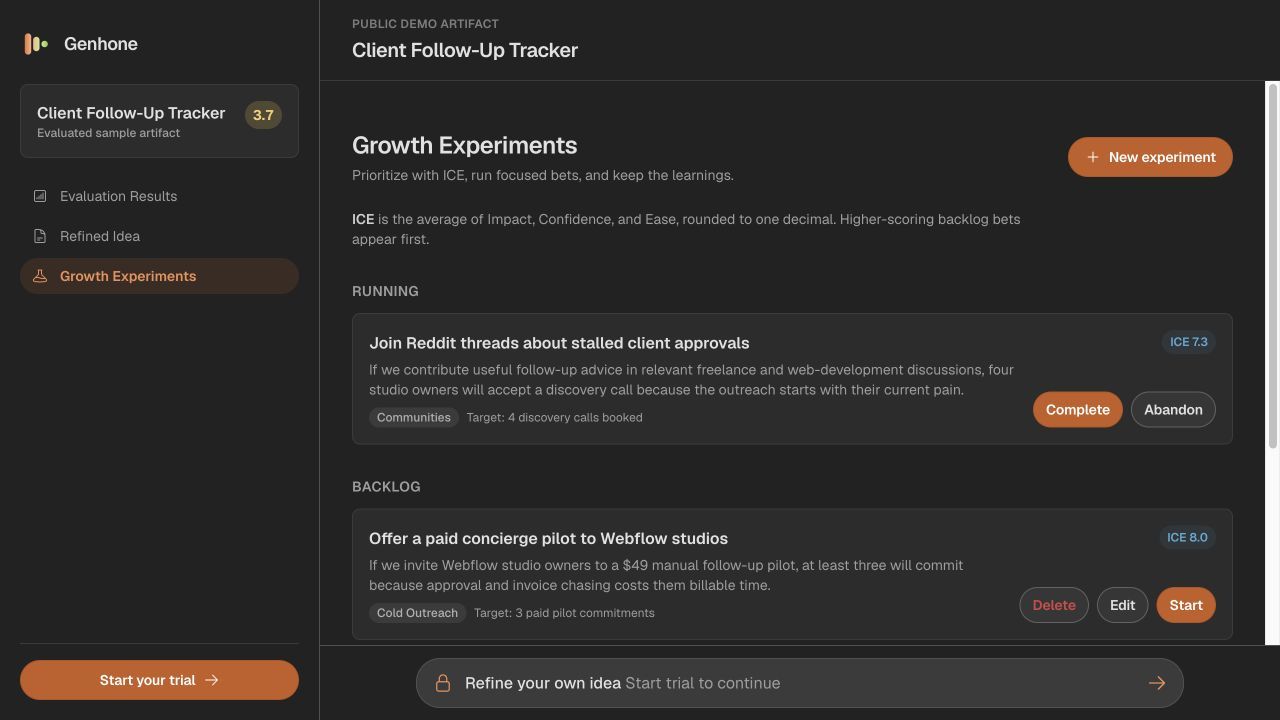
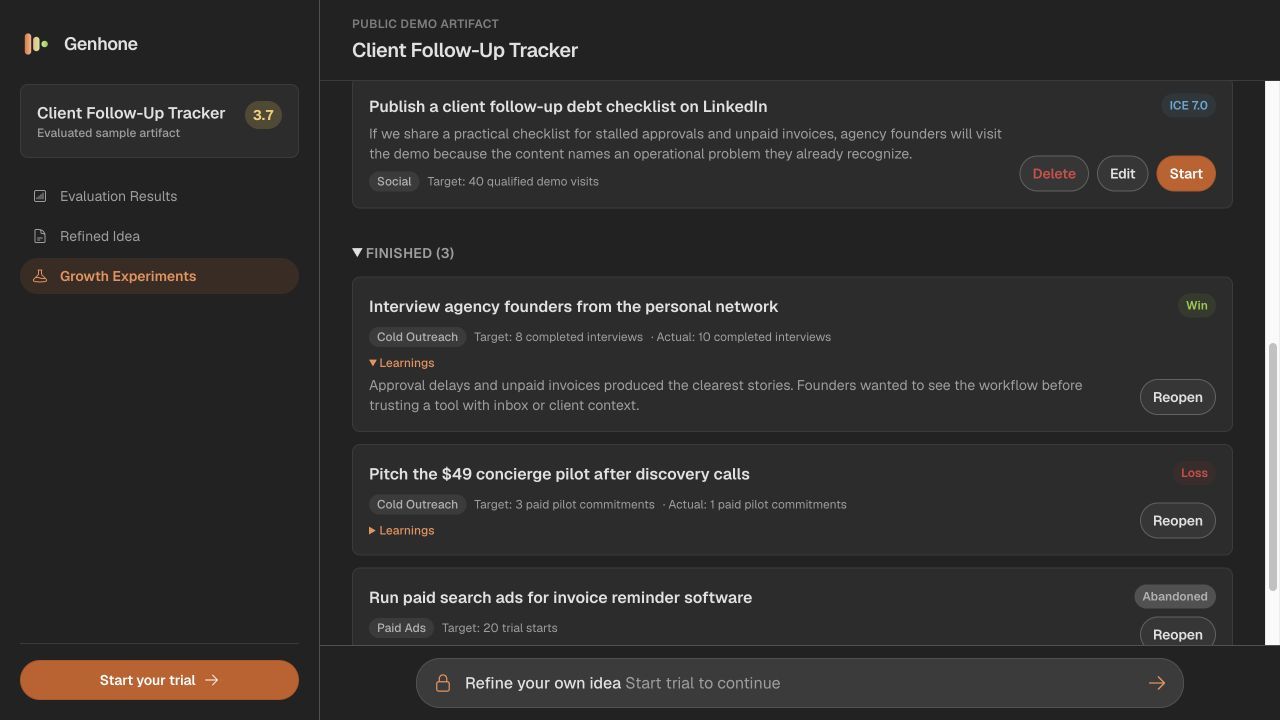
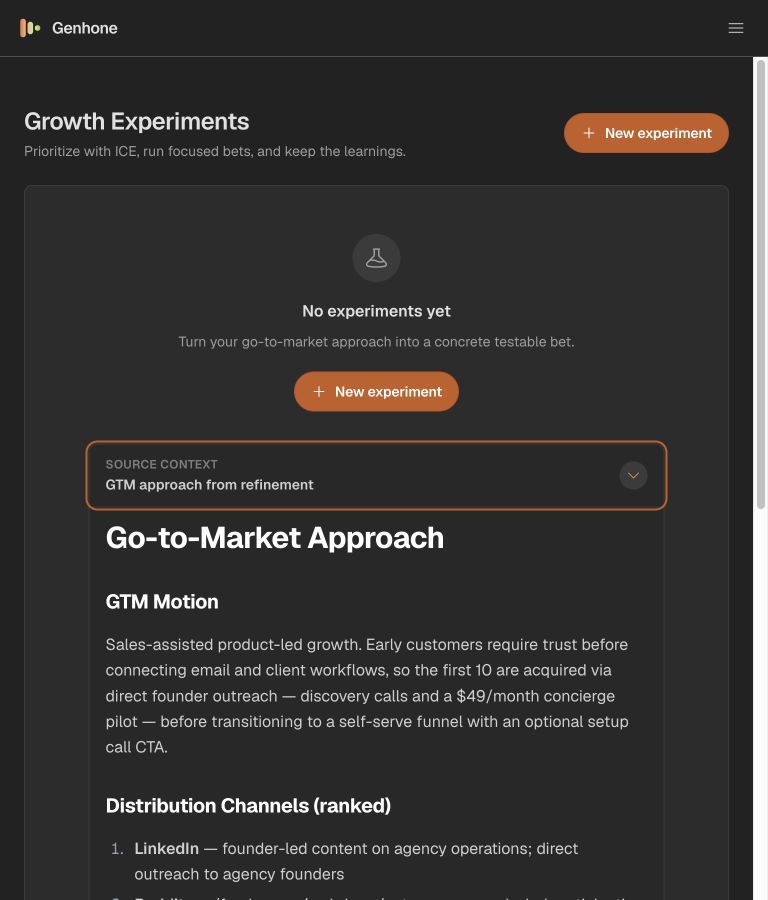
Genhone attaches experiments to an evaluated idea. Its empty state can show the refined GTM approach as source context, helping the founder turn an existing assumption into a concrete bet.
It records title, hypothesis, channel, metric, target, 1–10 Impact, Confidence, and Ease inputs, ICE score, status, actual result, verdict, learning, and lifecycle dates. The UI sorts backlog items from highest to lowest ICE score; running and finished records remain visible in their own sections.
Genhone records experiments manually. It does not generate growth strategy or experiment ideas, execute tests, ingest analytics, assign traffic, run A/B tests, manage feature flags, calculate statistical significance, or prove causality.
FAQ
What is the difference between a growth experiment and a tactic?
A tactic is an action such as publishing content or sending outreach. A growth experiment connects that action to a named audience, expected result, metric, target, rationale, and decision.
How many growth experiments should a solo founder run at once?
Usually one active bet when the same founder must build, sell, support, and measure. Independent, low-effort observations may overlap. This is focus guidance, not a Genhone-enforced restriction.
Is a growth experiment the same as an A/B test?
No. A/B testing compares variants under a controlled allocation design. A growth experiment can instead be an interview, outreach test, concierge pilot, pricing conversation, or manual onboarding test. Do not describe directional evidence as randomized proof.
What should I do when an experiment is inconclusive?
Identify what failed: execution, exposure, audience selection, measurement, or signal quality. Correct that problem and rerun only if the assumption still matters. Preserve the original record so the uncertainty remains visible.
When is a spreadsheet enough for tracking growth experiments?
A spreadsheet is enough when fields stay consistent, idea context remains attached, and past learnings are easy to retrieve. Move to a dedicated tracker when fragmentation begins to affect decisions.
Turn the Next Assumption Into a Recorded Bet
Choose one assumption, define one metric and target, rank it, run it, and retain the result. The smallest useful loop ends with a changed belief and a clear next decision.
Open the Growth Experiments sandbox in Genhone’s public demo.