How to Write a Testable Growth Experiment Hypothesis
“Try outbound” and “redesign onboarding” are tasks, not hypotheses. They leave the audience, expected behavior, rationale, and success threshold unstated, so almost any result can be rationalized afterward.
Use this growth experiment hypothesis template: “If we [bounded change] for [specific audience], we expect [observable outcome] because [observed mechanism].” Make it testable by declaring one metric, a numeric target, the exposure or time window, and the decision the result will change before you start. Low-traffic evidence can guide a decision without proving causality.
The purpose is not to make a guess sound scientific. It is to make the later decision readable. The hypothesis states the relationship you want to challenge; the rest of the experiment record defines how you will observe it, where you will stop, and what the result is allowed to change.
Copy This Growth Experiment Hypothesis Template
Copy this sentence-plus-preflight worksheet into a Markdown file, notes tool, or experiment record:
If we [one bounded action or change] for [specific audience] through [channel or surface], we expect [one observable outcome] because [mechanism grounded in an observation].

Primary metric: [one observable measure]

Target: [numeric threshold declared before execution]

Exposure or window: [who/how many/which period will encounter the test]

Decision:
- If [threshold is met], we will [next step].
- If [threshold is missed], we will [different next step].
- If the result is uninterpretable, we will [repair the test or gather missing evidence].

Evidence limit: This test can inform [bounded belief or decision], but it cannot establish [broader claim or causality].
Keep the sentence readable. Put the exact metric, numeric target, exposure, and decision rules in the preflight fields instead of forcing every detail into one line.
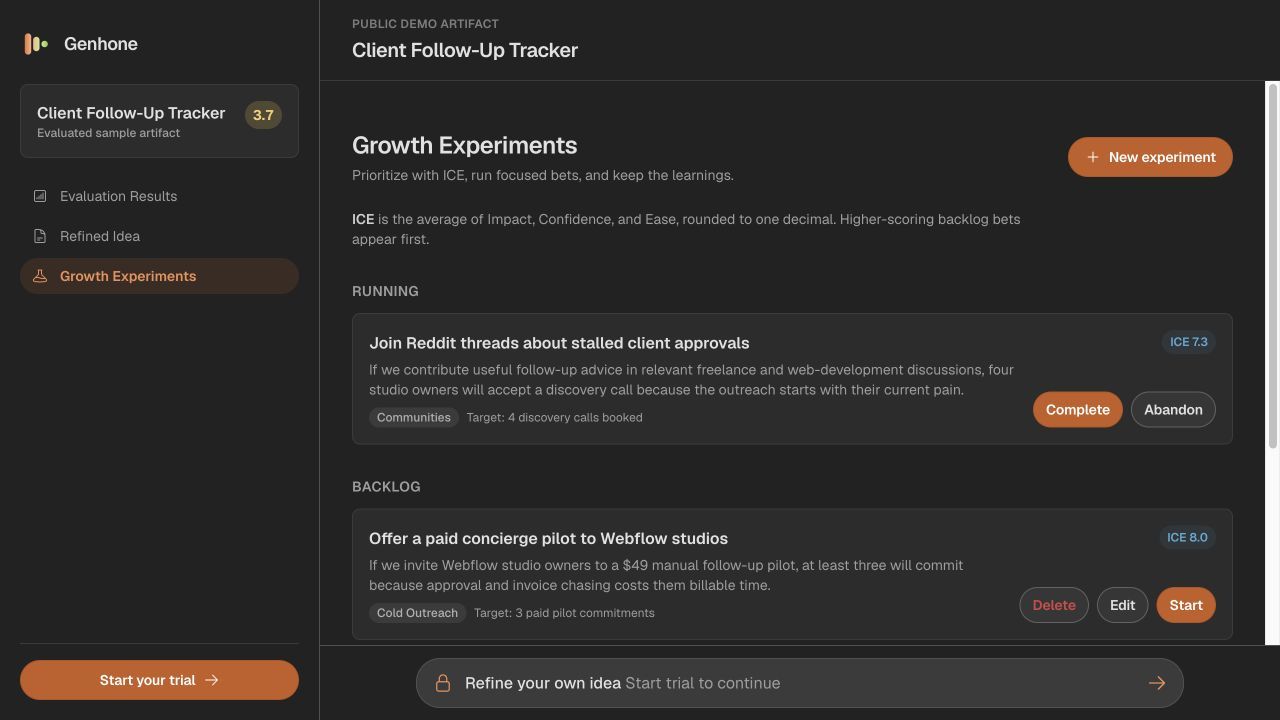
In Genhone, the first sentence fits the founder-written hypothesis field. The channel, metric, and target are stored separately in the experiment record. Exposure or window, decision branches, and evidence limits are planning prompts in this worksheet, not dedicated Genhone fields.
A filled example in 60 seconds
Demonstration — not a Genhone case study or benchmark
Suppose a founder is evaluating a B2B SaaS idea for teams that gather evidence manually before making product decisions. In this fictional example, recent conversations suggest that the evidence-gathering workflow is painful, while broad messages to “SaaS founders” receive generic interest.
If we send a problem-specific email to solo B2B SaaS founders who recently launched a product, we expect qualified replies about their evidence-gathering workflow because the message names a repeated task they can recognize instead of a broad product category.

Primary metric: Qualified replies that describe the workflow or agree to a problem interview.

Target: At least 4 qualified replies.

Exposure or window: 30 matched founders contacted once, with one relevant follow-up, observed for 10 days.

Decision:
- If at least 4 qualified replies arrive, continue to problem interviews with this segment.
- If fewer than 4 arrive, rewrite the segment or message before testing the solution.
- If deliverability or targeting cannot be verified, repair the list and rerun the bounded test.

Evidence limit: This test can inform whether this segment recognizes the problem in this message, but it cannot establish total market demand or prove that the message caused every reply.
The values—30 prospects, four replies, and 10 days—are illustrative demonstration values, not recommended benchmarks. The founder would choose thresholds from the economics and decision needs of the actual test.
What Makes a Growth Hypothesis Testable?
A growth hypothesis is testable when it identifies one bounded input, one observable outcome, a reason the two may be related, and a plausible result that could weaken the belief.
Another founder should be able to read the record, run the same bounded test, and know what decision the result is allowed to change.
| Testability element | Question it must answer | Common failure |
|---|---|---|
| Source observation | What existing signal or risk prompted this test? | The tactic was chosen because it is popular. |
| Audience | Who encounters the change? | “Users,” “founders,” or “everyone.” |
| One change or action | What exactly differs or happens? | A bundled redesign or multi-channel campaign. |
| Observable outcome | What behavior will be counted? | “Better engagement” or “more interest.” |
| Mechanism | Why should this action move that outcome? | The desired result is restated as the reason. |
| Target | What threshold matters before the data appears? | Any movement is called a win afterward. |
| Exposure or window | Under what bounded conditions is the result read? | There is no exposure rule or end. |
| Decision | What changes if the target is met or missed? | The result is interesting but has no next action. |
| Falsifiability | What result would weaken the belief? | The statement can only be confirmed. |
Precision alone is not enough. A hypothesis can name an audience, action, and number while still testing the wrong thing. If the assumption concerns willingness to pay but the metric is landing-page time, the observed behavior is too remote from the belief. If no possible result would change a decision, the exercise is documentation rather than a useful test.
Hypothesis vs assumption vs tactic vs prediction
Use one continuous example to separate the terms:
| Term | Meaning | Example |
|---|---|---|
| Assumption | A belief about a buyer, problem, channel, or mechanism. | Solo B2B SaaS founders ignore broad growth messaging because it does not map to a workflow they recognize. |
| Tactic | The action performed. | Send problem-specific outbound emails. |
| Prediction | The observation expected. | More recipients will send qualified replies. |
| Hypothesis | The explicit relationship between the action, outcome, and reason that a test can challenge. | If we send problem-specific emails to recently launched solo B2B SaaS founders, we expect qualified replies because the message maps the offer to a repeated evidence-gathering workflow. |
The assumption is the belief. The tactic is what you do. The prediction is what you expect to observe. The hypothesis connects them in a form the test can weaken.
Build the Hypothesis From One Real Assumption
Do not begin with a list of channels. Begin with an observation or a risk from the idea you have already evaluated.
A useful source assumption may concern:
- whether a reachable buyer recognizes the problem;
- whether a proposed message matches the buyer’s language;
- whether one activation step removes a known point of friction;
- whether suitable prospects will discuss a concrete price or pilot;
- whether a channel can reach a narrow segment with a relevant offer.
A structured evaluation gives you the buyer, problem, alternatives, GTM approach, pricing logic, and largest uncertainties. The guide to evaluating a SaaS idea before building can help establish that context. Evaluation does not remove the need to test the assumption.
Use this chain:
Observation or risk
→ Assumption
→ Bounded change or action
→ Expected behavior
→ Reason
→ Decision
For example:
Observation: Interviewees describe importing data as the point where setup stalls.

Assumption: New users abandon setup because the import instructions do not connect each step to the file they already have.

Bounded change: Guide one import session with an annotated example file.

Expected behavior: The user completes a valid first import.

Reason: The example removes uncertainty about required columns and formatting.

Decision: Keep and productize the guide, revise it, or investigate a different source of friction.
Choose the belief that can change a near-term decision
Prefer an assumption that changes whether you continue, narrow, reword, manually pilot, or abandon a specific route.
“There is demand for our product” is too broad. One outreach test cannot resolve it. “This segment recognizes this workflow problem strongly enough to accept a problem interview” is narrower and can influence the next step.
If your audience still reads as “startups,” “businesses,” or “founders,” use the guide to defining the ICP for a SaaS idea before writing the hypothesis. A test cannot produce a clear segment signal when the segment itself is undefined.
Write One Bounded Change for One Audience
“Do SEO,” “try LinkedIn,” “redesign onboarding,” and “test pricing” fail as hypothesis inputs because each can hide many actions.
“Do SEO” could mean changing one title, publishing 20 pages, earning links, or rebuilding information architecture. “Redesign onboarding” might change copy, sequence, permissions, data import, and support at once. Even if a metric moves, you will not know which belief deserves an update.
Instead, name:
- one specific audience;
- one channel or surface;
- one action or change;
- one behavior you will observe.
A bounded action is not automatically a controlled experiment. Outreach, interviews, concierge delivery, and manual pilots often lack randomized controls. They can still create useful directional evidence when the exposure and interpretation are explicit. “Bounded” describes the test’s limits; it does not grant causal certainty.
Weak-to-testable rewrite: vague channel tactic
Here is one tactic rewritten in four stages.
Stage 1 — tactic only
Try LinkedIn outbound.
Nothing identifies the audience, message, result, or reason.
Stage 2 — audience and action added
Send a direct message about manual customer-research synthesis to solo B2B SaaS founders who have launched within the past six months.
The action is bounded, but the statement still does not say what behavior is expected or why.
Stage 3 — observable outcome and rationale added
If we send a direct message about manual customer-research synthesis to solo B2B SaaS founders who launched within the past six months, we expect qualified replies because the message names a current post-launch workflow rather than offering generic growth help.
This is a usable hypothesis sentence. It still needs precommitted measurement and decision fields.
Stage 4 — metric, target, exposure, and decision precommitted
Primary metric: Qualified replies that describe the workflow or accept a problem interview.

Target: At least 3 qualified replies.

Exposure or window: 25 matched founders, one message and one relevant follow-up, observed for 10 days.

Decision:
- If at least 3 qualified replies arrive, book interviews and keep the segment-message pair.
- If fewer than 3 arrive, revise either the segment or message before testing a product offer.
- If targeting quality or delivery is unclear, repair the list before interpreting the result.

Evidence limit: This test can update confidence that this message resonates with this reachable segment. It cannot estimate market-wide demand or isolate the message as the cause of every reply.
All numbers in Stage 4 are illustrative demonstration values, not outbound benchmarks.
Name One Observable Outcome and Numeric Target
The hypothesis sentence names the expected outcome. The experiment record defines exactly how that outcome will be counted.
Choose a metric close to the assumption:
- Use qualified replies or booked problem interviews to test whether a segment recognizes a problem.
- Use completed first imports or another defined activation behavior to test a specific onboarding friction.
- Use paid-pilot commitments, deposits, or another payment-related behavior to test a concrete offer.
- Use completed workflow steps to test whether a concierge or manual process is usable.
Emails sent, calls made, and sessions hosted are activity counts. Impressions, opens, and page views may describe exposure, but they are usually weak success criteria when the assumption concerns problem recognition, activation, or willingness to pay.
Declare one numeric target before execution. The target is not a universal benchmark. It is the threshold at which the result changes your decision for this bounded test.
A target such as “at least three suitable prospects agree to a paid pilot” is useful only when you have also defined suitable prospect, the offer, the exposure, and the next action. The number does not become meaningful by being precise.
Define the exposure or window without inventing certainty
Duration alone does not define exposure. “Run for two weeks” says little if you do not know whether five or 500 suitable people encountered the test.
For outreach, interviews, pricing conversations, and manual tests, define the exposure directly:
- a fixed list of matched prospects;
- a fixed number of suitable conversations;
- a fixed sequence of onboarding sessions;
- a specific cohort entering the same step;
- a stated offer shown under consistent conditions.
Then add a reasonable observation window so responses are not counted indefinitely.
For traffic-based tests where the decision depends on estimating a causal effect, use an experimentation or statistical method appropriate to the decision. Do not invent a sample-size or significance rule from a generic article. A small sequential test can inform what to investigate next without functioning as a randomized A/B test.
Add a “Because” That Can Teach You Something
The “because” clause should state the mechanism: why this action may affect this behavior for this audience.
Weak rationale:
Because it will convert better.
This merely repeats the desired outcome.
Explanatory rationale:
Because buyers cannot map the broad promise to the workflow they already struggle with.
The second version gives you something to inspect. If replies remain generic, perhaps the message still fails to name the workflow. If prospects recognize the workflow but reject the interview, the friction may concern trust, urgency, or the ask rather than problem language.
Ground the mechanism in an observation you actually have: supplied user language, a support pattern, funnel behavior, prior outreach, or a previous result. Do not manufacture a customer insight to make the sentence look complete. If the observation is missing, gather it first or label the mechanism as a weak assumption.
A metric can also move for a different reason. Qualified replies could increase because the list improved, the sender became more credible, or the timing changed. A directional result may support the next decision without confirming the mechanism.
Precommit the Decision and Evidence Limit
Write the decision branches before the result arrives:
- If the threshold is met, what will you continue or test next?
- If it is missed, what will you narrow, rewrite, or stop?
- If the result is uninterpretable, what condition must be repaired?
Precommitment makes it harder to move the goalposts after seeing the data. It does not remove judgment or bias, but it preserves the original decision rule for review.
Then state the evidence limit:
This test can inform [bounded belief or decision], but it cannot establish [broader claim or causality].
For a low-traffic founder test, prefer:
- Supported: the result gives enough directional evidence for the precommitted next step.
- Weakened: the result falls below the threshold under interpretable conditions.
- Inconclusive: targeting, exposure, measurement, execution, or conflicting signals prevent a useful decision.
Avoid “proven,” “disproven,” and “validated” when the method cannot support those claims.
Low traffic does not make every test useless
A founder without A/B-test traffic can still run narrow outreach, customer interviews, price conversations, concierge delivery, manual onboarding, and message tests.
These methods can produce decision-relevant evidence about:
- whether an audience is reachable;
- whether buyers use or recognize certain language;
- whether a workflow repeats;
- where activation becomes difficult;
- whether suitable prospects will discuss or accept a concrete offer.
They do not automatically estimate population demand or prove causality. The evidence limit keeps a useful small test from becoming a market-wide claim.
Three Worked Growth Hypothesis Examples
Every example below is a Demonstration, not a reported Genhone result or customer case study. All numeric values are illustrative choices for showing the method, not benchmarks.
1. Narrow outbound message
Demonstration
Source assumption or observation: In this fictional scenario, broad “save time on customer research” messages receive polite but generic responses. The founder suspects recently launched solo SaaS founders will respond more concretely when the message names manual interview synthesis.
Hypothesis sentence:
If we send a problem-specific email to solo B2B SaaS founders who launched within the past six months, we expect qualified replies about manual interview synthesis because the message maps the offer to a workflow they may be doing now.
Primary metric: Qualified replies that describe the workflow or accept a problem interview.
Target: At least four qualified replies. This is an illustrative demonstration threshold, not a reply-rate benchmark.
Exposure or window: A demonstration list of 30 matched founders, contacted once with one relevant follow-up, observed for 10 days.
Decision branches:
- If at least four qualified replies arrive, continue to problem interviews using the same segment and language.
- If fewer than four arrive under interpretable delivery conditions, revise the segment or message before presenting a solution.
- If list quality or delivery cannot be verified, repair the exposure and rerun the test.
Evidence limit: The test can update confidence that this segment recognizes the problem in this message. It cannot establish total market demand, estimate a stable market-wide response rate, or prove the message caused each reply.
Why it is testable: It defines one audience, one message action, one observable behavior, a predeclared threshold, bounded exposure, and a result that can weaken the segment-message belief.
2. Manual onboarding or activation step
Demonstration
Source assumption or observation: In this fictional scenario, three recent onboarding sessions stalled when users had to format an import file. The founder suspects uncertainty about the required columns prevents completion.
Hypothesis sentence:
If we guide new users through one annotated example-file step during onboarding, we expect more of them to complete a valid first import because the example makes the required structure visible before they upload their own data.
Primary metric: Completion of one valid first import during or immediately after the guided session.
Target: At least five completions across six guided sessions. Five of six is an illustrative demonstration threshold, not an activation benchmark.
Exposure or window: Six suitable new-user sessions using the same guided step, with import completion observed through the end of each session and one day afterward.
Decision branches:
- If at least five users complete a valid import, keep the guide and test whether it can work without founder assistance.
- If fewer than five complete, inspect where sessions stall and revise the step before productizing it.
- If users arrive without suitable files or face unrelated technical failures, classify the result as inconclusive and rerun under usable conditions.
Evidence limit: This sequential manual test can inform whether the annotated step helps suitable users complete the workflow. It cannot isolate causal effect, predict performance for all users, or be described as an A/B test.
Why it is testable: It connects a specific observed friction to one guided change, one activation behavior, bounded sessions, and an explicit next decision.
3. Pricing conversation or paid pilot
Demonstration
Source assumption or observation: In this fictional scenario, suitable prospects describe spending several hours each month compiling the same report, but no payment behavior has been observed. The founder believes a fixed-scope manual pilot may be easier to evaluate than an unfinished software subscription.
Hypothesis sentence:
If we offer a fixed-scope paid reporting pilot to operations leads who already compile this report manually, we expect paid-pilot commitments because the offer replaces a current workflow without requiring them to adopt unfinished software.
Primary metric: Paid-pilot commitments under the stated scope and price.
Target: At least two paid-pilot commitments. Two is an illustrative demonstration threshold, not a willingness-to-pay or sales benchmark.
Exposure or window: The same concrete offer presented to 10 suitable operations leads during scheduled conversations over three weeks.
Decision branches:
- If at least two prospects commit under the stated terms, deliver the pilots and study repeatability before deciding what to automate.
- If none commit, revisit the buyer, pain, offer, trust requirements, and price before building.
- If prospects want materially different scopes, treat the result as inconclusive for the original offer and define a narrower one.
Evidence limit: Several commitments can update confidence that this offer has value for the contacted prospects. They cannot establish a market-wide conversion rate, prove the proposed SaaS price, or predict retention.
This example uses a paid pilot as payment-related evidence. The guide to validating SaaS pricing before launch explains how buyer, alternatives, package, price, and behavior fit together.
Why it is testable: The offer, audience, commitment behavior, exposure, threshold, and decision branches are all declared before the conversations.
A Five-Minute Testability Check Before You Run It
Use this yes-or-no checklist after writing the sentence and preflight:
- Is the audience specific?
- Is there one bounded action or change?
- Is the outcome directly observable?
- Is the reason more than a restatement of the goal?
- Is one numeric target declared in advance?
- Is the exposure or observation window defined?
- Could a plausible result weaken the belief?
- Will the result change a named decision?
- Does the evidence-limit sentence prevent overclaiming?
If any answer is “no,” rewrite the hypothesis or gather the missing observation before prioritizing the experiment. Do not compensate for a missing audience, mechanism, or decision with an arbitrary testability score.
Where the Hypothesis Fits in Genhone
Genhone stores a founder-entered hypothesis against an evaluated idea, along with the channel, target metric and value, ICE inputs, status, actual result, verdict, and learning.
The evaluated idea provides context for choosing a first test. Its refined GTM approach may identify a reachable buyer, a proposed channel, and an assumption worth challenging. The founder still writes the hypothesis and decides how to run the experiment.
Genhone manually records hypotheses and experiment details. It does not:
- generate growth strategy or hypotheses;
- execute experiments;
- ingest analytics;
- manage audiences;
- run A/B tests;
- calculate statistical significance;
- prove causality.
Exposure plans, decision branches, evidence limits, formal baselines, guardrail metrics, and sample-size plans are not dedicated Genhone fields. Keep those planning notes alongside the experiment where you can review them before interpreting the result.
FAQ
What is a growth experiment hypothesis?
A growth experiment hypothesis is a testable statement connecting one bounded action or change to one expected observable outcome for a specific audience, with a reason the action may produce that outcome. The experiment then defines the metric, target, exposure, and decision rules used to challenge the belief.
What is the best growth experiment hypothesis template?
A practical growth experiment hypothesis template is: “If we [bounded change] for [specific audience] through [channel or surface], we expect [observable outcome] because [observed mechanism].” Pair the sentence with one metric, a numeric target, bounded exposure, decision branches, and an evidence-limit statement.
Does a growth hypothesis need a numeric target?
The experiment should have a numeric target declared before execution. The hypothesis sentence can remain readable while the exact metric and target sit in separate fields. The target is a decision threshold for this test, not a universal benchmark.
Can I test a growth hypothesis without enough traffic for an A/B test?
Yes. Narrow outreach, interviews, price conversations, concierge delivery, manual onboarding, and message tests can produce directional evidence for a near-term decision. State what each test can update and what it cannot establish. Do not present a small sequential test as causal proof or a market-wide estimate.
What makes a growth hypothesis falsifiable?
A growth hypothesis is falsifiable when a plausible, observable result would weaken the stated belief. If every outcome can be explained as support, the hypothesis is not useful. A predeclared target, exposure, and missed-threshold decision make the weakening result explicit.
Should I put the metric inside the hypothesis sentence?
Not necessarily. Keep the sentence easy to read, then store the exact metric and target as separate precommitted fields. Genhone follows this pattern: the founder-written hypothesis is separate from the channel, target metric, and target value in the experiment record.
Turn One Assumption Into a Measurable Bet
A testable growth hypothesis needs two parts:
- A sentence connecting one bounded action, one specific audience, one observable outcome, and one grounded reason.
- A preflight declaring the metric, numeric target, exposure, decision branches, and evidence limit.
Start with an assumption that can change a near-term decision. Keep the action narrow. Count behavior close to the belief. Decide what “met,” “missed,” and “inconclusive” mean before the result arrives.
That is enough to turn “try outbound” or “redesign onboarding” into a measurable bet without pretending a low-traffic signal proves more than it can.
Open the Growth Experiments sandbox in Genhone’s public demo.